Underbody Coating
UNDERBODY COATING
The process of protection of car’s underbody from corrosion is called as Underbody Coating of a car. This process not only protects the car’s underbody but also protects parts like inner cavities, internal body panels, frame rails and other parts which are not reachable physically & are prone to rusting - corrosion.
Why protection of underbody is so important?
Protecting a car’s underbody should be the top most priority because in monsoon season when the heavy precipitation in the roads lead to become mini-ponds & mini-rivers and the cars are left stranded there thus making the underbody region prone to corrosion.
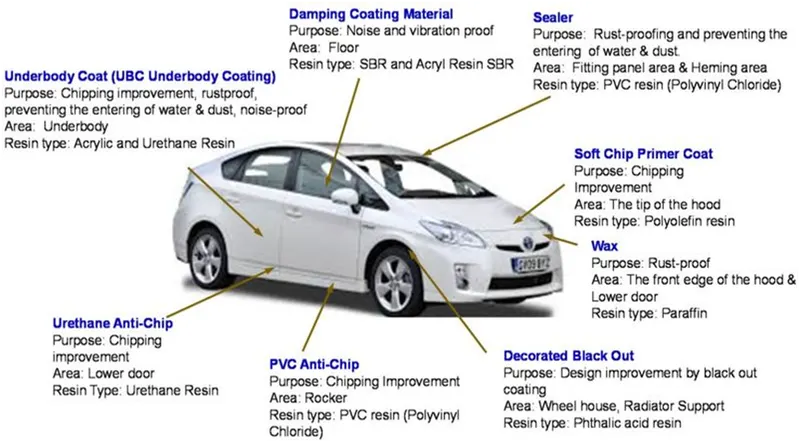
Protective coating composition for vehicle underbodies is comprised of (percentages by weight of the total weight of the composition)
|
PVC Resin |
20-40% |
|
Plasticizer |
30-50% |
|
Adhesion promoter |
0.5 - 1.5% |
|
Natural coated fillers |
20-30% |
|
Additives and Pigments |
1-3% |
|
Swelling Agent |
1-3% |
|
Phenolic resin (resorcin) |
0.2-1.2% |
|
Solvents |
1-3% |
Thickness of the coating for different vehicle varies
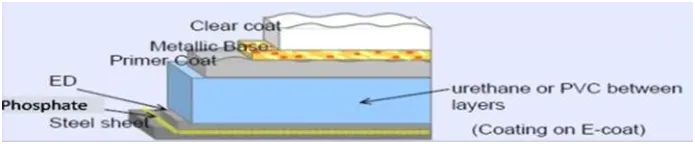
PROCESS OF UNDERBODY COATING:
- PREHEAT TREATMENT
This process removes and cleans excess metal to provide an appropriate surface which will enable the bonding of a corrosion protective layer. Steaming process removes the remaining oils & welding residues. Pre-treatment helps the primer to bond onto the metal.
3 primary liquid dip processes - degreasing, conditioning & phosphating.
The degreasing solution is composed of alkaline salts & surfactants which include caustic soda, sodium carbonate. The surfactants are types of detergents for emulsifying oils and lubricants.
Surface conditioner creates nucleation sites for phosphate crystal to grow. It increases the number of crystallization nuclei on the metal surface to enhance bonding mechanism.
Lastly, acid etches on steel surface which causes hydrogen to be released while metal phosphate ions are precipitated onto the surface in a crystalline form. Phosphate treatment applies an inert layer of metal phosphate, providing resistance to corrosion spread.
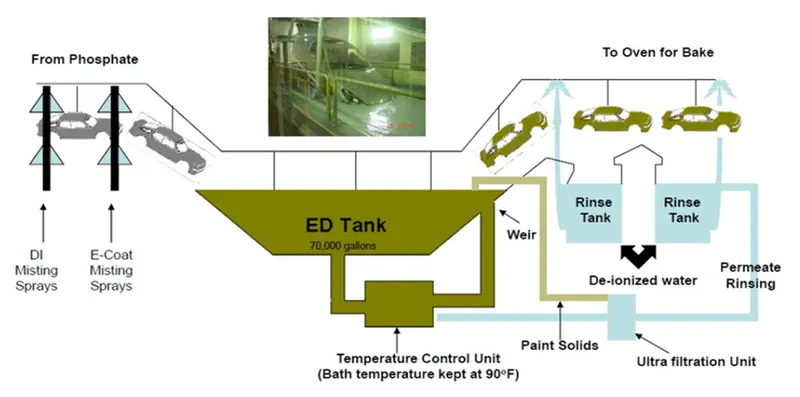
- ELECTRODEPOSITION
In ED-coating, the bodies are dipped into the coating solution & an electric current is passed through it. The charged nature of this coating process forces the paint to penetrate into the places where a spray would not reach. A mixture of resin, binder, & a paste are fed into the ED tank containing the pigments during the operation. Pigments provide color & gloss. The solution in the tank consists of 80-90% deionised water & 10-20% paint solids. The resin is the backbone of the final paint film & provides corrosion protection, durability, & toughness.
The body enters into a pre-heated bake oven after ED-coating & kept at a temperature of 1600C for 10 minutes which causes painted film to perform maximum performance properties. Oven temperature & heating time primarily enhance chip resistance & film adhesion to the body.
Sanding of the surface is usually performed to eliminate the defects before the body enters into the next application step.
A common challenge in current ED-coating process is that the water spots may remain behind that contaminates coated surfaces. If water spots are present, they have removed by sanding. Hence, the use of well-deionized water & routinely monitor its conductivity is necessary
- SEALER/PVC
It is typical to apply on a soft tip primer coat which can improve the chipping resistance.
Sealing using PVC is applied on the front edge of the hood, which is an area prone to chipping shock, using a high elastic resin that resides between the ED & primer coats. Also, the radiator supports, wheel housing, & under rare areas of the body are coated with a relatively dull black pigment called a blackout coating.
- PRIMER.
The primer fills in & smoothens the minor imperfections & scratches that may have been created on the previous steps & by sanding or grinding used to remove small imperfections. It maximizes adhesion between it & the ED-coat & basecoat thus increasing the paint durability.
3 stages of primer coating operation in an automobile assembly plant – Interior coating, Exterior coating, & cutting in an oven.
Precautions –
- Manual spraying is used for the interior coating of the doors, engine compartment, & trunk space.
- It is important that are primer colour matches the basecoat to be able to impart uniform coating appearances between interior & exterior coat.
- TOPCOAT
The final step in a body coating process which consists of 2 layers-
Basecoat: The 3rd layer added to the automobile surface after the primer & before the clearcoat consisting primary colouring pigments as part of basecoat. More than thousand of base coat colours are known today & each year more than hundreds of colours are added to the list which helps the automobiles to impart its colour. 3 different types of basecoats used for automobiles - solvent-borne medium solids (MS), solvent-borne high solids (HS), & water-borne.
Clearcoat: The final coating on an automobile surface is the clearcoat. It provides environmental etch, durability, & scratch resistance to the overall coating. It resist against the damage caused by UV rays from the sun result in fading of color & gloss. The clearcoat makes repairs & maintenance easier. Environmental etch is an appearance issue caused when the formation of water spots or the non-removable marks caused when from bird droppings & other chemicals comes in contact with the automobiles surface. Thus causing the loss of material & deformation or pitting of the clearcoat surface.
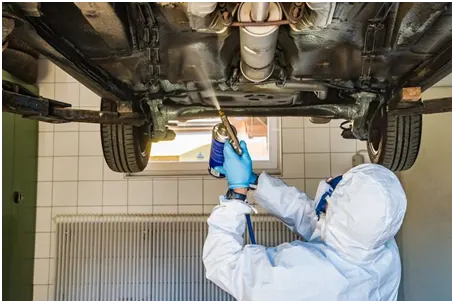
TYPES OF UNDERBODY COATING
1. Rubberized Undercoating
- easy to apply
- dries to a soft rubbery finish
- sound-cushioning effect
- protection from dust, moisture, & dents
- it is safe to use on wheel wells and quarter panels
- coating can be painted over & over again, if necessary
- coating can be easily removed with an undercoating removal spray
2. Wax or Paraffin-Based Undercoating
- paraffin-based undercoating
- available in a spray gun canister or in an aerosol
- cheapest and quickest
- base protection in moderately humid climates
- wear off quicker
- need to be stripped and reapplied at least once every year
- never truly harden
- they drip or flow into seams and cracks to provide protective properties
3. Polyurethane Undercoating
- undercoating is a little bit quicker and easier to apply
- come in canister preload into an application gun
- It requires more surface prep work before applying the paint - sanding and applying an etching primer to bare metals before coating.
- top-coated with either acrylic or polyester urethane
- sealant works by seeping into all cracks and seams, displacing the salt and moisture & oozing around rusty areas to bond with un-oxidized metal to protect.
4. Asphalt-Based Undercoating
- for large trucks and heavy machinery
- provides extra durability against rocks, chips, and moisture
- contains a bit of rubberized material that sets firmly and also helps to soften the noise
- non-paintable
- needs more cure time
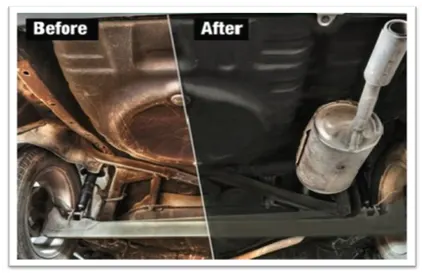
ADVANTAGES-
- It prolong car’s life
- It protect from rust & corrosion
- Protects vital components of car
- Insulates against heat and cold thus maintaining the thermal conductivity.
- Prevent paint chipping
- Spray hides welds, repairs & bodywork to increase the aesthetic appearance of the vehicle.
- Reduces NVH (Noise Vibrations Harshness) levels thus improving vehicle acoustic performance to provide a quieter ride.
DISADVANTAGES-
- It is costly.
- Applying underbody coating will not have any effect to the already corroded part.
- Corrosion starts itself after few years & the underbody coating is not preferable for the owner who change their car after a few year.
- A third-party undercoating service might void your vehicle’s warranty.