Underbody Coating
Underbody Coating:
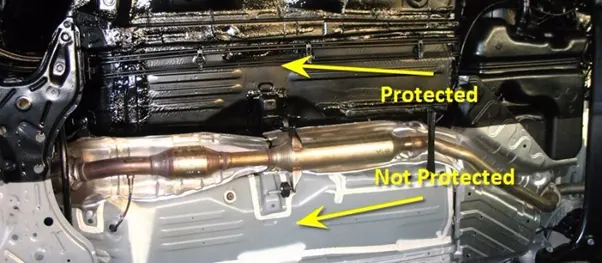
The underside of cars acts as a barrier between the outside environment and the metal parts of the vehicle. Because of the hostile atmosphere, automobiles' underbodies are vulnerable to damage. Vehicles' undercarriages receive coatings to guard against things like corrosion, chemicals, dampness, water damage, and chipping of the underbody. The underbelly of automobiles can be protected using automotive underbody coatings.
Based on various product compositions, the majority of these coatings offer chemical and corrosion resistance in addition to a number of other qualities. Applying vehicle underbody coatings prevents the metal from being harmed by gravel, stones, salt, and other road debris. This protects the underbody and wheel arches from chip damage.
The underbody coating process consists of the first two layers in the total coating process, whereas the automotive coating process for a vehicle's body requires a minimum of five coats of paint. These two layers offer dependable corrosion protection, but as time passes and damage occurs, these coatings must be replaced. These services are frequently offered by automotive aftermarket service companies during routine vehicle maintenance.
Automotive underbody coatings also provide defense against the moisture, humidity, and damp conditions that might leak into a car's underside through paintwork joints or cracks and lead to corrosion.
Compared to an uncoated underbody, the elastic polymers employed in vehicle underbody coatings allow for less noise when impacted by road debris. As a consequence, vehicle vibrations are minimized and reduced.
Automotive coating process:
- Pre-treatment: Pre-treatment is the initial step in preparing BIW for further coating. The three basic liquid dip techniques of degreasing, conditioning and phosphating are used in pre-treatment to clean the body surface and get rid of any welding residues and leftover oils from the stamping process. The degreasing solution is made up of alkaline salts and surfactants, such as sodium carbonate, caustic soda, and trisodium phosphate. Surfactants, which are detergents, are used on the BIW to emulsify oils and lubricants.
- Electrodeposition (ED): Automobiles have coatings applied to the metal frames and underbody to stop corrosion, but not to other surfaces like the roof. The structural metals (or other materials) are primed before further coatings are applied when they are not coated to avoid corrosion. According to the BIW material property, the ED procedures are adjusted. Rust and corrosion are kept at bay by this ED coating.
- Rust-proof materials: Sealer/PVC: Underbody coating (UBC) and the seam sealing with PVC and urethane make up the third phase. The sealant is put on the outside and inside of the doors, the hood, the trunk, and the front dash. It is also put on the outside and inside of the metal joints and the outside part of the rear wheel well.
- Primer: The application of a priming surface, often known as primer, is the fourth coating stage. It can be powdered, solvent-borne, or water-borne. These primers are employed to increase the E-coat and topcoat's adherence, offer chip protection, improve paint look, and be ecologically friendly and compliant with emission requirements.
- Top-Coat: Applying the topcoat, which is made up of two layers (the basecoat and clear coat) is the last stage in the body coating procedure. The clear coat protects against environmental impacts, corrosion, and UV radiation deterioration promotes unparalleled color retention, and gives a smooth, flawless finish. The basecoat includes the primary coloring pigment.
Types of Vehicle Undercoating:
It might be expensive to have undercoating professionally put into your car, but thankfully, you can do it yourself for a much lower cost if the money is tight. Here are a few examples of the numerous undercoating varieties that are offered.
1. Rubberized Undercoating
Rubberized car undercoating is simple to use, provides sound absorption, and guards against dirt, moisture, and dings or dents.
Rubberized undercoating is safe to use on your wheel wells and quarter panels in addition to your undercarriage. It cures to a soft rubbery surface that halts further rust, damage, or moisture leaks. It is possible to paint over the coating and, if necessary for bodywork, to remove it quickly and simply using an undercoating removal spray.
In general, the rubberized coating is the finest option for safeguarding the underside of your automobile since it offers the easiest and most effective defense against rust and moisture.
2. Polyurethane undercoating
Utilizing a sealer with a polyurethane base is the other method for undercoating your car. It takes a little less time and effort to apply this kind of car undercoating.
Polyurethane undercoating frequently comes in canisters that may be preloaded into application guns. This kind of sealant works by flowing over rusty spots, seeping into all cracks and seams, displacing moisture and salt, and bonding with and protecting
uncorroded metal It may also be painted over and sands easily in case of bodywork is required.
On the other hand, this kind of automotive undercoating often requires a little bit more surface preparation work before applying — it is typically advised to sand and apply an etching primer to bare metals before utilizing.
3. Wax or Paraffin-Based Undercoatings
The simplest and least expensive method for safeguarding your vehicle's underside is paraffin-based undercoating. However, keep in mind that it must be stripped and reapplied at least once each year because it will wear off more quickly than other kinds of undercoating.
Undercoatings made of wax never really harden. They leak or run into seams and fractures during application to offer protective qualities. They often come in an aerosol can or a spray gun canister and provide at least a basic level of protection in fairly humid regions.
4. Asphalt-Based Undercoating
Any of the aforementioned kinds of undercoating are adequate for protecting ordinary autos. Asphalt-based undercoating offers a little bit more resilience against pebbles, chips, and moisture for large vehicles and heavy equipment.
Undercoating made of asphalt frequently includes a small amount of rubberized material that helps it set up securely and reduce noise. This form of undercoating, which is often available in five-gallon pails and has a longer cure period than the other three, is best used solely for undercarriages because it cannot be painted.
Advantages:
- Your automobile is shielded from rust and corrosion by an additional layer of protection provided by undercoating.
- Although undercoating ultimately wears away, it can provide years of protection. Due to debris being deflected and prevented from eating away at the car, even automobiles in hot areas receive protection.
- It is self-applicable.
- It reduces the noise coming from the car's undercarriage.
- It protects the interior of the automobile from the sweltering temperatures coming from below.
- When stones strike the coating, it does not chip off.
Disadvantages:
- If there is already corrosion present, undercoating won't assist you since that corrosion must be removed before it can be applied, which might cost you money.
- For optimal effects, it must be administered every three to five years.
- It increases the vehicle's weight.