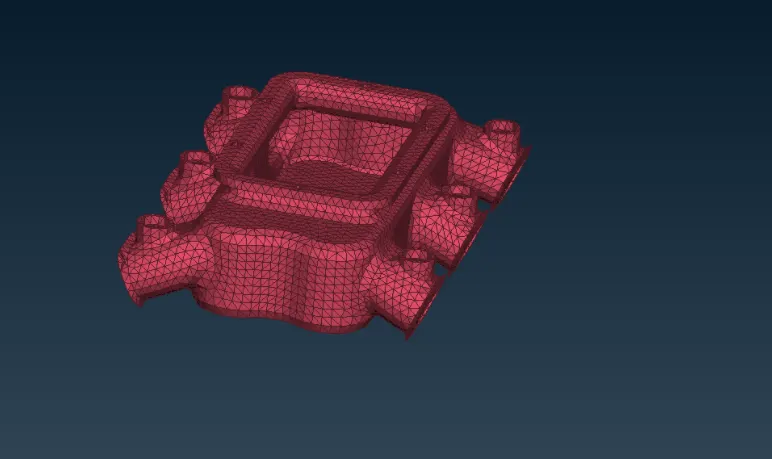
Tetra meshing of intake manifold assembly
AIM:
Mesh the given component with tetra elements and fulfill the required quality criteria
|
S.No |
Quality Criteria |
Value |
|
1 |
Target/Average length |
3 |
|
2 |
Minimum Length |
1 |
|
3 |
Maximum Length |
5 |
|
4 |
Tetcolapse |
0.2 |
THEORY:
Generally, 3d meshing is performed whenever the thickness of the components goes beyond 6mm or below 1/20 thickness area ratio. Few examples are like turbochargers, engine parts, intake manifolds, tyres, etc.3d meshing is generally done in two ways Tetra meshing and Hexa meshing. Generally, tetra meshing is preferred than Hexa meshing abiding to the complexities of Hexa meshing. In an analysis perspective, 3d Hexa mesh will give better results than tetra mesh due to its better shape function
Our main aim while performing 3d tetra meshing is to maintain the tet-collapse which is the distance from the opposite face divided by the area and multiplied by 1.24
SOFTWARE USED:
ANSA
INTRODUCTION:
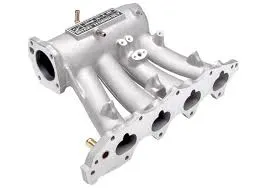
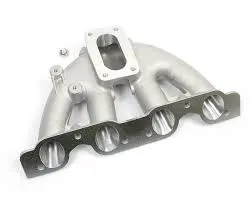
In automotive engineering, an inlet manifold or intake manifold is the part of an engine that supplies the fuel/air mixture to the cylinders. The word manifold comes from the Old English word manigfeald (from the Anglo-Saxon manig and feald and refers to the multiplying of one (pipe) into many.
The primary function of the intake manifold is to evenly distribute the combustion mixture (or just air in a direct injection engine) to each intake port in the cylinder head(s). Even distribution is important to optimize the efficiency and performance of the engine. It may also serve as a mount for the carburetor, throttle body, fuel injectors and other components of the engine.
Due to the downward movement of the pistons and the restriction caused by the throttle valve, in a reciprocating spark ignition piston engine, a partial vacuum (lower than atmospheric pressure) exists in the intake manifold. This manifold vacuum can be substantial, and can be used as a source of automobile ancillary power to drive auxiliary systems: power-assisted brakes, emission control devices, cruise control, ignition advance, windshield wipers, power windows, ventilation system valves, etc.
PROCEDURE:
Import the intake manifold.igs file in ansa
Set the perimeter length to 1mm under the mesh module for a complete refinement of the component
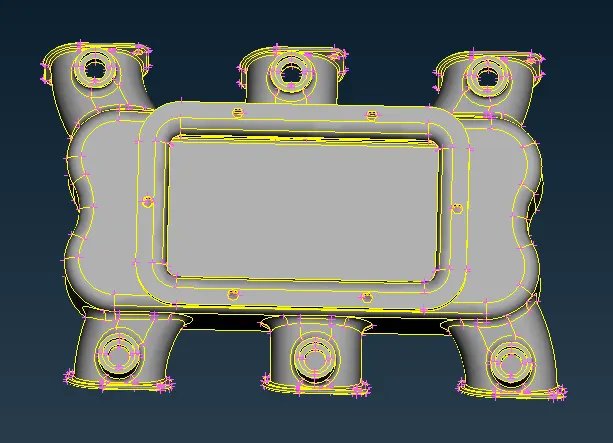
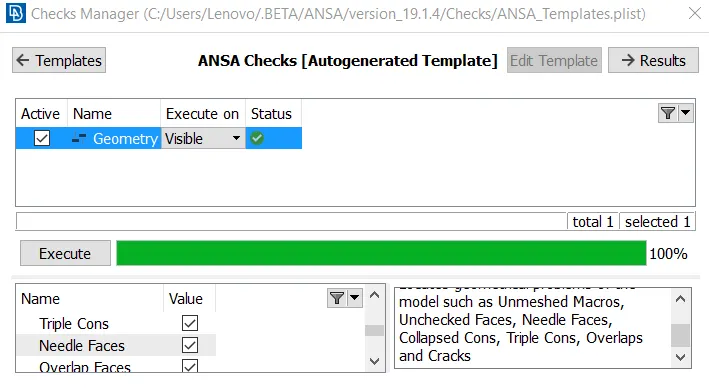
Check the geometry for any error like triple cons, single cons,cracks etc using the check geometry option
Assign the mesh parameters and the required quality criteria
For meshing the curved regions we use ortho tria mesh and for the flat surfaces we use tria mesh
We can use the Mesh Module->Spot mesh / best mesh for meshing as they are best-suited algorithms here
We can use the reconstruct option under Mesh->Shell Mesh for the proper mesh flow
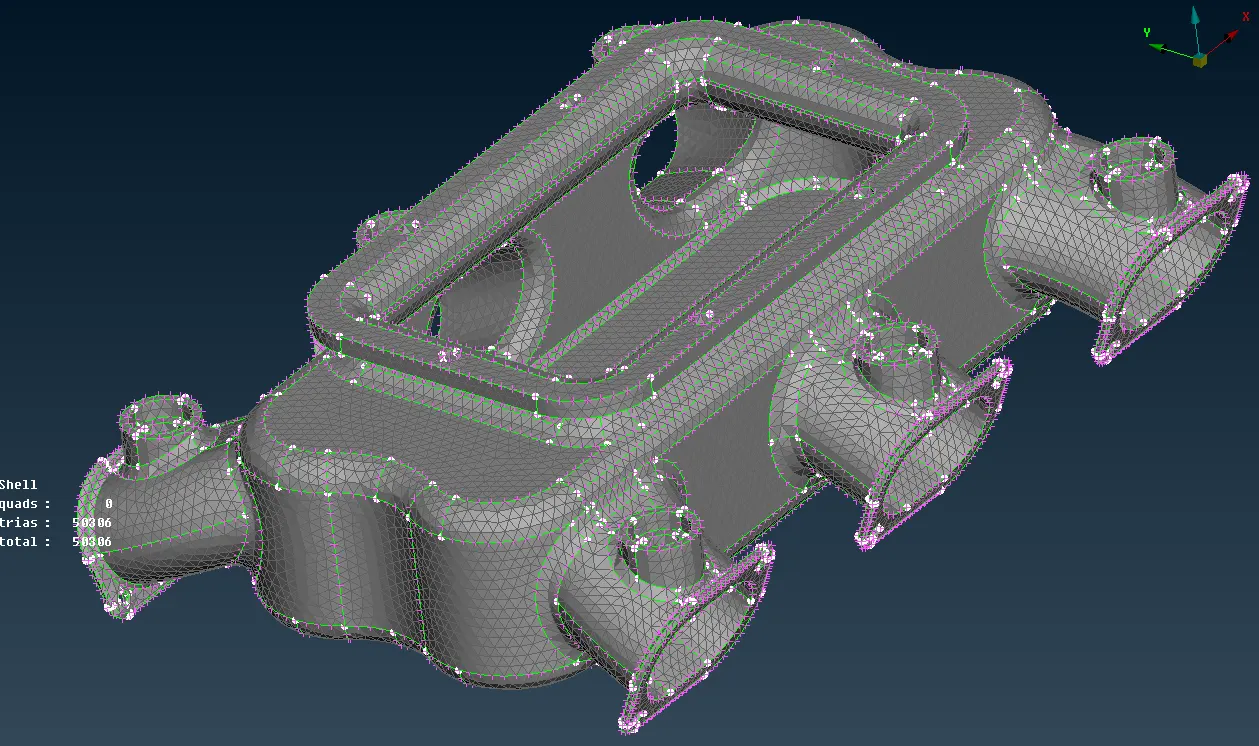
Define volume using define command under volume mesh module
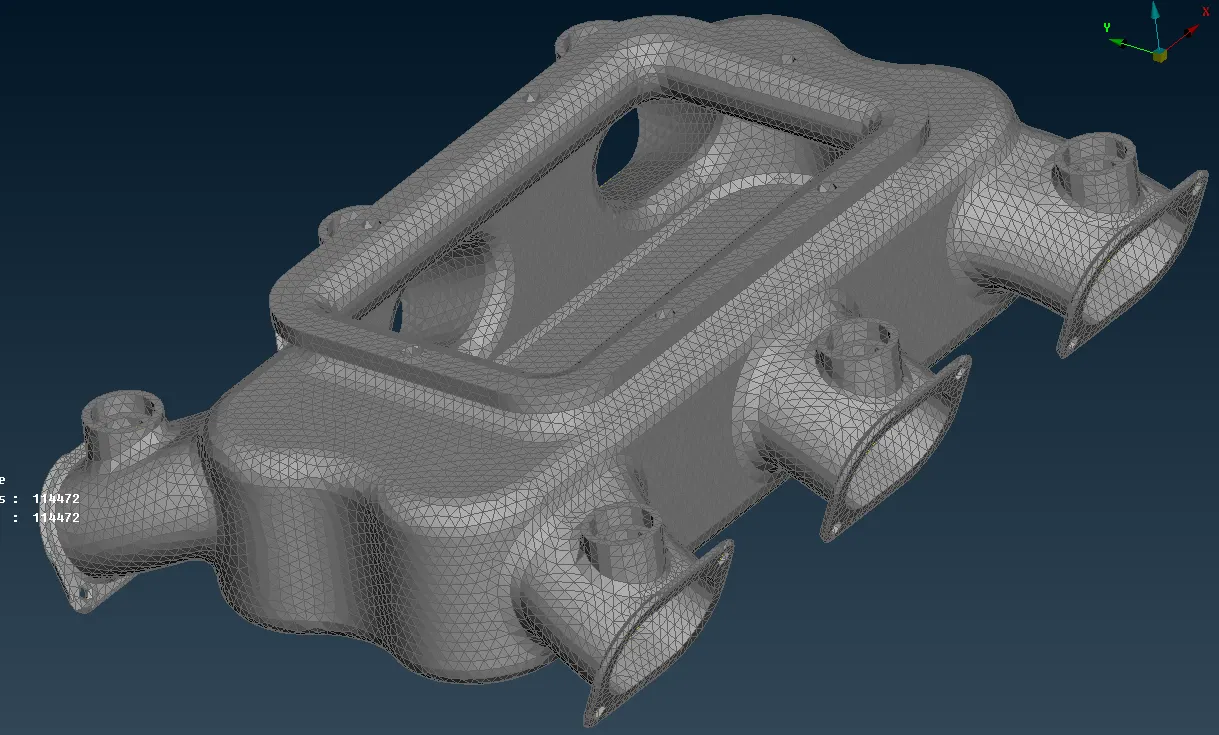
Select volume->list and remesh the component with tetra rapid/fem for volume meshing
RESULTS:
The given manifold is checked for any abnormal surfaces or bents and cleanup is performed
The tetra mesh was deployed on the compinents and off elements were cleared