Calculate the Forces acting on Vehicle
AIM:
To calculate the maximum propulsion power on a vehicle, maximum speed of the vehicle, Total traction power and to study the Range Rover Sport.
OBJECTIVES:
- Calculating the speed of the motor from the given tyre specification, gear ratio, and speed.
- To calculate the vehicle propulsion power using the given data.
- To check the difference in the traction power, after reducing the tyre pressure by 15%
- Study the Range rover sport model, for the dragon challenge.
STUDY 1
An electric scooter is a two-wheeler vehicle that is a plug-in electric vehicle. There is an onboard electric rechargeable lithium-ion battery of 48 volts which is connected to a 4kw DC electric motor. This motor drives the wheel with the help of a belt drive. The 4kw motor provides a torque of 200Nm which gives a mileage of 100km per charge.
For calculation 1 (90/100 R10 53J) To find the max speed of the motor.
Given data
Velocity = 90 kmph
Gear ratio = 7
Tyre size = 90/100 R10 53J
Sol:-
converting Kmph to m/s
1Km/hr = 5/18 m/s
Velocity = 90 * 5/18
= 25 m/s
To calculate the radius 90/100 R10
where 90 width of tyre (W)
100 Aspect Ratio (AR)
R10 Rim diameter (d)
Convert inches to mm
1 inch = 25.4mm
10 inches = 10 * 25.4
d (rim) (mm) = 254 mm
To calculate the diameter of the wheel
D(wheel) = 2W (AR/100) + d
= 2 * 90 (100/100) + 254
= 434 mm
Radius of the wheel = 434/2
= 217 mm
= 0.217 m
Speed of the motor
`ω = G * v/r`
= 7 * 25/0.217
= 806.45 rad/s
Converting rad/s to RPM
= rad/s * 60/ 2π
= 806.45 * 60/2*3.14
= 7701 RPM
For calculation 2 (90/90 R18 51P) To find the max speed of the motor.
Given data
Velocity = 90 kmph
Gear ratio = 7
Tyre size = 90/90 R18 51P
Sol:-
converting Kmph to m/s
1Km/hr = 5/18 m/s
Velocity = 90 * 5/18
= 25 m/s
To calculate the radius 90/100 R10
where 90 width of tyre (W)
90 Aspect Ratio (AR)
R18 Rim diameter (d)
Convert inches to mm
1 inch = 25.4mm
18 inches = 18 * 25.4
d (rim) (mm)= 457.2 mm
To calculate the diameter of the wheel
D(wheel) = 2W (AR/100) + d
= 2 * 90 (90/100) + 457.2
= 619.2 mm
Radius of the wheel = 619.2/2
=309.6 mm
= 0.3096 m
Speed of the motor
`ω = G * v/r`
= 7 * 25/0.3096
= 565.24 rad/s
Converting rad/s to RPM
= rad/s * 60/ 2π
= 565.24 * 60/2*3.14
= 5398 RPM
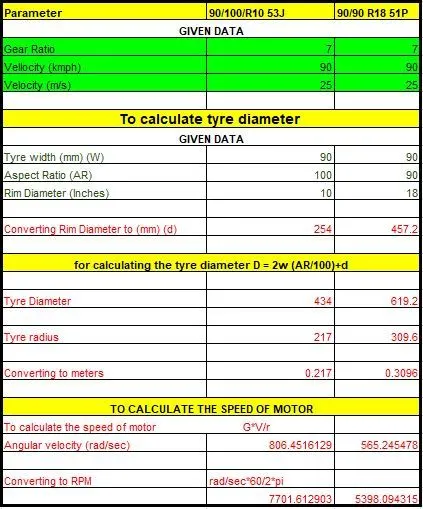
As seen from the calculation for the tyre model no. 90/100 R10 53J we can get the max speed of 7701 RPM and by using the tyre model no. 90/90 R18 51P we can get the max speed of 5398 RPM.
Calculation using Excel worksheet
Study 2
Prepare an excel calculator to identify the vehicle propulsion power using the given data as the input.
Formulas used
Rolling resistance = `Frr= μrr * m* g`
Where μrr = Coefficient of rolling resistance
Aerodynamic drag = `Fad = 0.5 * ρ * A * C_d * v^2`
tractive force = `F_t = Frr + Fad`
Total power = `p = F_t * v/1000`
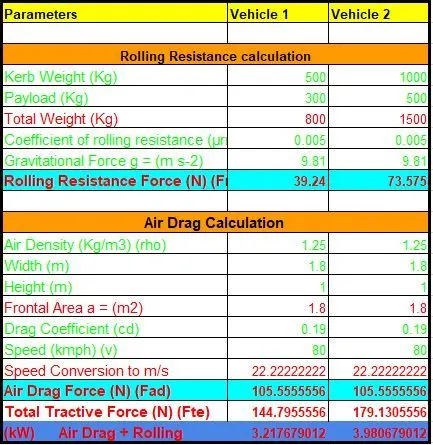
As we can see that the total power in kW by changing the weight and keeping all other parameters the same for each of the cases is calculated as 3.2176 kW and 3.9806kW respective for vehicle 1 and vehicle 2
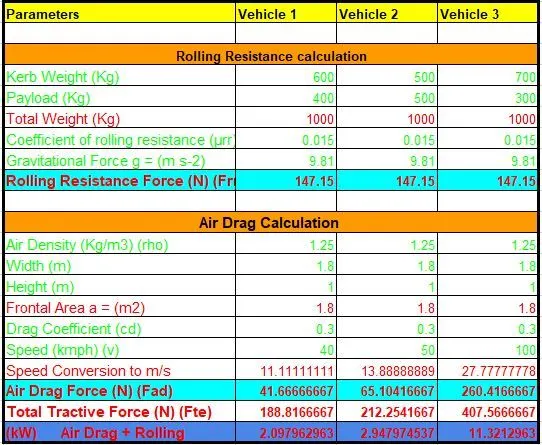
Vehicle propulsion power at the different velocity:
Limitations:
- These Excel calculations are not very suitable for lengthy calculations.
- for every calculation, we have to make sure to put the right units.
- The process becomes very tedious for larger calculations as we have to manually input each value.
- The range for these calculations is not so high so the accuracy is not attending easily.
STUDY 3
If the pressure of the tyre is reduced by 15% the coefficient of rolling resistance will be two times the normal value
First, we have to see the tractive power difference between the two vehicles.
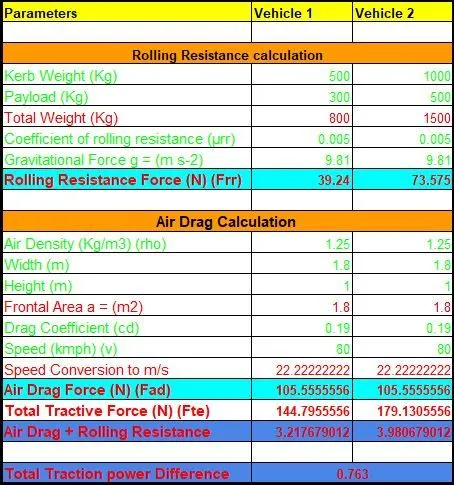
After a 15% reduction in the tyre pressure
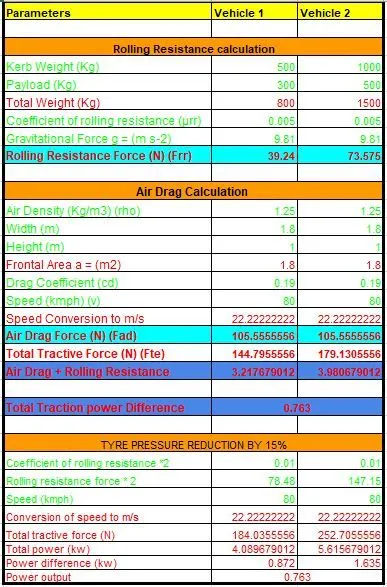
After the decrease in the tire pressure, the total power requirement had increased even after all the parameters are kept constant. before the pressure reduction, the power requirement was 3.2176 and 3.9806 kW for each of the vehicles, but after the pressure decrease, the total power requirement is 4.0896 and 5.6156 kW respectively.
STUDY 4
To study the Range rover sport Dragon challenge for the gradability, average speed of the car.
To see the video for the Range rover dragon challenge please click the below link
https://www.youtube.com/watch?v=EUwzWHD3Htg
The range rover sport is the electrically operated SUV, which had taken the Dragon challenge which was taken place at the Tianmen mountain ranges which is the curviest road with a total of 99 hairpins bent turns along the road. Further, after these roads are a total of 999 steps straight to the heaven gate with a steep angle of 45 degrees. Range rove sport has a 300ps Ingenium petrol engine as well as 116PS electric motor. Together they produce 404bhp and 500Nm of torque. The total time taken by the Range rover sport was about 22 min and 41 seconds, to cover the distance of 11.2 km including the 99 turns and 999 steps.
Gradeability
Gradeability defines as the highest grade that a vehicle can go maintaining a particular speed. It depends on
- tractive force
- Rolling resistance
- Adhesion
- Engine torque
- Transmission, transfer case, final drive, and tyre ratio.
To calculate the gradability use we have to use the percentage slope formula
Percentage = [tan(Degree)]X100
For the range rover hill riding challenge, the angle is 45 degrees.
percentage of Slope = [tan(45)]X100
Calculated out this gives a slope percentage of 100%
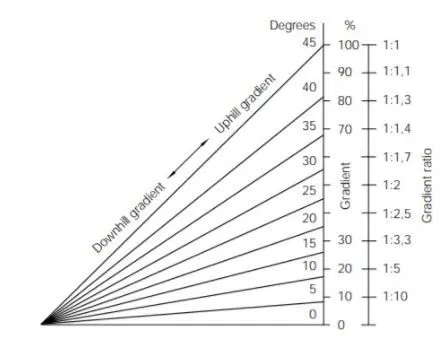
This shows the gradeability chart was 45 degree = 100% and having the 1:1 gradient Ratio
Average Speed of the car during the course
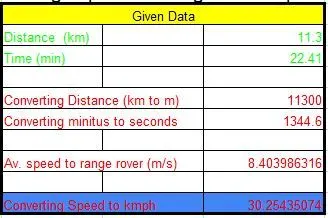
The total distance covered was 11.3 km in the time of 22.41 min, for the complete journey the average speed was calculated to be 30.25 kmph
All the force acting on the car are
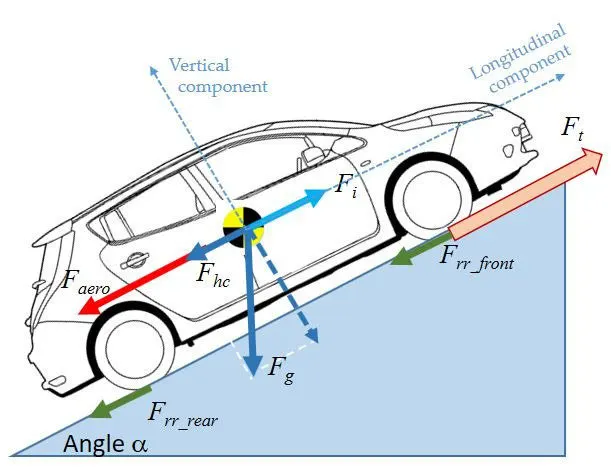
- Tractive Force - between the tyre and the steps
- Gradability efforts- Distance traveled at a 45-degree angle.
- Aerodynamic drag - As the car travelling high the atmosphere changes and the density of the air creates the drag.
- Rolling Resistance-the rolling resistance is more because of the steep slope of the hill.
- Verticle and longitudinal forces.
Conclusion-
As we can see from the above calculation the maximum speed of a car was calculated using the tyre data, the vehicle propulsion power was calculated for the different conditions, and the study of the Range rover sport was also done.
To excess the Excel sheet for calculation please click the below link.
https://drive.google.com/file/d/1Llgq7CwGa8TOGguBiWhiZElkr9RHdwYt/view?usp=sharing