Management of Thermal battery
AIM: Thermal Management of battery.
OBJECTIVE -
1. Prepare a report summarizing thermal management techniques for the electric car battery packs (not more than 500 words).
2. create a simple simscape model with a battery and show the temperature dependence in the performance. Also, connect a resistor load of 10 Ohm.
(Hint: Table based battery, Temperature source)
3. Compare the resultant's graph for different areas of contact with heat.
OBJECTIVE 1 - Prepare a report summarizing thermal management techniques for the electric car battery packs.
The importance of a cooling system
While advancements have been made in electric vehicles batteries that allow them to deliver more power and require less frequent changes, one of the biggest challenges that remain for battery safety is the ability to design an effective cooling system.
Batteries work based on the principle of voltage differential and at high temperature, the electron inside becomes excited which deserves the difference in voltage between the two sides of the battery. Because batteries are only manufactured to work between certain temperature extremes, they will stop working if there is no cooling system to keep it in working range.
If there is a larger internal temperature difference it can lead to different charge and discharge rates for each cell and deteriorate the battery pack performance. potential thermal stability issues such as capacity degradation, thermal runaway, and fire explosion could occur if the battery overheats or if there is nonuniform temperature distribution in the battery pack. In the face of life-threatening safety issues, innovation is continually happening in the electric vehicle industry to improve the battery cooling system.
TYPE OF COOLING SYSTEM
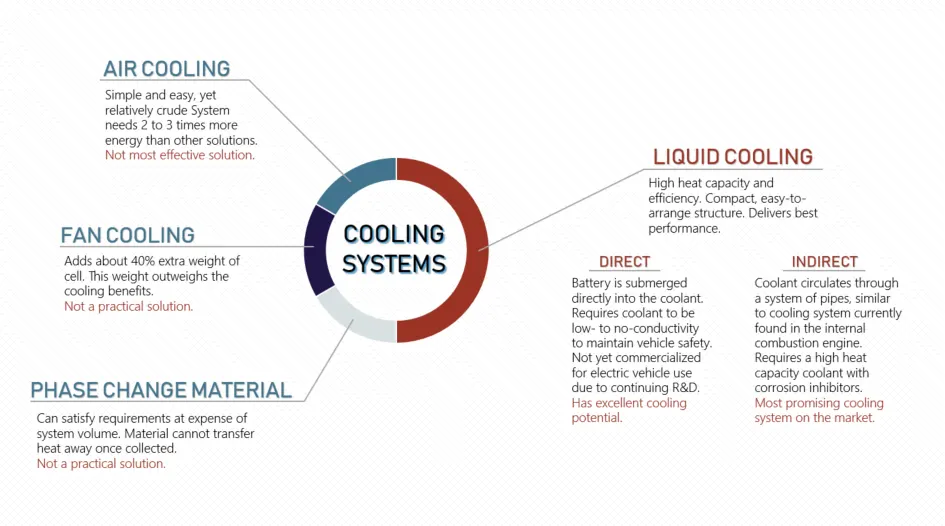
There are various types of cooling systems that can be used for the requirement of the vehicle. There is a various cooling system that can be used according to the requirement of the vehicle. There are air cooling systems, liquid cooling systems, and fan cooling systems. The air cooling system is the easy yet relative crude system needs 2 -3 times more energy than other solution. Were the liquid cooling system is a high heat capacity and efficiency. compact easy to arrange structure and deliver the best performance.
2 different methods are used for cooling the battery Direct method and indirect method
Direct method
The battery is submerged directly into the coolant. Requires coolant to be low to no conductivity to maintain vehicle safety. Not yet commercialized for electric vehicle use due to continuous R&D.
Indirect method
Coolant circulates through a system of pipes similar to the cooling system currently found in the internal combustion engine. Required a high heat capacity coolant with corrosion inhibitors.
OBJECTIVE 2 - Create a simple simscape model with a battery and show the temperature dependence in the performance. Also, connect a resistor load of 10 Ohm.
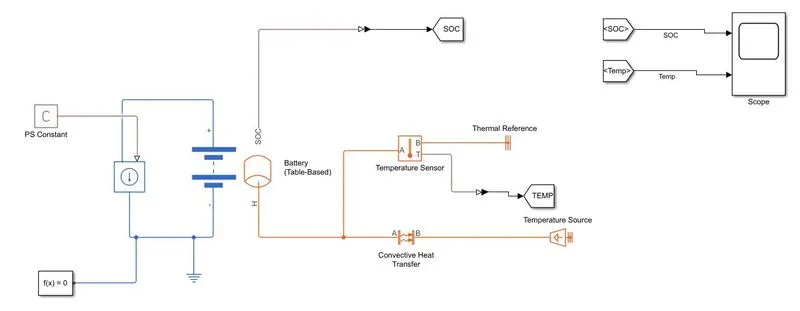
- A battery is discharging a fixed amount of current whilst being heated by a temperature source
- Max battery capacity is 4.2Ah and 2.1A (0.5C rate) of current is being discharged for 1 hour
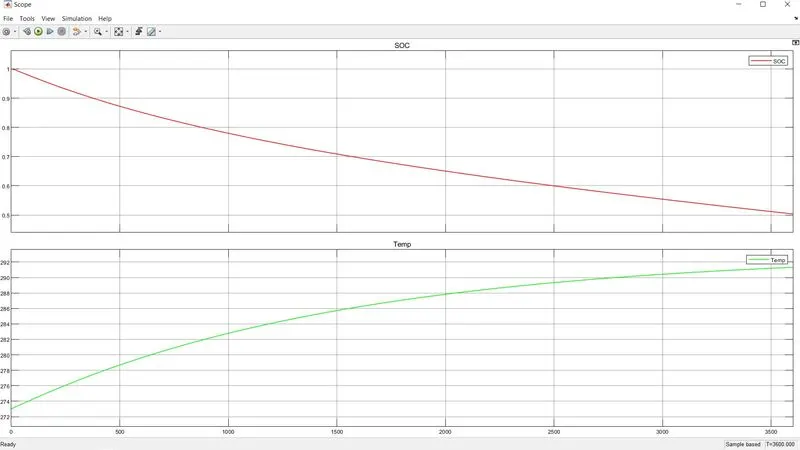
- The battery is at 298K the surface area of the battery in contact with the heating fluid is `1m^2`.
RESULT
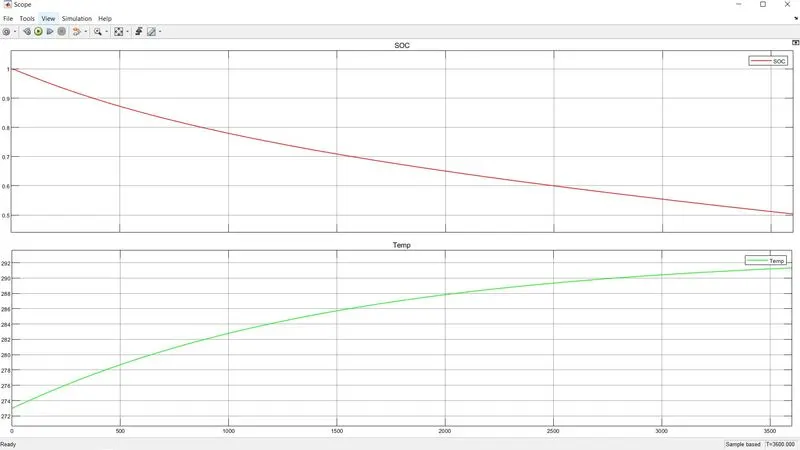
- Here we can see that the battery SOC was reduced to 50% of the total value and the temperature of the battery pack reached 291k.
- The thermal contact area was kept as `1m^2`.
Now adding the resistor of 10 ohms to the circuit to see the results of the model.
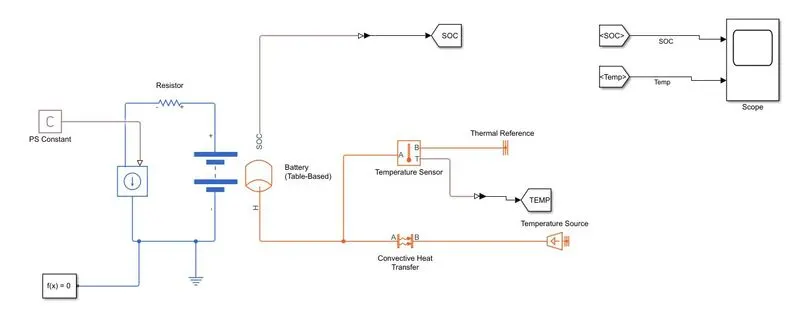
- Identical results as Study 1 - no change in battery temperature or SOC with the attachment of a 10ohm resistor
- This is probably because 10ohm is too low of a resistance to extract enough power from the circuit to affect battery parameters or performance.
OBJECTIVE 3 - Compare the resultant's graph for different areas of contact with heat.
- Now we will be changing the contact area by `1m^2, 0.1m^2, 10m^2`
For `1m^2`
For `0.1m^2`
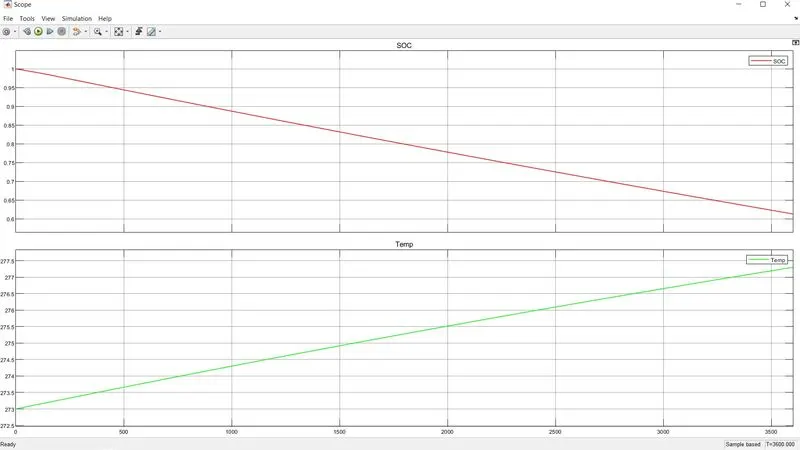
- Since the contact area is very low the max temperature of the battery went up to 277.5k and even the SOC also reduces slowly.
For `10 m^2`
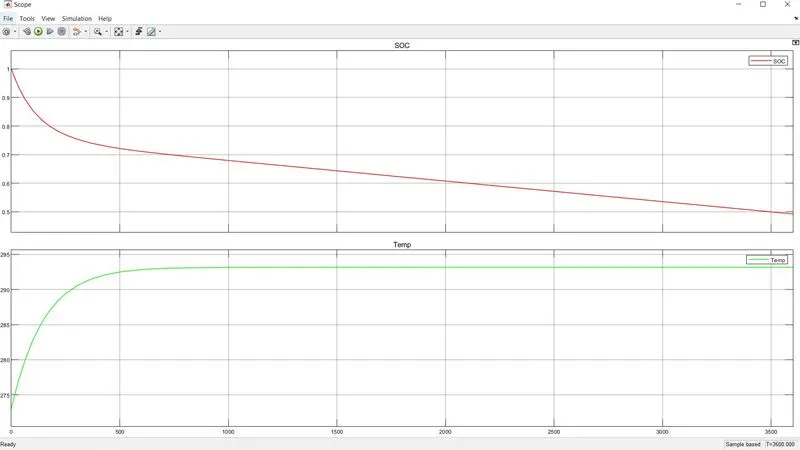
- As the contact increases the temperature of the battery also increases to 294k, the SOC also decreased at a rapid rate than we observed earlier.
CONCLUSION
Here we have seen and studied the thermal effect on the battery pack and the performance of the battery pack by changing the parameters of the simulation. The contact area of the battery affects the temperature of the battery pack.