THE HYBRID VEHICULAR TRANSPORTATION SITUATION IN INDIA
THE HYBRID VEHICULAR TRANSPORTATION SITUATION IN INDIA
AIM:
To write a brief report on the hybrid/electrified vehicular transportation situation in India.
HYBRID VECHILE:
Hybrid electric vehicles (HEVs) are powered by an internal combustion engine in combination with one or more electric motors that use energy stored in batteries to propel the vehicle. HEVs combine the benefits of high fuel economy and low tailpipe emissions with the power and range of conventional vehicles.
TRANSPORTATION IN INDIA:
The transportation sector accounts for 18% of total energy consumption in India. Moreover, the automotive sector also contributes an estimated 142 Million Tons of CO2 emissions annually, out of which 123 million tones is contributed by the road transport segment alone. It is pertinent to introduce alternative means in the transport sector which can be coupled with India’s rapid economic growth, rising urbanization, travel demand and country’s energy security. Therefore, transportation sector needs to undergo a significant transformation from oil- based system to a more environment friendly electricity-based system and should involve the entire transportation system including the last mile connectivity in far remote areas.
ELECTRIC MOBILITY IN AUTOMOTIVE SECTOR:
Electric mobility comes with zero or ultra-low emissions of local air pollutants and much lower noise, and, by being one of the most innovative clusters for the automotive sector, can provide a major boost to the economic and industrial competitiveness, attracting investments, especially in countries. Electric mobility will also contribute to balancing energy demand, energy storage and environmental sustainability.
GOVERNMENT INITIATIVES:
The government of India have undertaken multiple initiatives to promote manufacturing and adoption of electric vehicles in India. The climate change commitments made by Government of India during the COP21 Summit held at Paris to reduce emission intensity by 33- 35% by 2030 from 2005 levels With support of the government, electric vehicles have started penetrating in the Indian market. However, availability of adequate Charging Infrastructure is one of the key requirements for accelerated adoption of electric vehicles in India.
In this regard, Ministry of Power has issued “Charging Infrastructure for Electric Vehicles – Guidelines and Standards” mentioning the roles and responsibilities of various stakeholders at Central & State level, for expediting the development of public EV charging infrastructure across the country. Ministry of Power has designated Bureau of Energy Efficiency (BEE) as the Central Nodal Agency (CNA) for the National-level rollout of charging infrastructure in the country.
Central as well as State governments have been promoting adoption of EVs by providing fiscal as well as non-fiscal incentives. Some of the incentives being provided on purchase of EVs are:
- Upfront capital subsidy under FAME India Scheme Phase II
- Goods & Services Tax (GST) on EVs has been reduced from 12% to 5%,
- Income tax deduction can be claimed on the interest paid on loans taken for purchase of EVs.
MINISTRY OF POWER:
It has clarified that charging EVs is considered a service, which means that operating EV charging stations will not require a license. It has also issued a policy on charging infrastructure to enable faster adoption of EVs. The revised consolidated Guidelines & Standards for Charging Infrastructure for Electric Vehicles was promulgated on January 14, 2022.
MINISTRY OF ROAD TRANSPORT AND HIGHWAYS:
It has announced that both commercial as well as private battery-operated vehicles will be issued green license plates. It has also notified that all battery operated, ethanol-powered, and methanol-powered transport vehicles will be exempted from the commercial permit requirement.
DEPARTMENT OF SCIENCE AND TECHNOLOGY:
It has launched a grand challenge for developing the Indian Standards for Electric Vehicle Charging Infrastructure.
NITI AAYOG:
The National Mission on Transformative Mobility and Battery has been approved by the cabinet, and the inter-ministerial steering committee of the Mission will be chaired by the CEO of Niti Aayog. The Mission aims to create a Phased Manufacturing Program (PMP) for five years till 2024, to support setting up large-scale, export-competitive integrated batteries and cell-manufacturing giga plants in India, as well as localizing production across the entire electric vehicle value chain.
PRIVATE SECTORS IN ELECTRIC VEHICLE:
The Indian EV market being in its nascent stages is viewed as an opportunity waiting to be exploited. Other players that also have products in the EV market include MG Motors, Maruti Suzuki, Renault, Audi, Volvo, Hero, Ather, etc. An expansion in the EV industry will also see other associated industries catch on too. This includes the battery and EV chargers. Interests have been shown by many companies like Siemens, Schneider, Delta, etc.
LIST OF TOP PRIVATE EV MANUFACTURES IN INDIA:
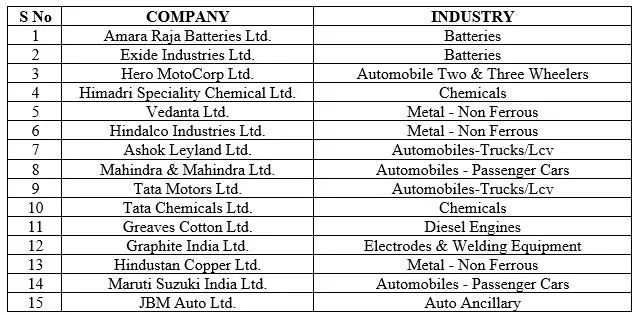
The government has also realized that it is best to target their efforts towards the public transport system in the initial stages. This is because the purchase of EVs in the private sector will depend on major other factors like attractiveness etc. The public transport system being one of the most heavily used in a country like India will definitely offer a huge boost to the sector.
Other leading EV stocks in India that are working on Electric Vehicles or related EV ancillary products are JBM Auto, Olectra Greentech, Kabra Extrusion Technik, IOC, BPCL, Reliance Industries, NTPC, Power Grid, Tata Chemicals, Gujarat Fluorochemicals, Neogen Chemicals, Tatva Chintan Pharma, Motherson Sumi, Suprajit Engineering, Minda Industries, Fiem Industries, Tata Elxsi, L&T Technology, Hindustan Copper, NALCO and Hindalco. In addition, six big Tata Group companies joined hands under the name Tata UniEVerse to create an EV ecosystem.
REFERENCES:
- https://tradebrains.in/top-electric-vehicle-companies-india/
- https://beeindia.gov.in/content/e-mobility
TOPIC 1: NEW MISTSUBISHI OUTLANDER PHEV TO ADOPT AN EVOLVED ALL-WHEEL CONTROL TECHNOLOGY
PHEV's ALL-WHEEL CONTROL (S-AWC) TECHNOLOGY
Mitsubishi Motors Corporation (MMC) will use an evolved version of the Super-All Wheel Control (S-AWC) system in its plug-in hybrid (PHEV) model of the all-new Outlander crossover SUV. The Super-All Wheel Control (S-AWC) is integrated with vehicle dynamics control system, based on a twin-motor 4WD system with one drive motor in front and another in the rear, has a new brake Active Yaw Control (AYC) function for the rear wheels. This allows the system to distribute the driving force to the front and rear wheels optimally according to road and driving conditions, while torque vectoring by controlling the brakes on the left and right wheels is also possible for the front and rear wheels. This makes it possible to extract the maximum performance from all four tires in a more balanced manner.
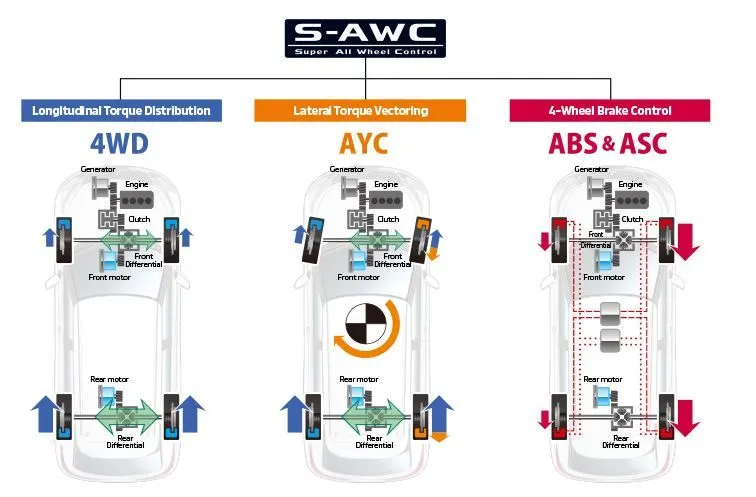
The S-AWC system is all-wheel control technology that offers integrated control of Active Stability Control (ASC), Anti-lock Braking System (ABS) and Active Yaw Control (AYC), which controls the left and right wheels via braking. With an increase of around 40 percent in the output of the front and rear motors and drive battery, the new model can keep driving in EV mode and avoid starting the engine as much as possible even when pressing hard on the accelerator, delivering the smooth, powerful and satisfying motor-based driving of high-output twin-motor 4WD. Switching to a large capacity drive battery with total capacity of 20 kilowatts (kWh) and raising the equivalent all-electric range to 87 kilometers has assured sufficient driving range even when using functions such as the air conditioner, while at the same time helping to reduce the frequency of charging. An increase in the capacity of the gas tank has also expanded the total possible range when combining EV driving with hybrid driving.
The all-new Outlander PHEV is equipped with evolved MI-PILOT single-lane driver assistance technology for highways. The control system integrates Adaptive Cruise Control (ACC) and Lane Keep Assist (LKA) to assist the driver in maintaining distance between vehicles while keeping in the center of the lane. It also detects speed limit signs and automatically adjusts the set speed accordingly. MI-PILOT with Navi-link utilizes map data to automatically adjust vehicle speed as needed according to curves, forks, and other circumstances on expressways. In addition, seven drive modes can be selected depending on road conditions and driving style. Normal, the basic mode, is optimized for normal driving on paved roads. Gravel mode provides balanced operability and road handling ability on unpaved or wet paved roads, and Snow mode delivers stable vehicle behavior on snowy and other slippery roads. In addition, there are Power mode, which offers powerful acceleration, and Eco mode that prioritizes economic and environmentally friendly driving.
WHY IT IS IMPORTANT, HOW IT HELPS:
The Super-All Wheel Control (S-AWC) increases vehicle in driving, cornering and braking. Conventional vehicles employ a braking control system to control the brake forces in the left and right wheels only on the front, but the evolved S-AWC adds a braking control system for the rear wheels. The S-AWC continuously captures accelerating, cornering and braking, and creates control values while considering all the effects on the vehicle, such as responsiveness to the drivers, traction performance, and running performance.
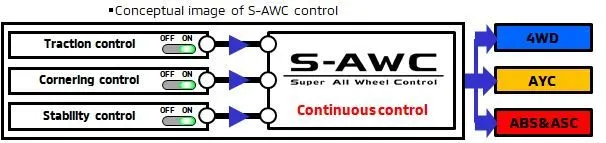
By S-AWC, it is possible to extract the maximum performance from all four tires in a more balanced manner by reducing the forces on the front wheel through braking. Distributing brake control to all four wheels reduces the braking force on each individual tire, making it possible to utilize AYC to even greater effect on slippery roads. Also by the application of AWC, the vehicle will be propelled with Safe, secure and comfortable driving in various weather and road conditions.
REFERENCES:
- https://www.mitsubishi-motors.com/en/innovation/technology/SUVNewValue/sawc4/
- https://www.greencarcongress.com/2021/10/20211002-outlander.html
TOPIC 2: EATON’S VEHICLE GROUP INTRODUCES LINEUP OF SPECIALIZED DIFFERENTIALS FOR ELECTRIFIED VEHICLE
SPECIALIZED DIFFERENTIALS FOR ELECTRIFIED VEHICLE
Power management company Eaton’s Vehicle Group launched a lineup of specialized differentials for electrified vehicles with comparable performance to traditional internal combustion engine (ICE) vehicles. Also, Eaton conducts a total system analysis, using state-of-the-art tools and in-house know-how, to design a differential for electrified vehicles optimized for efficiency, reliability and manufacturing.
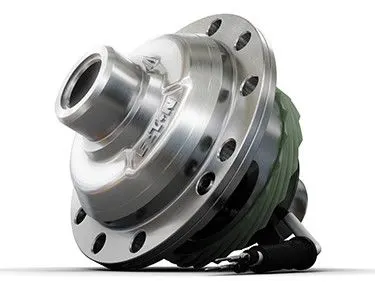
Eaton’s Traction Control differentials can provide improved traction in adverse conditions, such as snow and mud, and improved stability while trailering. As a global supplier, Eaton has extensive knowledge of vehicle dynamics and safety standards, as well as decades of experience working with global automotive manufacturers to integrate differentials into new vehicle platforms. Eaton has been supplying differentials to the EV market since 2015. Eaton offers a full range of differentials for electrified vehicles, including automatic limited-slip, automatic locking and electronic selectable locking differentials. Each differential is engineered, tested and validated for a variety of traction control applications. Performance is verified at Eaton’s Proving Ground testing complex in Marshall, Michigan.
Eaton’s Traction Control solutions include:
Truetrac – Helical-gear limited-slip differential maximizes wheel traction and enhances driving and handling characteristics. Easily integrated into compact packaging spaces, with high power density capacity.
ELocker – Allows for maximum driveline flexibility. Users can switch from a fully open to a fully locked axle at the touch of a button, or it can be integrated into the vehicle (auto-locking). High torque capacity and range, with compact designs for EV applications.
IntelliTrac – Smart electronically controlled, limited-slip differential is fully integrated to the vehicle to provide instant response and optimized vehicle performance at any speed or traction condition.
MLocker – Automatic, mechanical locking differential which provides drivers best-in-class traction without the need for buttons, shift knobs or other driver intervention. Improves towing and off-road performance with low integration cost.
Posi – Limited slip differential which automatically prevents wheel slip before it can get started. Easily integrates into most axle designs and can be tuned for application requirements.
Open – Compact open differential which allows cost-effective solution for managing torque between left and right wheels.
WHY IT IS IMPORTANT, HOW IT HELPS:
Traction Control differentials can provide improved vehicle traction in adverse conditions, such as snow and mud, and improved stability while trailering. By utilizing a self-contained, automatic engagement mechanism and traction control solutions, the MLocker differential engages in low-traction situations when a wheel speed difference. Automatic locking takes less than a fraction of a second, improving traction and providing the driver with increased safety and confidence when traveling on wet or icy roads, gravel, mud, and dirt. Also with Eaton’s traction control provides maximum driveline flexibility and instant response and optimized vehicle performance at any speed or on traction conditions.
REFERENCES:
- https://autonewsblaster.com/2022/03/eaton-celebrates-50-years-of-mlocker-differential-production.html
- https://www.greencarcongress.com/2021/08/20210826-eaton.html