Supervised Learning - Classification Week 9 Challenge
1. What is a Neural Network?
A. Neural networks are used to mimic the basic functioning of the human brain and are inspired by how the human brain interprets information. It is used to solve various real-time tasks because of its ability to perform computations quickly and its fast responses.
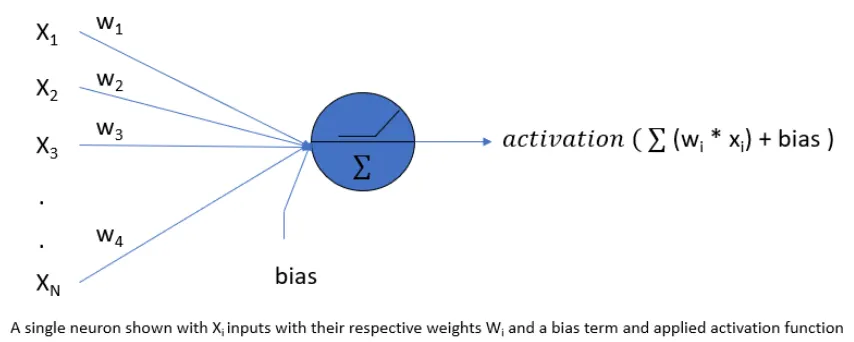
An Artificial Neural Network model contains various components that are inspired by the biological nervous system.
Artificial Neural Network has a huge number of interconnected processing elements, also known as Nodes. These nodes are connected with other nodes using a connection link. The connection link contains weights, these weights contain the information about the input signal. Each iteration and input in turn leads to updating of these weights. After inputting all the data instances from the training data set, the final weights of the Neural Network along with its architecture is known as the Trained Neural Network. This process is called Training of Neural Networks. This trained neural network is used to solve specific problems as defined in the problem statement.
2. What is deep learning?
A. Deep Learning is a subfield of machine learning concerned with algorithms inspired by the structure and function of the brain called artificial neural networks.
Deep learning models are meant to analyze data with a similar logical structure to how humans make decisions and draw conclusions. These models are modeled after the human brain, and they enable data to be passed between nodes that mimic neurons. They layer algorithms to create an artificial neural network (ANN) that can learn and make decisions on its own. This design makes deep learning models more capable than standard machine learning models.
3. What is the role of the activation function?
A. An Activation Function decides whether a neuron should be activated or not. This means that it will decide whether the neuron's input to the network is important or not in the process of prediction using simpler mathematical operations.
4. What are the different types of activation functions?
A.
1. Binary step function:
f'(x) = 0, for all x

2. Linear Function
f(x)=ax

3. Sigmoid
f(x) = 1/(1+e^-x)

4. Tanh
tanh(x)=2sigmoid(2x)-1

There are some functions which are advancements of Relu like 'Leaky-Relu' etc
5.What do you understand by backpropagation?
A.
Artificial neural networks use backpropagation as a learning algorithm to compute a gradient descent with respect to weight values for the various inputs. By comparing desired outputs to achieved system outputs, the systems are tuned by adjusting connection weights to narrow the difference between the two as much as possible.
The algorithm gets its name because the weights are updated backward, from output to input.