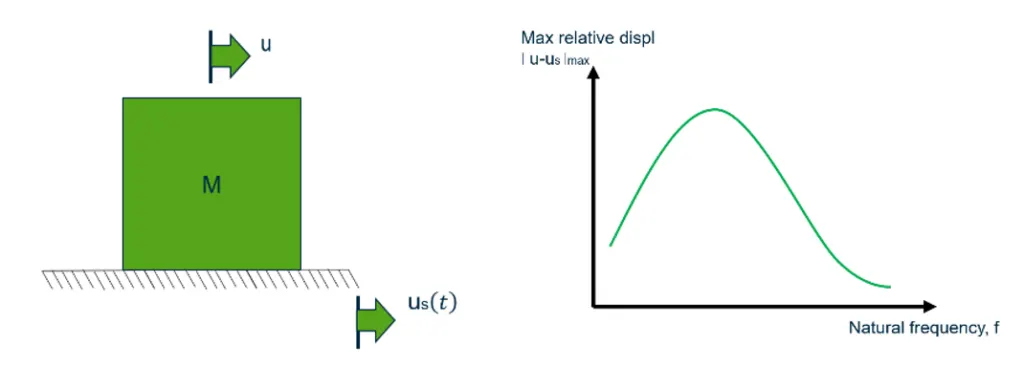
Structural dynamics
Question 1-
Aim- Differentiate Static analysis and Dynamic analysis with proper representing pictures
Answer-
| Static Analysis | Dynamic Analysis |
| Static analysis is time invariant analysis of forces like Stress, strain and displacement etc. | Dynamic analysis is time dependent analysis |
| The results are a consequence of the applied constraints and loads, for example, bearings, gravity, forces, etc. | Inertia and damping forces taken into account |
| Static loads applied on structure slowy | Dynamic Loads applied on the structures Suddenly |
| Example- Dead Load , Live load | Example- Earthquake load , Wind Load |
| Static analysis done with minimum three degree of freedom | Dynamic analysis of structure done with single degree of freedom |
| Static analysis done where the structure deformations behave linear | Dynamic analysis done where structure behaves non-linear deformations |
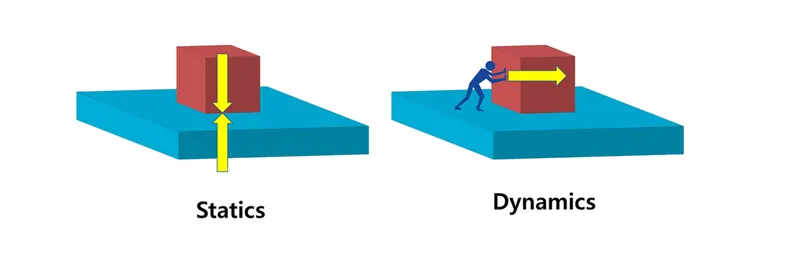
Below are the pictures differentiating static and dynamic behaviour.

Question 2-
Aim- Explain the following with relevant force-displacement graph
- Elastic behavior
- Inelastic behavior
- Plastic behavior
- Non-linear Inelastic behavior
Answer-
1) Elastic behavior- Elasticity is the ability of a body to resist any permanent change to it when stress is applied. When stress application ceases, the body regains its original shape and size. Different materials show different elastic behavior. The study of the elastic behavior of a material is of much importance.
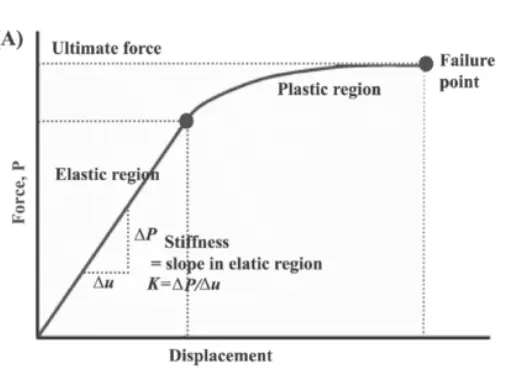
2) Inelastic Behavior- Deformation of a material that does not disappper on removal of the force that produced it.
3) Plastic Behavior- For stresses beyond the elastic limit, a material exhibits plastic behavior. This means the material deforms irreversibly and does not return to its original shape and size, even when the load is removed. When stress is gradually increased beyond the elastic limit, the material undergoes plastic deformation.
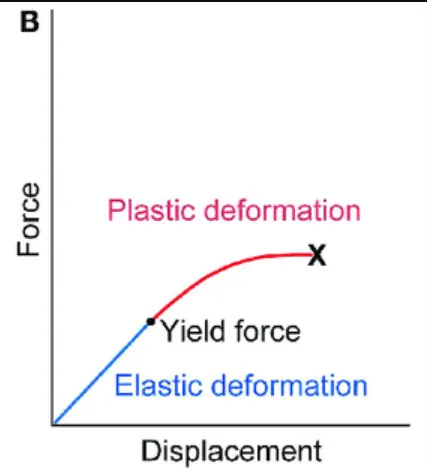
4) Non- Linear Elastic Behavior-
Materials have elastic behavior usually only up to a certain load, which is called the 'yield point'. After that, the deformations are plastic. Rubber, for instance, has an elastic stress–strain curve, but the relation is not linear − in such cases nonlinear elastic models are required.
Question 3-
Aim- Explain Mass, Stiffness & Damping components in the equation of motion
Answer-
Mass: Newton's second law, which states that the force F acting on a body is equal to the mass m of the body multiplied by the acceleration a of its Centre of mass, F = ma, is the basic equation of motion in classical mechanics.
Mass is always constant for a body. One way to calculate mass: Mass = volume × density. Weight is the measure of the gravitational force acting on a mass.
Stiffness: Stiffness relates to how a component bends under load while still returning to its original shape once the load is removed. Since the component dimensions are unchanged after load is removed, stiffness is associated with elastic deformation. A material can have high strength and low stiffness.
Damping: Damping is a reduction in vibration over a period of time. Damping will eventually bring a vibrating object to rest. A damping mechanism suppresses vibrations of the structure.
Question 4-
Aim- Provide relationship between Natural period (Tn) & Natural frequency (f) and provide their definitions
Answer-
Natural period: The natural period of a building is simply a time taken by it to undergo one complete cycle of oscillation. The natural period is one of the properties or building which is controlled by mass and stiffness.
The time period of a building is its natural period of oscillation when subjected to ground shaking in the event of an earthquake.
The building is modelled to be under harmonic oscillation and the time period is calculated in a similar way as in harmonic oscillation
T = 2π√(k/m)
where k is the total stiffness and m is the total mass.
k is calculated as the sum of the lateral stiffness of all stiffness providing and moment resisting vertical members (columns, moment resisting frames, sheer walls, etc.) m is calculated as the sum of masses of all members on the Storey.
Natural Frequency: A natural frequency is defined as that frequency at which a body will vibrate if excited by an external force.
The frequency is nothing but the number of vibrations in a second and is the inverse of the time period
f = 1/T
Question 5-
Aim- Explain in detail about Response spectrum & its Graph
Answer-
A response spectrum is a graphical plot of the frequency of an oscillator and its damping. The response spectrum plot represents the peak or steady-state response (velocity, displacement, or acceleration) of a series of oscillators of varying natural frequency. In vibration analysis of any system, the response spectrum is very useful as the resulting plot can provide the response of any linear system with respect to its natural frequency. The response spectrum finds its usage in interpreting seismic or earthquake events and slug flow events. Response Spectrum Analysis is a scientific method for estimating the structural response of dynamic vibration events.