Structural dynamics
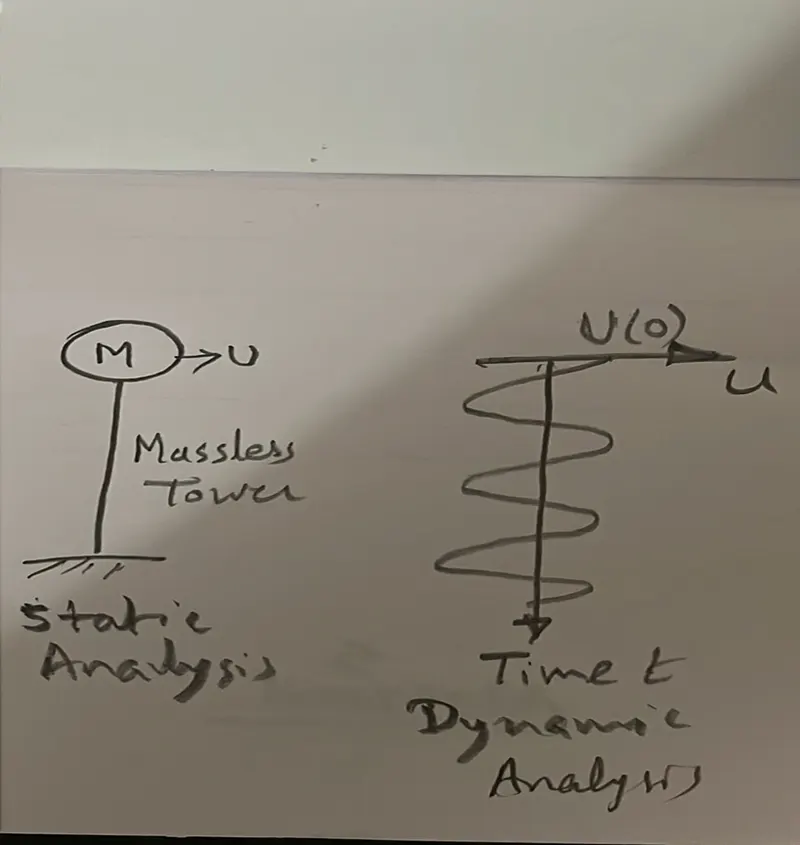
- Differentiate Static analysis and Dynamic analysis with proper representing pictures (30 marks)
Ans 1. When loads and displacements are applied very slowly to a structure the inertia forces which are equal to mass and acceleration are negligible and may be disregarded in the force equilibrium. This load or displacement variation with respect to time can be neglected and assumed to be constant in static analysis.
When the loads and forces are applied quickly the inertia forces cannot be disregarded in the equilibrium equations and the structure dynamically responds to those excitations, further the damping forces may also develop and should also be considered in the equilibrium of motion equation. The variation with respect to time is to be considered. The motion of structure cannot be disregarded. Inertia and damping forces must be accounted for dynamic analysis.
- Explain the following with relevant force-displacement graph (40 marks)
- Elastic behavior
- Inelastic behavior
- Plastic behavior
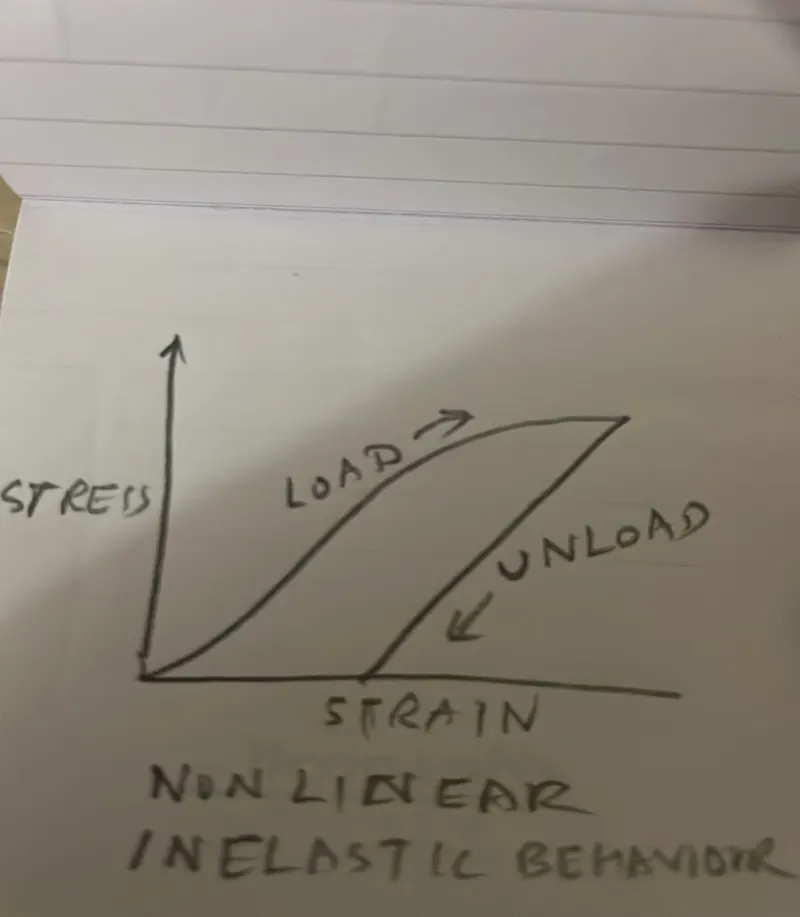
- Non-linear Inelastic behavior
Ans 2. Elastic Behaviour: The material subjected to load will have linear stress-strain behaviour and on removal of load the material will return to the original state.
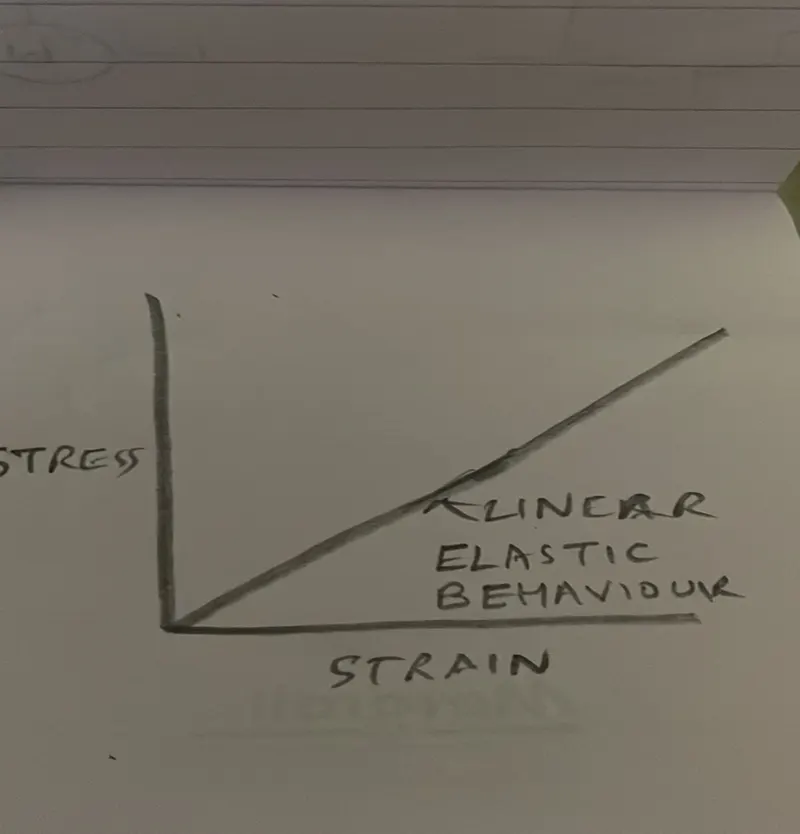
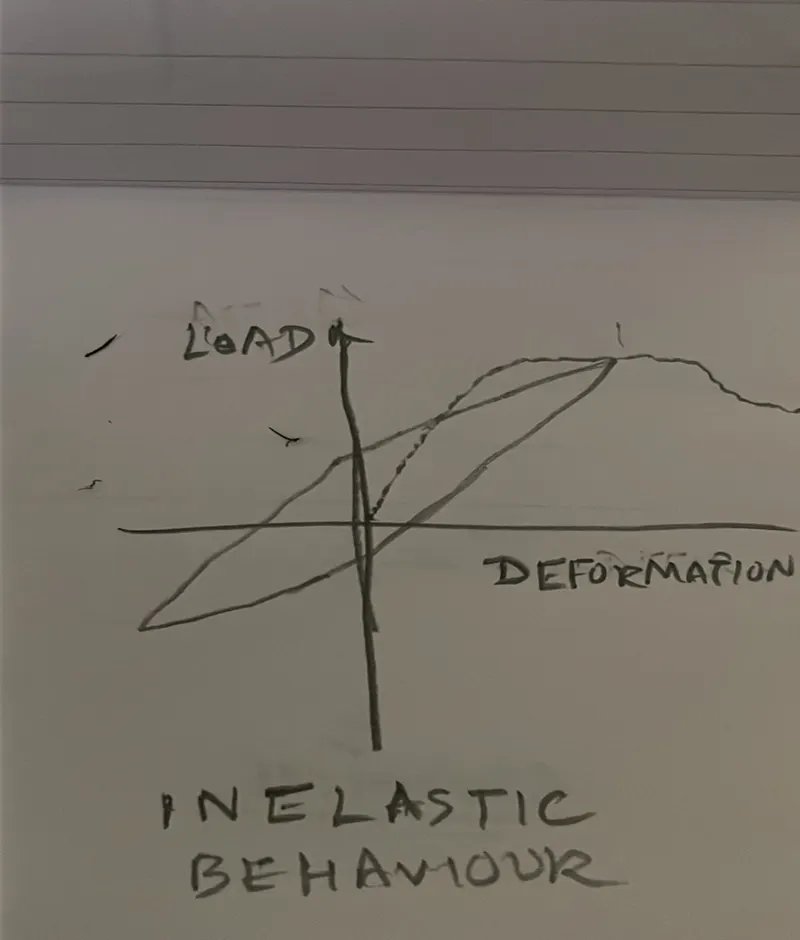
Inelastic behaviour: The loading and deformation pattern is different from the unloading and deformation pattern in inelastic behaviour.
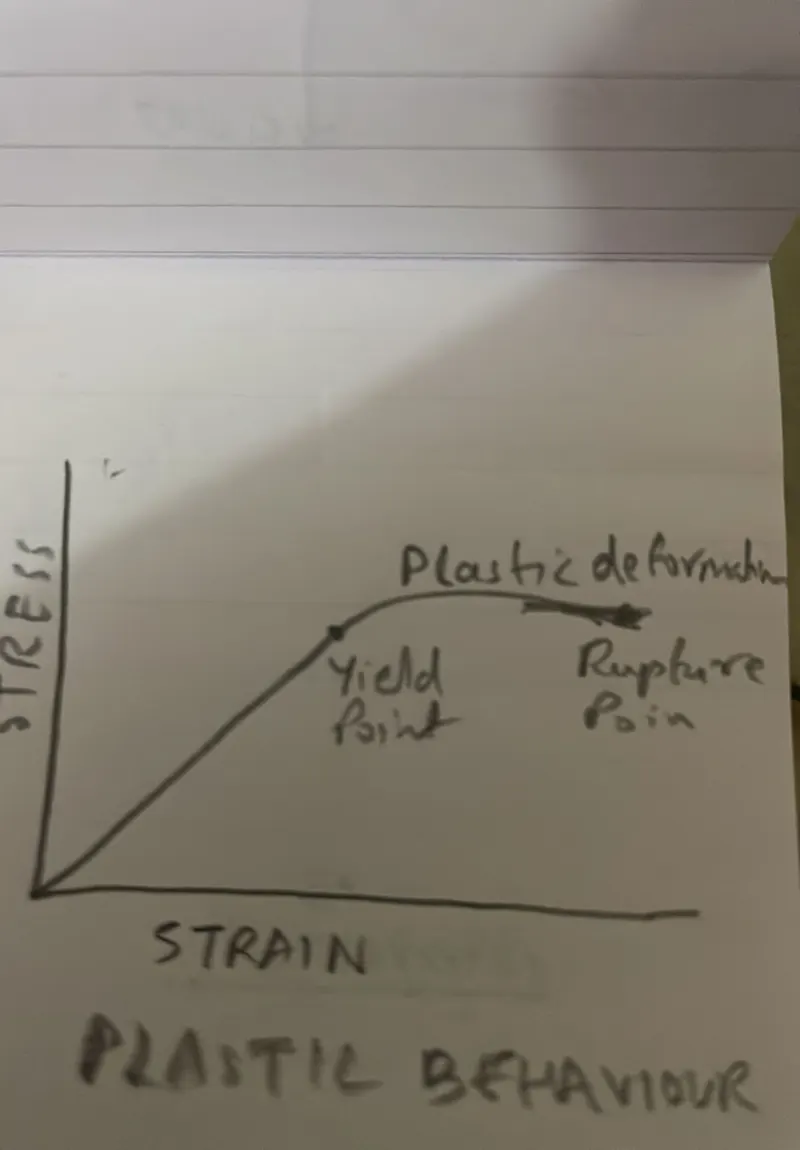
PLASTIC BEHAVIOUR: When stresses are applied beyond the elastic limit, a material exhibits plastic behaviour. The material deforms irreversibly and does not return to its original shape and size, even when the load is removed. When stress is gradually increased beyond the elastic limit, the material undergoes plastic deformation.
NONLINEAR INELASTIC BEHAVIOUR: When the material is loaded it undergoes plastic deformation and after unloading it follows different stress strain curve with permanent deformation
- Explain Mass, Stiffness & Damping components in the equation of motion (30 marks)
Ans 3. The characteristic frequency is known as the natural frequency of the system. Increasing the stiffness of the material increases the natural frequency of the system; Increasing the mass reduces the natural frequency of the system.
Damping decreases the natural frequency from its ideal value and there will be a decrease in the amplitude of the wave. The highest natural frequency is always decreased by damping, but the lower natural frequencies may either increase or decrease, depending on the form of the damping matrix.
- Provide relationship between Natural period (Tn) & Natural frequency (f) and provide their definitions (25 marks)
Ans 4. A natural frequency (f) is defined as that frequency at which a body will vibrate if excited by an external force.
Natural Period Tn of a building is the time taken by it to undergo one complete cycle of oscillation. It is an inherent property of a building controlled by its mass m and stiffness k. These three quantities are related by its units are seconds
- Explain in detail about Response spectrum & its Graph (25 marks)
Ans 5. A response spectrum is a graphical plot of the frequency of an oscillator and its damping. The response spectrum plot represents the peak or steady-state response (velocity, displacement, or acceleration) of a series of oscillators of varying natural frequency. In vibration analysis of any system, the response spectrum is very useful as the resulting plot can provide the response of any linear system with respect to its natural frequency.
In Response Spectrum Graph on X axis we plot natural period and on Y axis we plot response quantity which can be maximum displacement, velocity or acceleration.