Structural dynamics
Ans 1:
Static Analysis vs Dynamic Analysis
| Static Analysis | Dynamic Analyses |
| Variation of time on load has no effect. | Variation on load wrt time is considered. |
| Motion has no relation with instant of time, Displacement is taken as an Event instead of an activity. |
Motion is read at every instant of time, and maximum displacement/ response from a given action with constant damping system is under our consideration. |
| Many DOF can be analysed in a given frame. | Only one DOF is analysed/considered at an instant reaching its peak. |
| Inertia Force has no significance |
Originates mainly due to inertial property of mass system. |
| Damping Force did not come into effect. | Various Damping are considered, but for Mathematical simplification, Viscous damping is considered. |
| motion wrt to certain Frame of system is analysed. | Motion is analysed wrt to acc. of body relative to ground. |
-----------------------------------------------------------------------------------------------------------------------------------------------------------
Ans 2:
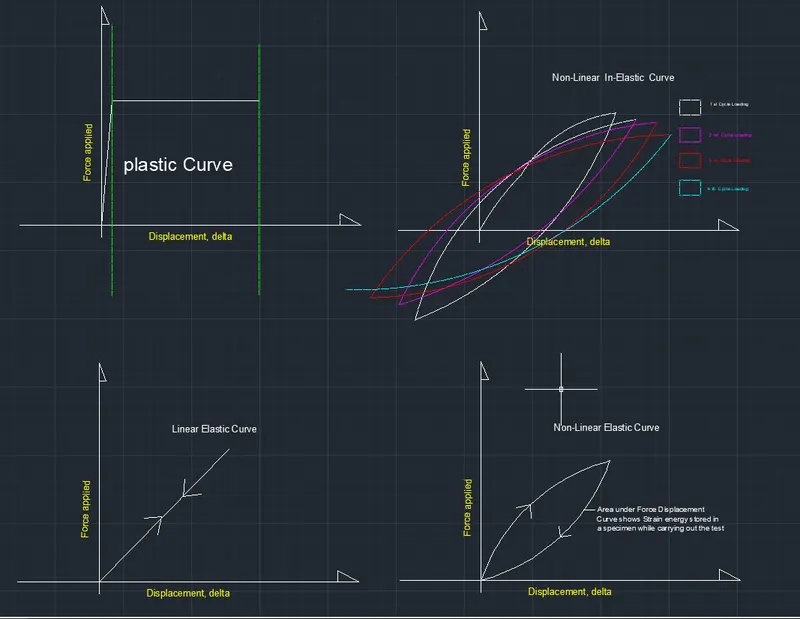
Elastic Behaviour: When the force is applied to a system, it gets stretched to certain extent. After Removal of Load, it will reach out to its original configuration irrespective of load path taken during Loading & Unloading. This Behaviour stands out to be an Elastic Behaviour.
Inelastic Behaviour: When the force is applied to a system, it get stretched to certain extent. After Removal of Load, it will not reach out to its original configuration showing some sort of deformity in its dimension called In-Elastic Behaviour.
Plastic Behaviour: When a force is applied to a system, it will reach out from the zone of Elasticity. Strength retained by an object with constant deformation in the material comes under Plasticity. it is a synonym of Ductility.
Nonlinear Behaviour: with Cyclic Loading of Force, it reach out the same deformation without going significant reduction in strength, is a desirable property for a structural component.
========================================================================================
Ans 3: Taking a one Bay Frame into consideration for understanding the concept behind the Equation of motion enclosing three components in it which includes:
- Mass Component - assumed to be concentrated at the floor level of single bay frame while Various Vertical supporting members to the Roof are considered to be Massless.
- Stiffness Component: Lateral Stiffness of the Frame are considered to be derived from the Stiffness of the Vertical members which can be easily calculated using Dimensions & Elastic Modulus of Material.
- Damping Component: Unlike the Stiffness, Damping cannot be calculated from the Configuration of a system. It is a highly complicated system to exactly simulate the magnitude & characteristic Rate of Damping component. So, in most of the cases, We are reached at its value by taking the overall effect on a model rather than its path of stress dissipation. In Elastic Cases, damping Force is directly proportional to Relative Velocity of mass wrt to its original position.
If a model is subjected to an External Force varying with Time, then this force gets resisted by above three components on two Principles
- Newton's Law of Motion (2nd law)
- De-Alembert Law
Each of the above Component get its direction of motion from Relative Displacement of Mass from its base. i.e ut'= u(g) + u
Where, ut' = Total displacement of the mass from its original position
u(g)= Displacement of the Ground
u = Relative displacement of the mass wrt its base i.e., displacement seen due to flexibility in a model
this u displacement is Pertinent Displacement for evaluating the Internal Forces generated in a frame.
=====================================================================================
Ans 4: Natural Period & Frequency are two terms used mostly to evaluate the periodic cyclic motion of a system like To- FRO motion of Pendulum, mass spring system with no damping resistance etc.
Natural Period (T) is the time taken by the particle or wave to complete its complete cycle or time taken by a particle to come in same phase from where it commences.
Natural frequency (f): No. of Cycles completed by a particle in a unit interval of time called Natural Frequency of the system.
For Example: A fan can take 1200 rotations in 60 sec, then Frequency might be 20 units per second
Time interval will be 0.05 sec to complete one cycle.
f=(1/T)
=================================================================================
Ans 5: Response Spectrum is a means of plotting maximum response quantity of a similar structures having same Degree of Freedom and Damping ratio with respect to Natural Frequency of particular system under an action of specific Ground Motion or Earthquake.
For Example: Suppose, we have 100 models each having single degree of freedom with identical damping Ratios. Each of this model is analysed with a specific action i.e. A specific Earthquake. Each model is taken in such a way that Natural Period of models are increasing in a cons equal pattern at a uniform interval.
While modelling each of the above model/Building, Peak Response Quantity which might be (Acceleration, Velocity, Displacement) of each one is noted & plotted wrt to its Natural Time Period.
Summarisation of Peak Response Quantity corresponding to Natural Time period of different model on a same graph, called Response Spectrum of Certain Quantity.
Response Spectrum can be of three types:
- Displacement Response Spectrum
- Velocity Response Spectrum
- Acceleration Response Spectrum
================================================================================