Structural dynamics
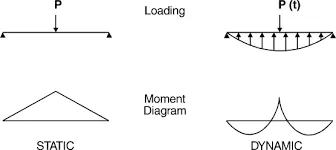
1. Differences between Static and Dynamic Analysis:
| Static Analysis | Dynamic Analysis |
| Load is constant with respect to time | Load varies with time |
| Static Problem has only one response ie., displacement. | Dynamic problem has mainly three responses, displacement, velocity and accelaration. |
| Static Problem has only one solution. | Dynamic problem has infinite number of solutions that are time dependent in nature |
| Generally it is simple analysis | Complex and time consuming analysis |
| The response can be calculated by the principle of static equilibrium | The response can be calculated by including inertial force and static equilibrium. |
2. (a) Elastic Behaviour:
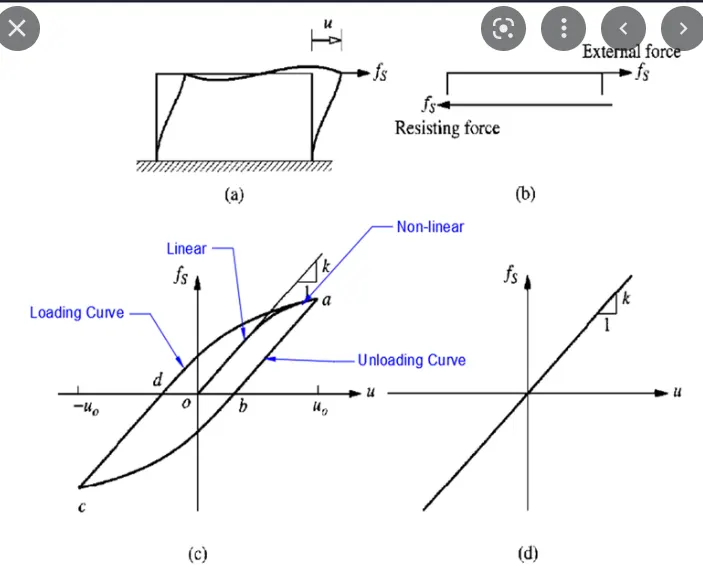
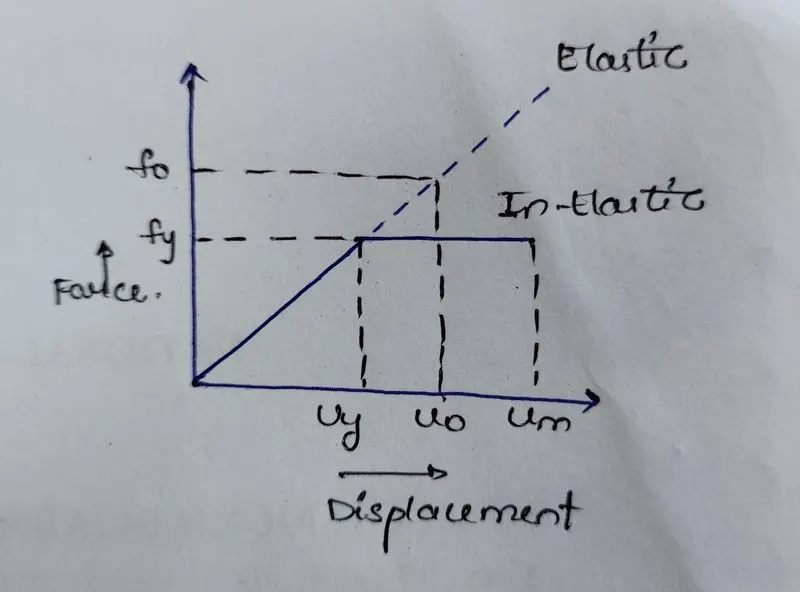
- Elasticity is the ability of a deformed material body to return to its original shape and size when the forces causing the deformation are removed.
- A body with this ability is said to behave or respond elastically.
- An Example for an Elastic Behaviour is a Rubber Band.
- It deforms with application of Force and once the force is removed it goes back to its original shape.
(b) Inelastic Behaviour:
- The In-elastic behaviour is quite opposite of the Elastic behaviour of the material or the body.
- Once the forces acting on the body are removed, even then the body remains in the deformed shape.
- Plasticity is the property of the material having Inelasticity.
(c) Plastic Behaviour:
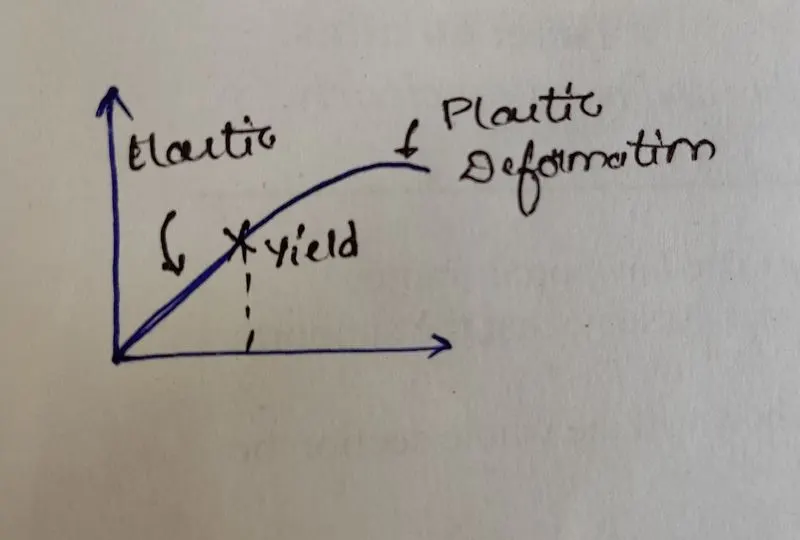
- The Plastic Behaviour of a Material or an Object is the combination of both Elastic and Inelastic deformartion of the body or the material.
- For stresses beyond the elastic limit, a material exhibits plastic behavior.
- This means the material deforms irreversibly and does not return to its original shape and size, even when the load is removed.
- When stress is gradually increased beyond the elastic limit, the material undergoes plastic deformation.
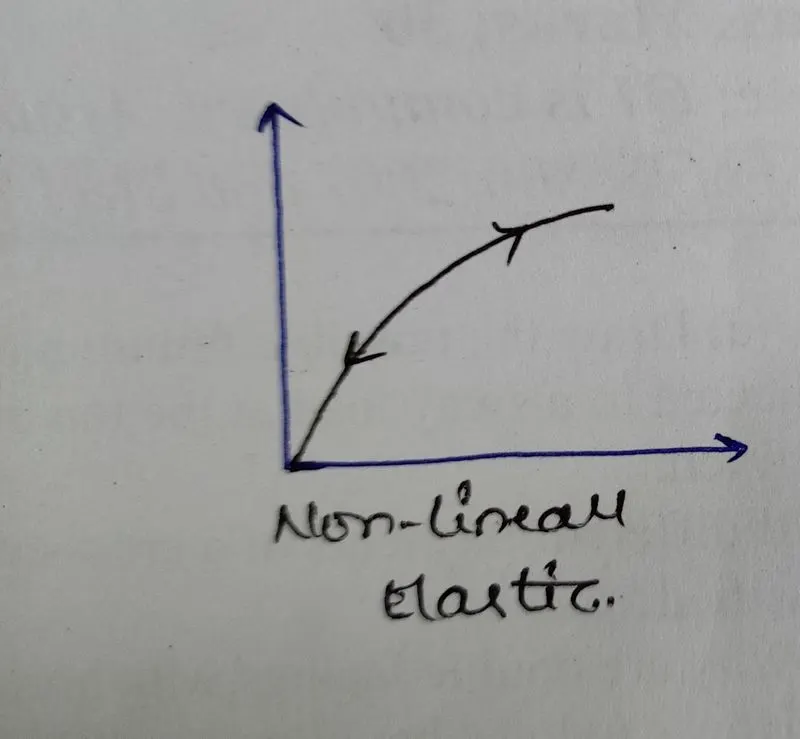
(d) Non-Linear In-Elastic Behaviour:
- It necessarily means the Body which is having an Inelastic behaviour deforms non-linearly when the forces are applied on the body.
- And after removing the forces or the loads the object fails to recover to its original position.


3. Elements of a Lumped Mass Parameter System
- Spring:
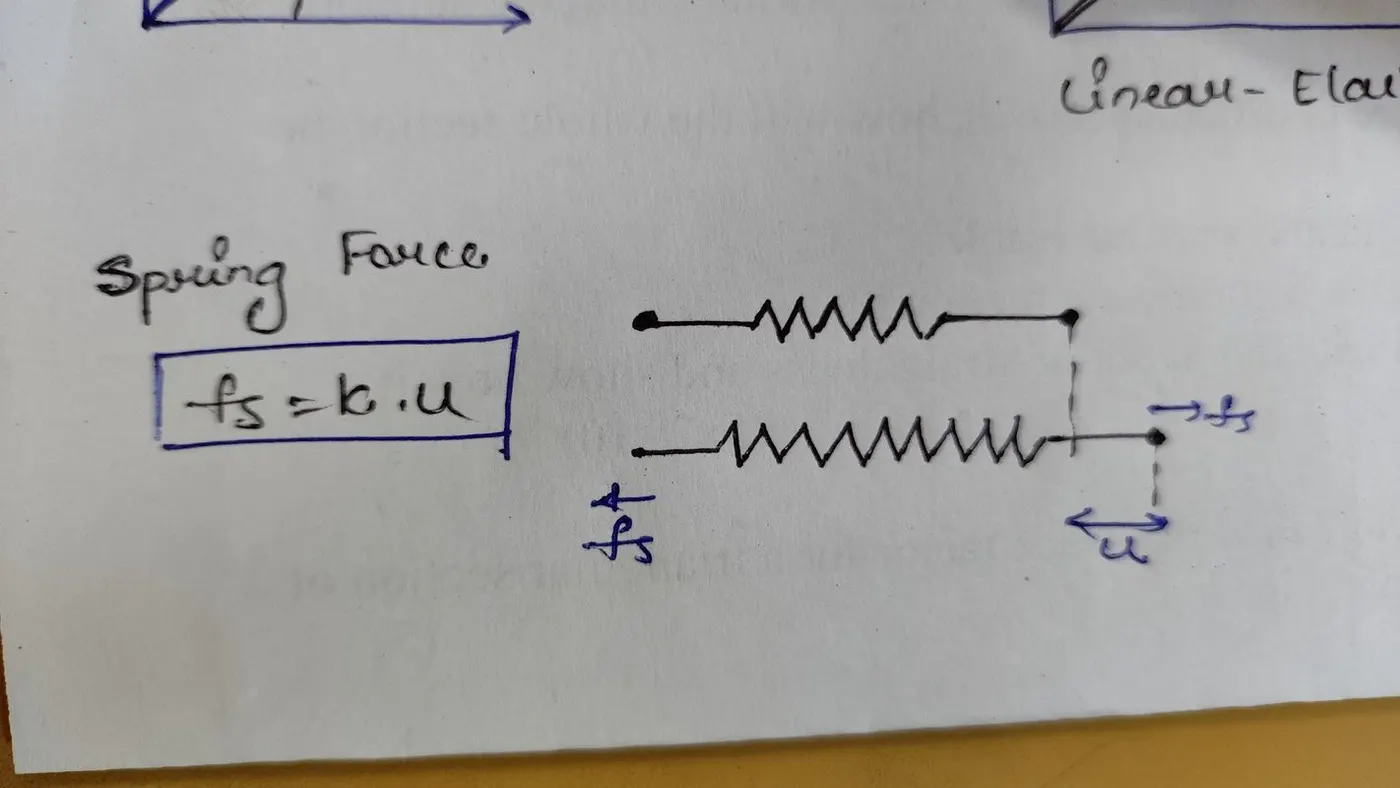
- The component which related Force to Displacement is called as Spring
- The Spring is considered to be massless i.e., the Mass of the Spring is negligible.
- Within its elastic range the spring serves as an Energy Storage Device and Energy stored in Spring during Elongation or Contraction by any displacement 'u' within elastic range is called as "Strain energy".
- Spring Force, Fs = k*u
- where, K = Stiffness of the System
- u= Displacement
- Damping Mechanism:
- As Spring is an Energy storage device there is also a means by which energy is dissiated from deforming the structure, these are called as Damping Mechanisms.
- The Damping Mechanism is gneerally a Viscous Dash Pot System.
- Most Common analytical model of Damping employed in Structural Dynamic is a Linear Viscous Dashpot Model.
- Damping Force, Fd= c*u
- where, c = Coefficient of Viscous Damping of the System
- u= Displacement
- Inertial Mass of the System:
- The system resists the displacement coming onto it which the help of inertial force.
- This inertial force is primarily due to the Weight of the System or the Object.
- The Inertial force is calculated with respect to the accelaration developed in the system.
- Inertial Force = m*a
- where, m = Mass of the System.
- a = Accelaration of the System
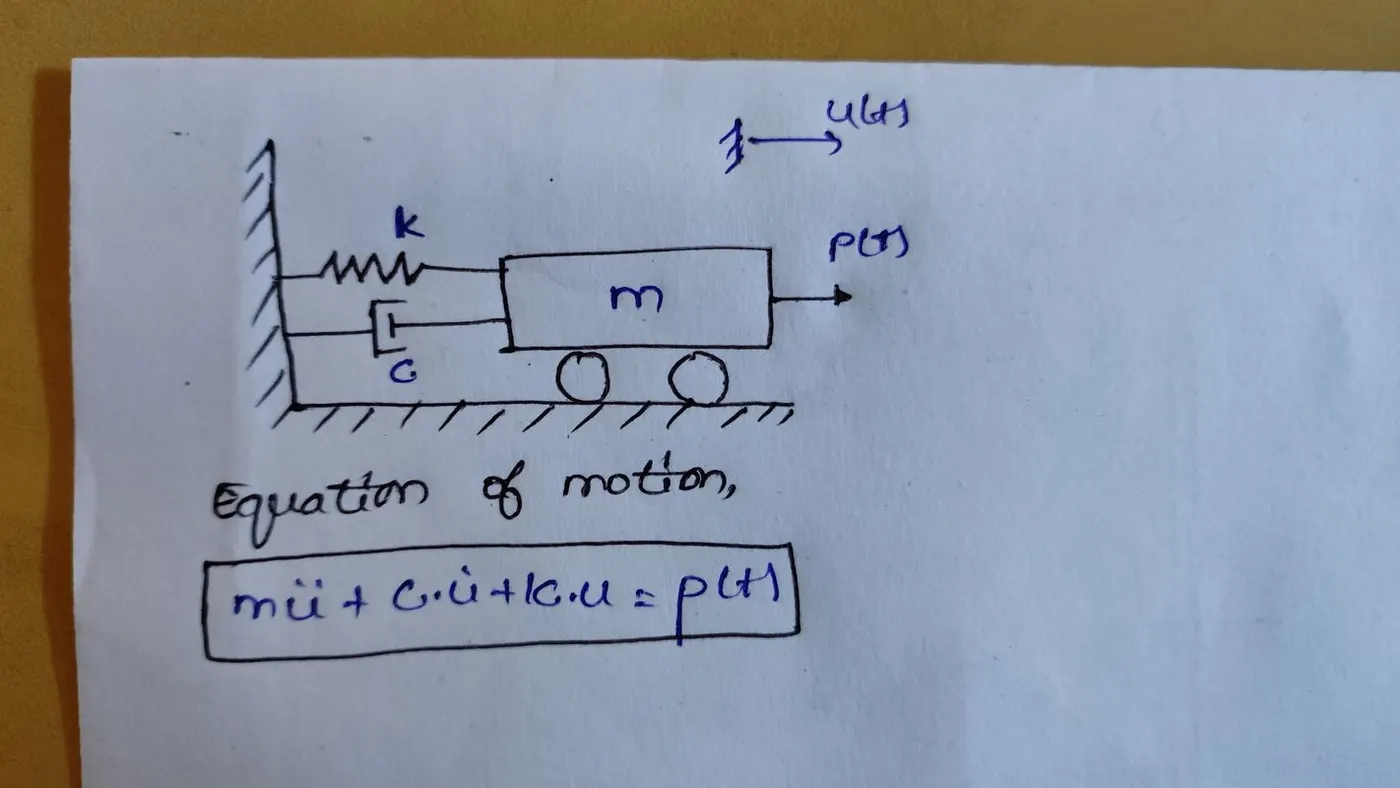
- A Spring Mass - Dashpot System is drawn for reference
4. Natural Time Period (Tn):
- The time taken for each complete cycle of oscillation i.e., one complete back-and-forth motion is the same and is called Fundamental Natural Period of the building.
- It is generally measured in Seconds, because generally the Natural Time Period of a Building varies from 1-3 seconds based on its height.
- For a Building it varies for 1-2.5 seconds. The greater the height the higher the Time period.
- For a Dam or a Bulk Structure it is about 0.5-0.75 seconds.
- The Time period will be very much higher in case of Cable Stayed Bridges.
- For Water Tanks and similar structures which have their mass concentrated at an elevation from ground have a very high Time Period.
Natural Frequency (f) :
- The natural frequency of a building is the frequency that the building sways in when it is returning to its original position after it has been excited.
- The intensity of the exciting force will affect the acceleration and speed of the building's movements, but the frequency will be same regardless to the force.
The Natural Time Period is given by Tn = 2π/ω
- Where, ω = Natural Frequency of the Structure or the Object.
- ω = √(k/m)
- k = Stiffness of the Structure
- m = Mass of the Structure
5. Response Spectrum:
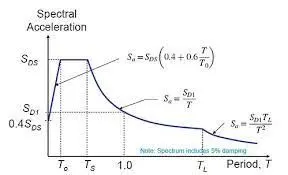
- As per the IS 1893 Code it is given as The representation of the maximum response of idealized single degree freedom systems having a certain period and damping, during earthquake ground motion.
- The Maximum response is plotted against the undamped natural period and for various damping values and can be expressed in terms of maximum absolute acceleration, maximum relative velocity or maximum relative displacement.
- A Response spectrum is a plot of the peak or steady-state response i.e., displacement, velocity or acceleration of a series of oscillators of varying Natural Frequency, that are forced into motion by the same base vibration or shock. The resulting plot can then be used to pick off the response of any Linear system, given its natural frequency of oscillation.
- Response spectra can also be used in assessing the response of linear systems with multiple modes of oscillation i.e., for a Multi-degree of freedom systems, although they are only accurate for low levels of damping.
- Modal Analysis is performed to identify the modes, and the response in that mode can be picked from the response spectrum.
- These peak responses are then combined to estimate a total response.
- A typical combination method is the Square Root of the Sum of the Squares (SRSS) if the modal frequencies are not close.