Structural dynamics
Answer To the Question No. -1
Question:
1. Differentiate Static analysis and Dynamic analysis with proper representing pictures.
Answer:
Objective: Objective of this question is to understand the difference between the Static and Dynamic analysis with the help of examples
Theory:
When load and displacements are applied very slowly. to a structure inertia forces with are equal to mass and acceleration are negligible and may be displacement as force equilibrium. So we ca neglect the variation of load and displacement with time when load apply very slowly. This corresponds to normally refers to what is as a static response to structure where force varies our time. Time variation of force with respect to time is neglected and assumed to be constant in static analysis contrast if the load and displacement are applied quickly the inertia force cannot be disregarded equilibrium equation.
three differences between static and Dynamic analysis.
- Variation of Load with time.
- Motion can not be disregarded
- two additional forces must be accounted
Inertia Forces.
Damping Forces.
Simple Structure
- Structures such as pergola and water tank
- These can be idealized as a conceptual mass 'm' supported by a massless structure with lateral stiffness 'k' in the lateral direction.
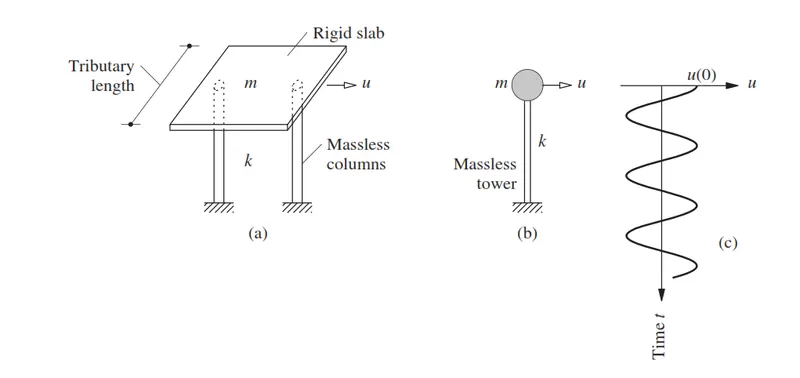
- Idealized pergola
- idealized water tank
- Free vibration due to the initial displacement
Answer To the Question No. -2
Question:2
2. Explain the following with relevant force-displacement graph.
- Elastic behavior
- Inelastic behavior
- Plastic behavior
- Non-linear Inelastic behavior
Answer:
Objective: we have to understand the relevant force displacement graph in this question.
Theory:
Elastic Behavior:
For a linear system the relationship between the lateral fs and resulting deformation u us linear, that is
`fs = ku`
where k is the lateral stiffness of the system it unit are force/ length
Consider the from below with boy width L1 height h1 elastic modiolus E11 and second moment of the cross-sectional area about the axis of bending = lb and le for beam and column respectively the column are fixed at the base.
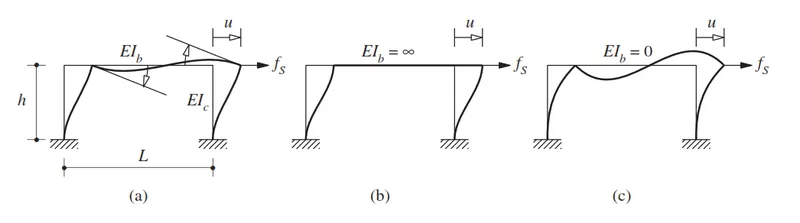
The lateral stiffness of the form can readily be determined for the two extreme cases if the beam is rigid (i.e. with flexural rigidity Elb = infinity) and for a beam with no- stiffness compute the lateral stiffness of the from with an intermediate realistic stiffness of the beam assume l= 2h and Elb = Elc =3EIch3">
Inelastic Behavior
Determined by experiments, the force–deformation relation for a structural component
undergoing cyclic deformations expected during earthquakes.
The initial loading curve is nonlinear at the larger amplitudes of deformation, and the un-
loading and reloading curves differ from the initial loading branch; such a system is said
to be inelastic. This implies that the force–deformation relation is path dependent, i.e., it
depends on whether the deformation is increasing or decreasing.
Non-Linear Inelastic behavior
Fore displacement relationship becomes non-linear and inelastic at large deformations.
Force fs corresponding to deformation is not single-valued and depends on history of deformations and whether deformations is increasing or decreasing Thus the resisting force can be Expressed as.
`fs = fs(u, v)`
Plastic Behavior of structure:
Plastic behavior known as permanent deformation after that member can not attain its original shape or position of deformation or displacement
Answer To the Question No. -3
Question:3
3. Explain Mass, Stiffness & Damping components in the equation of motion
Answer:
Objective: we have to understand the Mass, Stiffness % Damping Components in the equation of motion.
Theory:
The stiffness component- ; the frame without damping or mass , the external forces fs on the stiffness component is related to displacement by u by fs=ku if the system is linearly elastic.
`fs=ku`
The Damping component -: the frame with its damping property but no stiffness or mass the external force on the damping component is related to velocity by
`fd=cv`
The mass component = The roof mass without the stiffness or damping of the frame the external force fi on the mass component is related to acceleration by
`fi=m u`
`m u + fD +fs - m u + cu = ku = p(t)`
Answer To the Question No. -4
Question:4
4. Provide relationship between Natural period (Tn) & Natural frequency (f) and provide their definitions.
Answer:
Objective: in this Question we have to provide the relation between Natural Period and Natual frequency.
Theory:
Natural period (`tn`)-The time required for the undamped system to complete one cycle of free vibration natural period of vibration of the system, which we denote as Tn in units of sec It is related to the natural circular frequency of vibration, ωn in units of radians per second
`Tn=2π/ (ωn)`
Natuaral cyclic frequency of vibration of the system: A system executes 1/Tn cycles in 1 sec. This natural cyclic frequency of vibration is denoted by
`fn=1/ (Tn)`
The natural Vibration properties `wn, Tn , and fn` depend only on the mass and stiffness of the structure.
`k = m w^2`
Answer To the Question No. -5
Question:5
5. Explain in detail about Response spectrum & its Graph.
Answer:
Objective: we Have to explain the Responce Spectrum & its Graph in this question
Theory:
Response spectrum analysis is a method to estimate the structural response to short, nondeterministic, transient dynamic events. Examples of such events are earthquakes and shocks. Since the load's exact time history is unknown, it is difficult to perform a time-dependent analysis.
A response spectrum is a function of frequency or period, showing the peak response of a simple harmonic oscillator that is subjected to a transient event. The response spectrum is a function of the natural frequency of the oscillator and of its damping. Thus, it is not a direct representation of the frequency content of the excitation (as in a Fourier transform), but rather of the effect that the signal has on a postulated system with a single degree of freedom (SDOF)
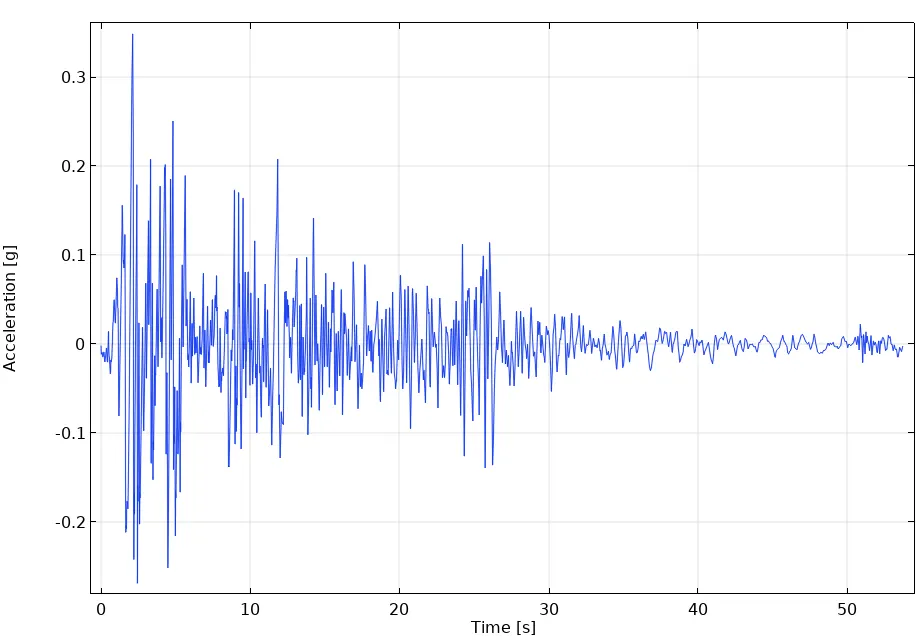
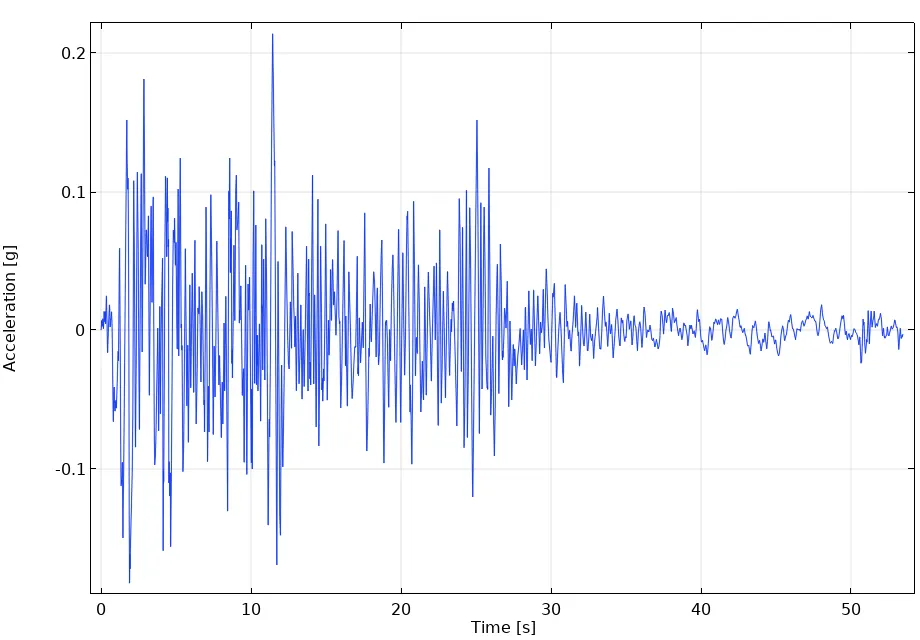
Example The El Centro Earthquake
One of the most studied earthquake recordings is that of the "El Centro" earthquake on May 18, 1940. Recorded signals (with some filtering) are shown below.