Structural dynamics
1.Static and dynamic analysis:
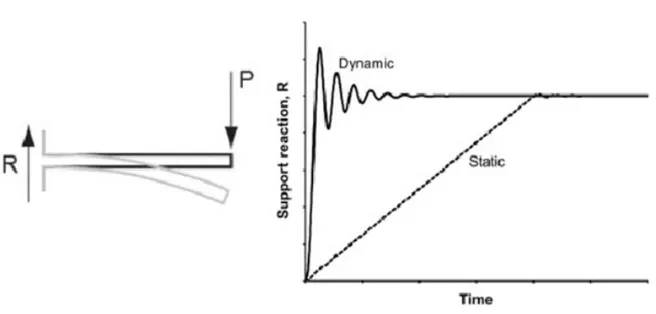
●Dynamic refers to a force on a structure that changes size,position or direction. While static refers to the force that has constant size, position and direction on or within a structure.
●In dynamic analysis,Inertia and damping forces are taken into account in equilibrium equation. And it is not considered in static analysis.
●Dynamic determines the stresses at the different points of the structure due to changing conditions over time while the static analysis determines the max. allowable load to be applied to the structure.
●Dynamic considers motion. Static doesn't vary with time but dynamic does.
2.
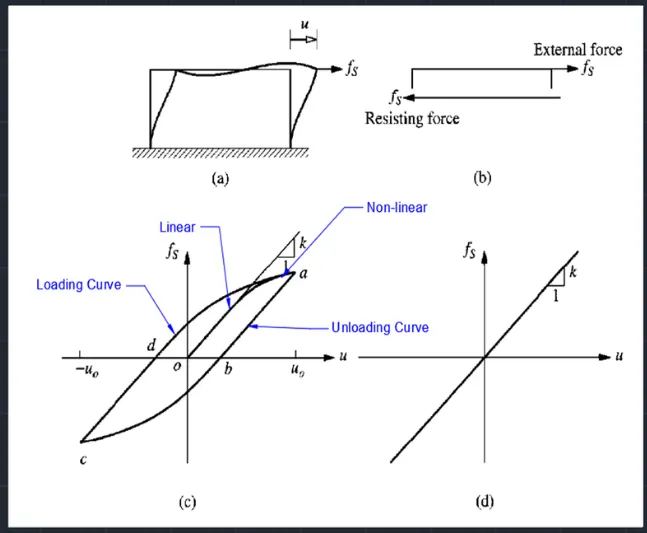
○Elastic behaviour-ability of a deformed material body to return to its original size and shape when the deformable forces are removed. This ability of a body is said to be elastical.
From the force-displacement graph at point O to a certain point, it shows linear path, hence the body shows elastic properties at certain limit with the forces applied..
○Inelastic behaviour-the material forms a deformation even after the removal of the forces applied to it. This they of material is inelastical.
From the force-displacement graph, in elastic forms a non- linear path. It is experienced by the body as soon as the path going out of the linear curve
○Plastic behaviour -a material exhibits plastic behaviour when the stress is beyond the elastic limit.In this the material deforms irreversibly and doesn't return to its original size and shape,even after the load is removed. When stress is gradually increased beyond the elastic limit,the material undergoes plastic deformation.
From the force-displacement graph,plastic behaviour corresponds to the unloading curve beyond point.
○Non-linear inelastic behaviour-in this materials have elastic behaviour only upto certain load,which is said to be 'yeild point '.
From the force-displacement graph,this behaviour occurs when the line from point O tends to bend point a .
●In dynamic analysis,Inertia and damping forces are taken into account in equilibrium equation. And it is not considered in static analysis.
●Dynamic determines the stresses at the different points of the structure due to changing conditions over time while the static analysis determines the max. allowable load to be applied to the structure.
●Dynamic considers motion. Static doesn't vary with time but dynamic does.
2.
○Elastic behaviour-ability of a deformed material body to return to its original size and shape when the deformable forces are removed. This ability of a body is said to be elastical.
From the force-displacement graph at point O to a certain point, it shows linear path, hence the body shows elastic properties at certain limit with the forces applied..
○Inelastic behaviour-the material forms a deformation even after the removal of the forces applied to it. This they of material is inelastical.
From the force-displacement graph, in elastic forms a non- linear path. It is experienced by the body as soon as the path going out of the linear curve
○Plastic behaviour -a material exhibits plastic behaviour when the stress is beyond the elastic limit.In this the material deforms irreversibly and doesn't return to its original size and shape,even after the load is removed. When stress is gradually increased beyond the elastic limit,the material undergoes plastic deformation.
From the force-displacement graph,plastic behaviour corresponds to the unloading curve beyond point.
○Non-linear inelastic behaviour-in this materials have elastic behaviour only upto certain load,which is said to be 'yeild point '.
From the force-displacement graph,this behaviour occurs when the line from point O tends to bend point a .
3.OBJECTIVE:- To explain the components of Mass, Stiffness and Damping in the equation of motion.
ANS:- A single degree of freedom system can be viewed as a combination of 3 purely independent systems
- Stiffness component
- Damping component
- Weight component
Stiffness Component:-
The term stiffness is used in earthquake engineering to refer to how well a building will withstand large lateral displacements caused by ground shaking.
Stiffness is a measure of how much force is needed to move a building a certain amount. Frame without damping or mass.
The external force fs on the stiffness component is related to the displacement u by fs=ku
If the system is linearly elastic.
Damping Component:-
Damping is the dissipation of vibrational energy in solid media and structures over time and distance.
Similar to the absorption of sound by air, damping occurs whenever there is any kind of friction that reduces motion and dissipates energy.
A frame with its damping properties, but without the stiffness or weight.
The external force acting on the damping component is related to the velocity by fd=cv.
Weight Component:-
Vertical irregularities in structures are Stiffness Irregularity, Mass Irregularity, Vertical Geometric Irregularity, Capacity Discontinuity. A. Mass Center.
Roof mass without frame stiffness or damping.
The external force f1 on the mass component is related to the acceleration fi=mu¨
mu¨+ fd + fs = p(t), which is mu¨ + cu˙ + ku = p(t)
Now an external force p(t) is applied to the entire system. So they can appear between the 3 components of the structure. That is, inertia, stiffness and damping force.
4.
OBJECTIVE: To determine the relationship between natural period and natural frequency.
ANS:-
Natural Period (Tn):-
The natural vibration of the system (Tn) is the time required for the undamped system to complete one cycle of free vibration (unit is seconds).
It refers to the natural circular frequency of vibration ωn in units of radians per second. S, Tn = 2π/ωn or ωn = 2π/Tn
Natural frequency (f):-
The number of cycles (or one complete revolution) performed by the system in one second with units in hertz. Where, fn=1/Tn
Natural oscillation properties ωn, Tn and f depend only on the weight and stiffness of the structure.
- Tn, ωn, fn (properties of natural vibrations) depend on only two quantities, which are mass and stiffness.
- ωn = sqrt(k/m), the stiffer one degree of freedom with the same mass will have a higher natural frequency and a shorter natural period.
- Natural frequency and Natural time are inversely proportional to each other.
- Similarly, the heavier of the 2 structures (or) one with more weight and if both structures have the same stiffness. The one with a heavier weight will have a lower frequency and a lower frequency and a longer natural period.
- ωn, n is natural (indicates emphasizing the natural properties of the system and when it is allowed freely without natural excitation).
- It is important to remember that an earthquake lasts for a few seconds. The movement of the earth gives way and freely vibrates the structure based on the velocity, the displacement that is applied to it. Since the system is linear, these vibration characteristics are independent of deflection and velocity.
- These properties are related to its weight and stiffness,
- The natural vibration properties ωn, Tn and fn depend only on the weight and stiffness of the structure. That is k=mw2.
- A stiffer system of 2 individual degrees of freedom with the same mass will have a shorter natural period (less time to complete one cycle) and a higher natural frequency.
- Similarly, the heavier mass of two structures with the same stiffness will have a longer natural period and a lower natural frequency. That is ωn = sqrt(k/m)..
5.Response spectrum analysis is a method to estimate the structural reaction to quick, nondeterministic, temporary dynamic occasions. Examples of such activities are earthquakes and shocks. On account that the precise time history of the weight isn't always known, it is tough to carry out a time-established evaluation. Because of the short duration of the occasion, it cannot be taken into consideration as an ergodic ("desk bound") system, so a random reaction technique is not relevant either.
The response spectrum technique is based on a unique sort of mode superposition. The concept is to provide an input that gives a limit to how tons an eigenmode having a positive herbal frequency and damping can be excited by using an occasion of this type.
The textual content below is separated into 3 components:
The definition of a reaction spectrum
Technology of a reaction spectrum from a given time records
The usage of a given reaction spectrum in a structural evaluation
In most cases, the engineer appearing a reaction spectrum evaluation is offered with a given design response spectrum, wherein case the two first parts may be taken into consideration as background cloth.
A response spectrum is a function of frequency or duration, showing the peak response of a simple harmonic oscillator this is subjected to a transient event. The reaction spectrum is a characteristic of the herbal frequency of the oscillator and of its damping. For this reason, it is not an immediate illustration of the frequency content of the excitation (as in a Fourier remodel), but alternatively of the effect that the signal has on a postulated device with a unmarried degree of freedom (SDOF).
Create a reaction Spectrum
For a positive given time records, , a reaction spectrum is created inside the following way:
Pick a frequency variety for which the spectrum ought to be generated
Pick a frequency step that determines how many points at the response spectrum have to be computed
Pick a positive damping ratio,
For each of the chosen frequencies
A. Solve Equation (1) withfor a sufficiently long term
B. Hold song of the most price ofand shop it
The equation may be solved by way of a pure numerical time stepping, but there may be better approaches of doing it. Ifis given as a number of factors in an accelerogram, then it is herbal to anticipate that the acceleration has a linear version in time between the ones points. So, for each c program languageperiod among two measurements, say fromto, the equation of motion for the oscillator is
Deformation response Spectrum:-
Right here is the paticular floor motion this is L-centro earthquake.
The reaction evolved for L-centro earthquake as proven.
Now, the time version of the deformation brought on inside the ground motion in 2 specific single degree of freedom system is provided.
Each unmarried degree of freedom as its very own period of vibrations this is Tn=1sec and Tn=2sec. And the damping ratio kept regular.
Every of the single degre freedom device subjected this earthquake. This is the displacement history that we obtain.
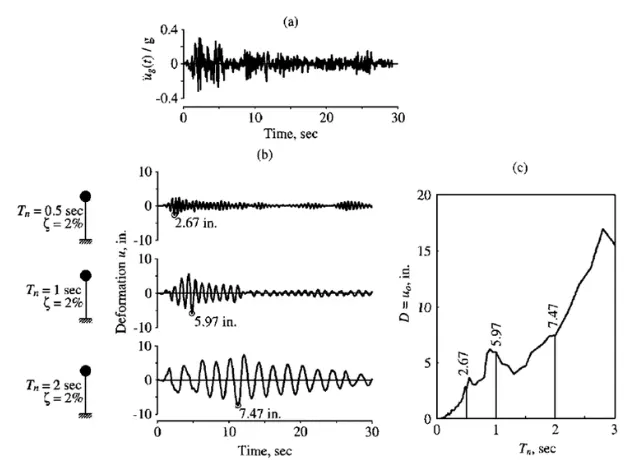
The first peak deformation we attain is two.67 inch for Tn=zero.5sec and Շ = 2%
Second top deformation we obtain is 5.97 inches for Tn=1sec and Շ = 2%
The third height deformation we gain is 7.47 inches for Tn=2sec and Շ = 2%
In x-axis, it indicates the herbal length of vibration and y-axis top displacement.
Now, to decide the peak deformation value, repeat the process once more and compute displacement for natural period vibration.
For a variety of single degree of freedom gadget with one of a kind duration of vibration maintain the damping ratio as constant.
For purchasing the peak duration of vibration that is displacement from the response spectrum curve. That deformation can be increased by using stiffness to get equivalent static pressure.
From there we are able to do easy structural analysis to obtain the bending moment and shear pressure within the shape.
Pseudo-Acceleration response Spectrum:-
Pseudo acceleration for an unmarried diploma od freedom device with natural frequency ωn is associated with its peak deformation D = uo, because of earthquake floor movement:
The response spectrum technique is based on a unique sort of mode superposition. The concept is to provide an input that gives a limit to how tons an eigenmode having a positive herbal frequency and damping can be excited by using an occasion of this type.
The textual content below is separated into 3 components:
The definition of a reaction spectrum
Technology of a reaction spectrum from a given time records
The usage of a given reaction spectrum in a structural evaluation
In most cases, the engineer appearing a reaction spectrum evaluation is offered with a given design response spectrum, wherein case the two first parts may be taken into consideration as background cloth.
A response spectrum is a function of frequency or duration, showing the peak response of a simple harmonic oscillator this is subjected to a transient event. The reaction spectrum is a characteristic of the herbal frequency of the oscillator and of its damping. For this reason, it is not an immediate illustration of the frequency content of the excitation (as in a Fourier remodel), but alternatively of the effect that the signal has on a postulated device with a unmarried degree of freedom (SDOF).
Create a reaction Spectrum
For a positive given time records, , a reaction spectrum is created inside the following way:
Pick a frequency variety for which the spectrum ought to be generated
Pick a frequency step that determines how many points at the response spectrum have to be computed
Pick a positive damping ratio,
For each of the chosen frequencies
A. Solve Equation (1) withfor a sufficiently long term
B. Hold song of the most price ofand shop it
The equation may be solved by way of a pure numerical time stepping, but there may be better approaches of doing it. Ifis given as a number of factors in an accelerogram, then it is herbal to anticipate that the acceleration has a linear version in time between the ones points. So, for each c program languageperiod among two measurements, say fromto, the equation of motion for the oscillator is
Deformation response Spectrum:-
Right here is the paticular floor motion this is L-centro earthquake.
The reaction evolved for L-centro earthquake as proven.
Now, the time version of the deformation brought on inside the ground motion in 2 specific single degree of freedom system is provided.
Each unmarried degree of freedom as its very own period of vibrations this is Tn=1sec and Tn=2sec. And the damping ratio kept regular.
Every of the single degre freedom device subjected this earthquake. This is the displacement history that we obtain.
The first peak deformation we attain is two.67 inch for Tn=zero.5sec and Շ = 2%
Second top deformation we obtain is 5.97 inches for Tn=1sec and Շ = 2%
The third height deformation we gain is 7.47 inches for Tn=2sec and Շ = 2%
In x-axis, it indicates the herbal length of vibration and y-axis top displacement.
Now, to decide the peak deformation value, repeat the process once more and compute displacement for natural period vibration.
For a variety of single degree of freedom gadget with one of a kind duration of vibration maintain the damping ratio as constant.
For purchasing the peak duration of vibration that is displacement from the response spectrum curve. That deformation can be increased by using stiffness to get equivalent static pressure.
From there we are able to do easy structural analysis to obtain the bending moment and shear pressure within the shape.
Pseudo-Acceleration response Spectrum:-
Pseudo acceleration for an unmarried diploma od freedom device with natural frequency ωn is associated with its peak deformation D = uo, because of earthquake floor movement:
A = (ωn^2) * D = ((2π/Tn)^2) * D.
The amount A has units of acceleration and is associated with the height price of base shear Vbo (simply some other name for the height price of the equivalent static force fso):
The amount A has units of acceleration and is associated with the height price of base shear Vbo (simply some other name for the height price of the equivalent static force fso):
Vbo = fso = mA (or) Vbo = (A/g)*ω.
A(t) is referred to as pseudo acceleration and can be easily obtained by multiplying deformation at each immediately of time with ωn^2 = ((2π/Tn)^2).
Maximum codes global are force-based values associated with top acceleration are referred to within the code and those values can be without problems elevated through the mass of the structure to obtain the equivalent static force.
Whilst equal static force is expressed within the form of deformation.
The stiffness of the gadget is to be calculated and it may be a arduous venture.
A(t) is referred to as pseudo acceleration and can be easily obtained by multiplying deformation at each immediately of time with ωn^2 = ((2π/Tn)^2).
Maximum codes global are force-based values associated with top acceleration are referred to within the code and those values can be without problems elevated through the mass of the structure to obtain the equivalent static force.
Whilst equal static force is expressed within the form of deformation.
The stiffness of the gadget is to be calculated and it may be a arduous venture.