Structural dynamics
CHALLENGE 02
1.
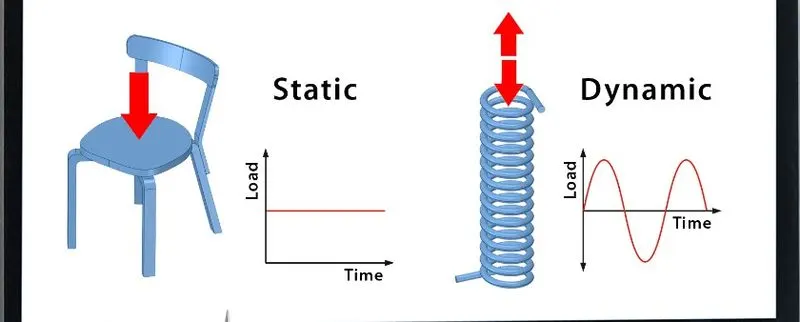
Static Analysis:
- It is in linear state and does not vary with time.
- It does not depend on time.
- Static force does not change in size, position or direction.
- In this inertia forces are produced due to their masses.
- Example: Hydraulic lifting cranes, stone on ground, etc.
Dynamic Analysis:
- It is acts as a non linear and does vary with time.
- It is depend on time.
- Dynamic forces change in either size, postitin or direction.
- In this inertia forces are considerd in the analysis.
- Example:Earthquake, moving car, hammering a metal, etc.
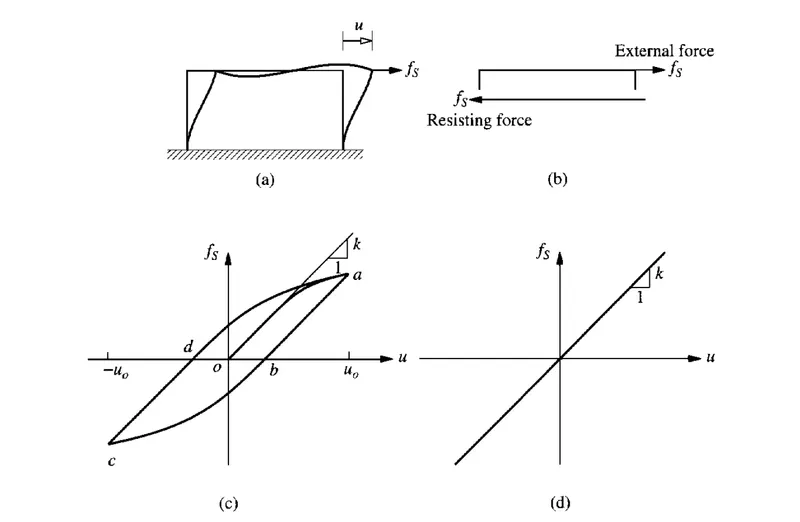
2. Explain the following with relevant force-displacement graph.
- Elastic behavior
- Inelastic behavior
- Plastic behavior
- Non-linear Inelastic behavior
Elastic behaviour:
Elastic behaviour is the property of the material upto which the material can retain it's shape. From the aforementioned graph it is clearly mentioned that upto a certain point from "O" the graph is linear and shown its elastic properties.
Inelastic behaviour:
Inelastic behaviour is the property of the material when the material can't retain it's previous shape after a certain deformation. In the aforementioned graph inelastic behavior has been shown in the upper shape of the curve upto point "a".
Plastic behaviour:
Plastic behavior occurs when the material completely lost it's ductility. In the above mentioned graph plastic behavior occurs during unloading after point "a".
Non-linear inelastic behaviour:
Non-linear inelastic behavior occurs after the line from "O" tends to bend towards point "a".
3. Explain Mass, Stiffness & Damping components in the equation of motion.
Stiffness component:
The frame without damping or mass. The external force fs on the stiffness component is related to displacement u by fs = ku, if the system is linearly elastic.
Damping component:
The frame with its damping property with no stiffness or mass. The external force on the damping component is related to velocity by fd=cv
Mass component:
The roof mass without the stiffness or damping of the frame. The external force fi on the mass component is related to the acceleration by fi = mü
mü + fD + fs = p(t) → mü + cὺ + ku = p(t)
4. Provide relationship between Natural period (Tn) & Natural frequency (f) and provide their definitions
Natural period of vibration (Tn):
The time required for the undamped system to complete one cycle of free vibration (unit is seconds). It is related to the natural circular frequence of vibration, Wn, in units of radian per second.
Tn = 2π/ωn or ωn = 2π/Tn
Natural cyclic frequency (f):
The number of cycles (or one complete revolution) executed by system in 1 second (unit in hertz).
fn = 1/Tn
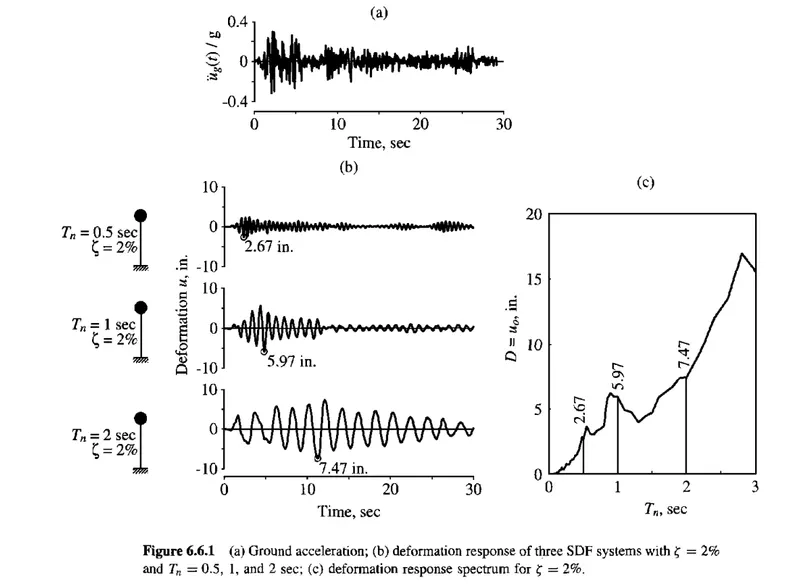
5. Explain in detail about Response spectrum & its Graph.
- It is a central concept in earthquake engineering, responce spectrum is a parctical means of characterizing ground motions and their effects on structures of different Tn.
- It provides a convenient means to summarize the peak response of all possible linear SDF systems to a particular component of ground motion.
- It also provides a particular approach to apply the knowledge of structural dynamics to the design of structures and development of lateral force requirements in building codes.
- A plot of the peak value of a response quantity (u,v and a) as a function of the natural vibration period Tn of the system, is called the response spectrum for that quantity.
- Each such plot is for SDF systems having a fixed damping ratio ᶗ and several such plots for different values of ᶗ are included to cover the range of damping values encountered in actual structures.
- The response spectrum can be of 3 types, The deformation response spectrum is a plot of peak u, against Tn for fixed ᶗ. A similar plot for peak ὺ, is the relative velocity response spectrum, and for peak üT, is the acceleration response spectrum.