Steady Vs Unsteady flow over a cylinder
STUDY OF THE VORTEX SHEDDING PHENOMENOM
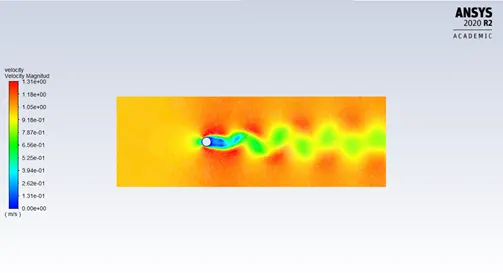
In fluid dynamics, vortex shedding is an oscillating flow that takes place when a fluid such as air or water flows past a bluff body at certain velocities, depending on the size and shape of the body. In this flow, vortices are created at the back of the body and detach periodically from either side of the body forming a Von Kármán vortex street. The fluid flow past the object creates alternating low-pressure vortices on the downstream side of the object. The object will tend to move toward the low-pressure zone.

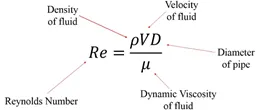
Reynolds Number
The Reynolds number (Re) helps predict flow patterns in different fluid flow situations. At low Reynolds numbers, flows tend to be dominated by laminar flow, while at high Reynolds numbers flows tend to be turbulent.
Strouhal Number
The frequency at which vortex shedding takes place for an infinite cylinder is related to the Strouhal number by the following equation:
Where St is the dimensionless Strouhal number, f is the vortex shedding frequency, D is the diameter of the cylinder and V is the flow velocity
The Strouhal number depends on the Reynolds number but a value of 0.22 is commonly used. Over four orders of magnitude in Reynolds number, from 100 to 100000, the Strouhal number varies only between 0.18 and 0.22.

Part I
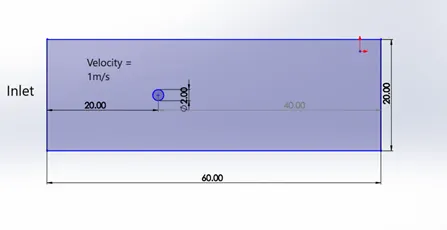
Simulate the flow with the steady and unsteady case and calculate the Strouhal Number for Re= 100.
Computational Domain
Mesh Details
|
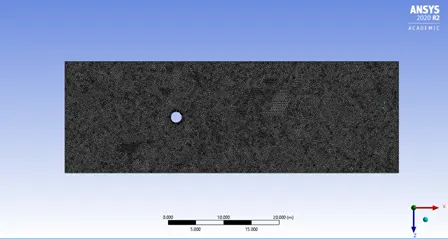
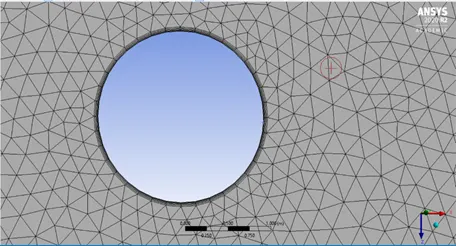
Meshing Element Geometry |
Triangular |
|
Element Size |
0.25 m |
|
Sizing Method |
Automatic |
|
First layer height |
5e-3 |
|
No of layers |
6 |
|
Growth Rate |
1.2 |
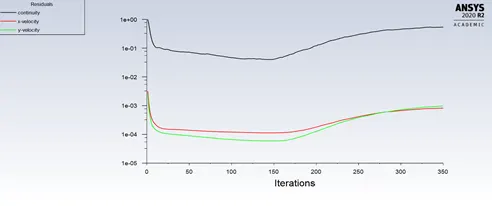
STEADY FLOW
|
Plots |
|
|
Residual Plot |
|
|
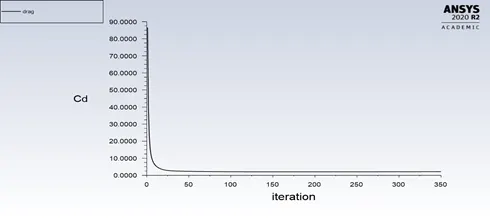
Drag Coefficient |
 |
|
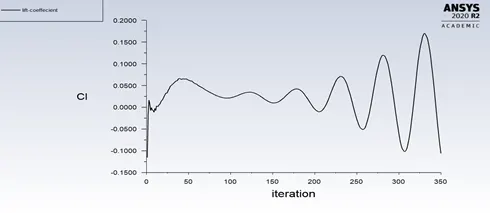
Lift Coefficient |
 |
|
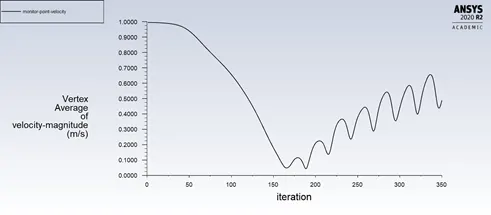
Vertex Average Velocity |
 |
|
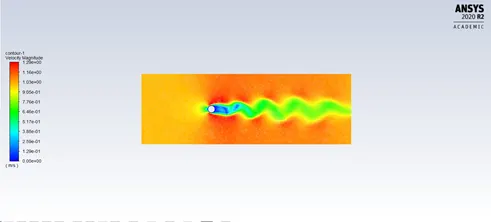
Contour Plot |
 |
UNSTEADY FLOW
|
Plots |
|
|
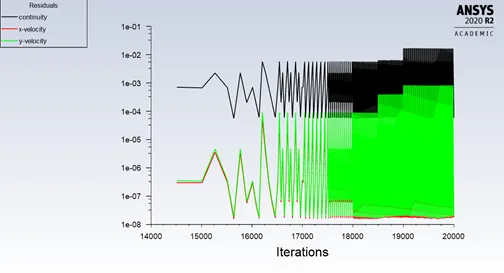
Residual Plots |
 |
|
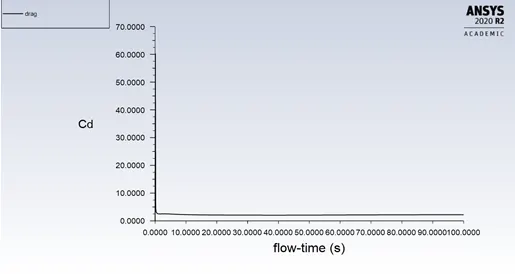
Drag Coefficient |
 |
|
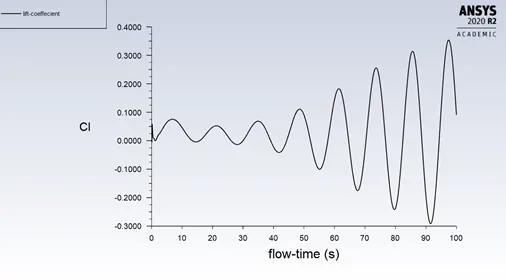
Lift Coefficient |
 |
|
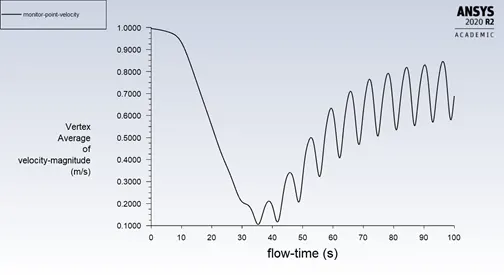
Vertex Average Velocity |
 |
|
Contour Plot |
|
Calculation of Strouhal Number
A Fourier transform is plotted. The file was transferred to Microsoft Excel and the vortex shedding frequency(f) was found.
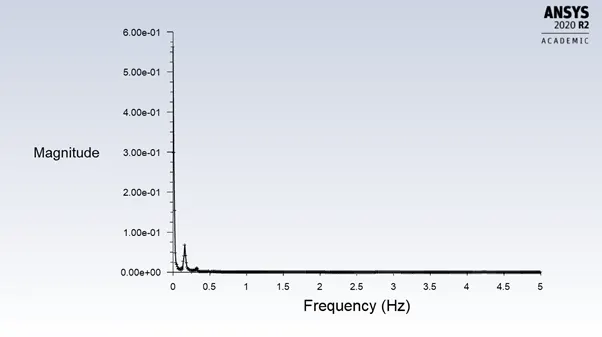
Vortex shedding frequency was found to have a value f=0.125
Substituting in the equation of Strouhal number
We obtain St= 0.25
Therefore, Strouhal Number= 0.25

PART II
Studying different steady flows by varying Reynolds number
The following study involves comparing different steady flows by varying the inlet velocity which in turn varies the Reynolds number.
Material Details
|
Material Used |
Air |
|
Density |
1kg/m^3 |
|
Viscosity |
0.02kg/ms |
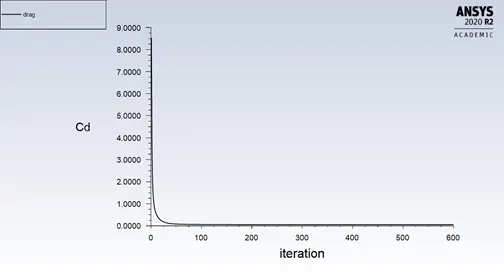
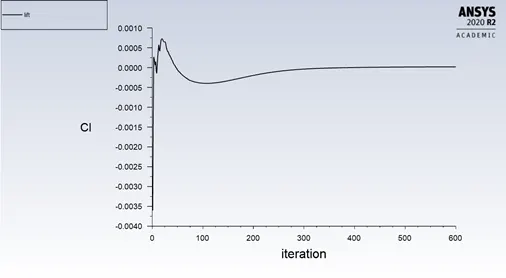
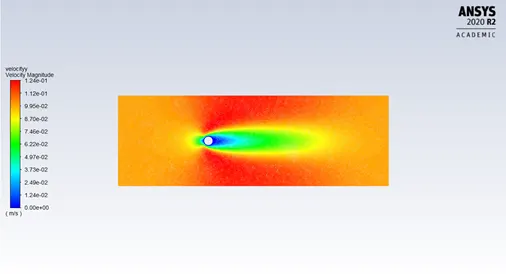
Case 1(Reynolds number=10)
The inlet velocity is set to 0.1m/s
No of iterations=600
Results
|
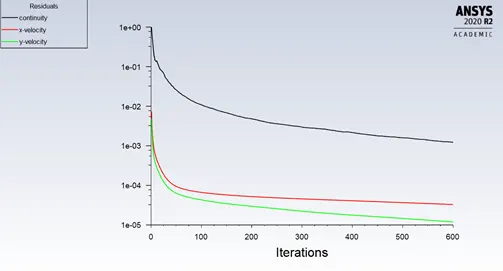
Residuals |
 |
|
Coefficient of Drag |
 |
|
Coefficient of Lift |
 |
|
Contour Plot |
 |
Clearly, from the residuals plot the steady flow can be observed to be converged.
No vortex shedding is observed in this case.
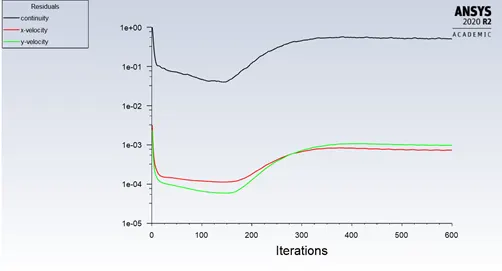
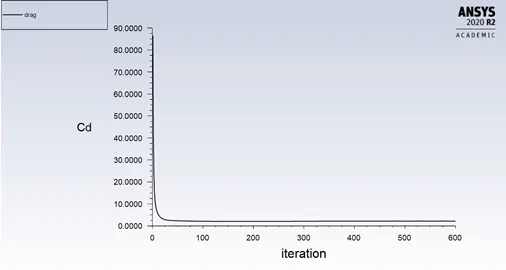
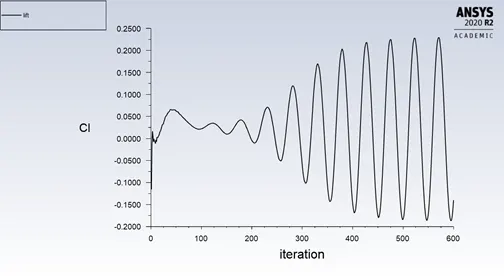
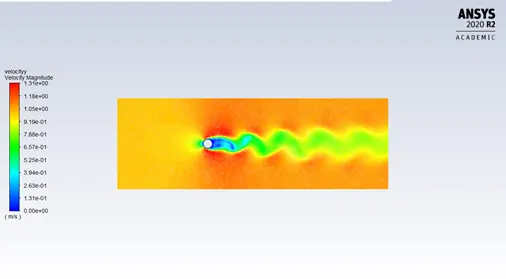
Case 2(Reynolds number=100)
The inlet velocity is set to 1m/s
No of iterations=600
|
Residuals |
 |
|
Coefficient of Drag |
 |
|
Coefficient of lift |
 |
|
Contour Plot |
 |
Clearly, from the residuals plot the steady flow can be observed to be converged.
Vortex shedding can be observed in the contour plot
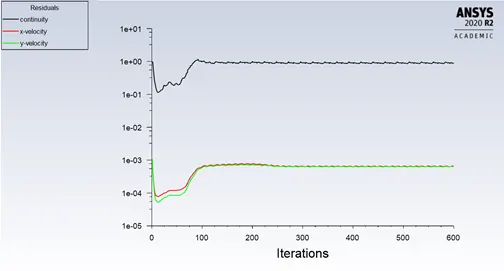
Case 3(Reynolds number=1000)
The inlet velocity is set to 10m/s
No of iterations=600
|
Residuals |
 |
|
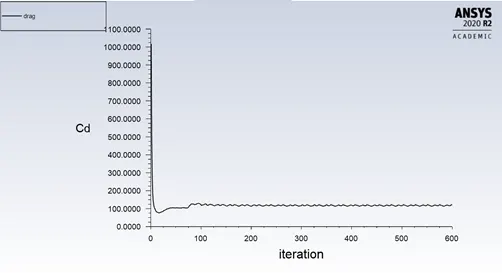
Coefficient of drag |
 |
|
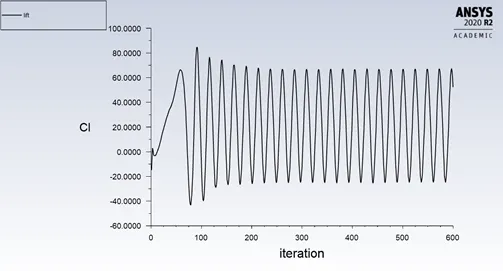
Coefficient of lift |
 |
|
Contour Plot |
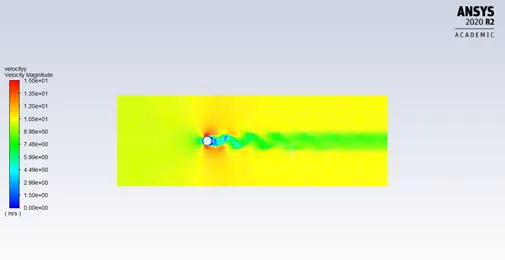 |
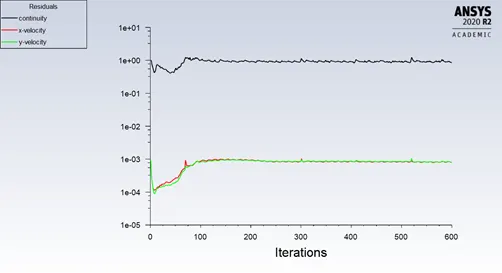
Clearly, from the residuals plot the steady flow can be observed to be converged
Case 4(Reynolds number=10000)
The inlet velocity is set to 100m/s
No of iterations=600
|
Residuals |
 |
|
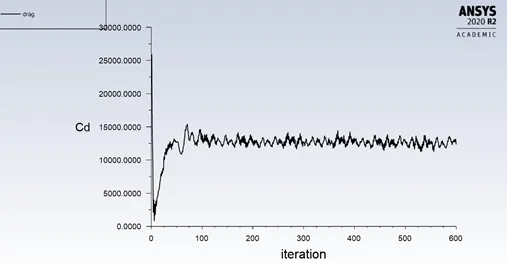
Coefficient of drag |
 |
|
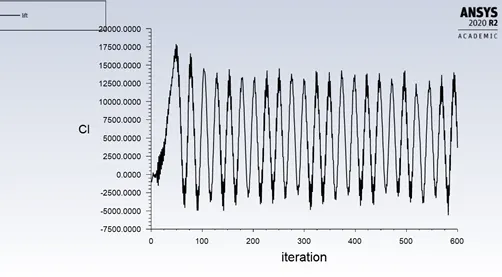
Coefficient of lift |
 |
|
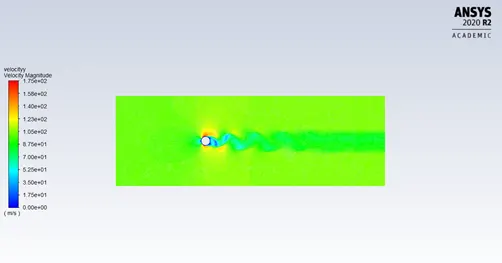
Contour Plot |
 |
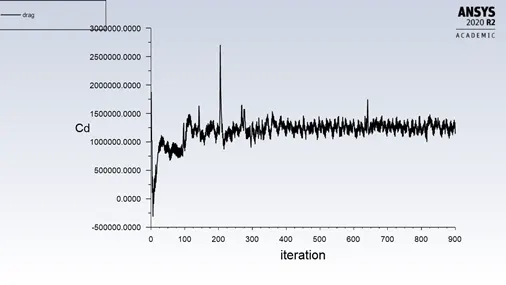
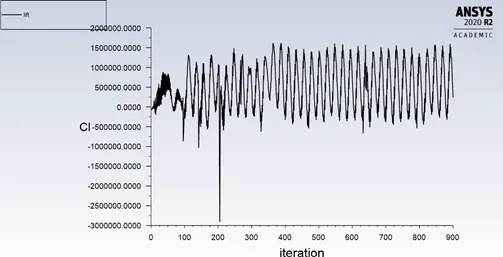
Case 5(Reynolds number=100000)
The inlet velocity is set to 1000m/s
No of iterations=900
|
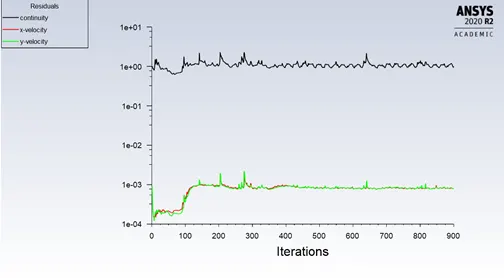
Residuals |
 |
|
Coefficient of drag |
 |
|
Coefficient of lift |
 |
|
Contour Plot |
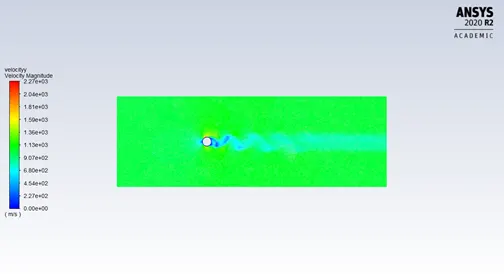 |
Clearly, from the residuals plot the steady flow can be observed to be converged
Calculation of Drag and Lift Coefficients
Drag Coefficient
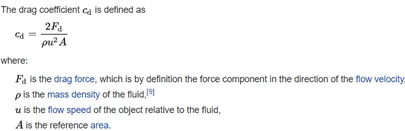
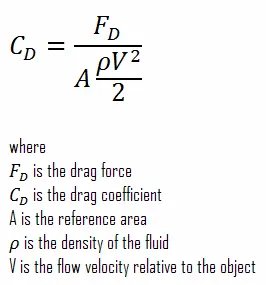
In fluid dynamics, the drag coefficient is a dimensionless quantity that is used to quantify the drag or resistance of an object in a fluid environment, such as air or water. It is used in the drag equation in which a lower drag coefficient indicates the object will have less aerodynamic or hydrodynamic drag. The drag coefficient is always associated with a particular surface area.
|
Reynolds Number |
Value of Drag Coefficient |
|
10 |
0.037 |
|
100 |
0.212 |
|
1000 |
0.117 |
|
10000 |
0.116 |
|
100000 |
0.120 |
Lift Coefficient
The lift coefficient (CL) is a dimensionless coefficient that relates the lift generated by a lifting body to the fluid density around the body, the fluid velocity and an associated reference area. A lifting body is a foil or a complete foil-bearing body such as a fixed-wing aircraft. CL is a function of the angle of the body to the flow, its Reynolds number and its Mach number. The section lift coefficient cl refers to the dynamic lift characteristics of a two-dimensional foil section, with the reference area replaced by the foil chord.
|
Reynolds Number |
Lift Coefficient |
|
10 |
0.000016 |
|
100 |
0.00012 |
|
1000 |
0.0404 |
|
10000 |
0.040 |
|
100000 |
0.09 |
Conclusion
It is observed that the coefficient of drag is low at low Reynolds numbers and high at high Reynolds number.
The drag coefficient decreases at low Reynolds numbers because the flow is in a regime called creeping flow. That is, the inertial forces are negligible. In this region, the Reynolds number is not all that great of a parameter for the drag coefficient because the governing equations are independent of the Reynolds number. Despite this, it is possible to analytically find the drag coefficient at very low Reynolds number to be Cd∝1Re. Once the drag coefficient levels off, the flow is now in the laminar region with significant inertial effects.
The drag coefficient rises again as more and more of the cylinder has a turbulent boundary layer. Turbulent boundary layers have a higher skin friction coefficient than their laminar counterparts. If the plot would go to higher Reynolds numbers, the drag coefficient would level off and then eventually probably decline again.
Preferred materials
Materials like carbon epoxy enhances smooth flow and can be used.