Sketch a G+1 residential plan according to Vaastu Shastra and Calculation of Loads as per IS code
1) Sketch a G+1 floor residential plan, according to Vaastu Shastra, and list down the names of the structural drawings required to be provided to the site for construction.
Also, assume the sizes of the structural elements (Column, Beam, Slab, etc.,) and accordingly calculate the individual corresponding loads from the members as per IS code.
Ans :
Intruduction :
Vastu Shastra- an inquisitive science of architecture encapsulates the forces which act upon a given space through flow of positive energy. Vastu refers to 'abode' or mansion and Shastra or Vidya means science or knowledge, so vastu vidya is the sacred holistic science pertaining to designing and building of houses. The principles of vastu have been derived from Sthapathya Veda- one of the ancient sacred books in Hinduism.
Vastu Shastra originated in India thousands of years ago. This can be translated as the science of architecture and is the ancient Indian science of creating a suitable framework. Vastu Shastra combines science, astronomy, astrology, and art to make our lives peaceful and secure.
Vastu Vidya’s text is part of Vastu Shastra. Vastu Vidya incorporates knowledge and ideas, sometimes with the support of layout drawings. These ideas are models for building space within a building or a collection of buildings. These ideas are aimed at integrating architecture with nature.
The principles of science in ancient days were based on the impact of the solar rays of different times of the day. To achieve accuracy, the observations made are noted below and corrected. Thus, Vastu Shastra is the most important science in India.
It has its own importance in civil constructions where anengineer should know about it.Vastu the word is an ancient method where the ancientengineer vishwakarma used it in all types of constructionslike forts, temples and old historical monuments.
It is interplay of various forces which are involved in solarsystem like land, wind, water, fire and sky.It is an ancient construction science which is covers thetheory of architectural works and also the philosophy.It is based upon various energies with are present in thisatmosphere like sun energy, earth energy, magnetic energy,wind energy, light energy, thermal energy and cosmic energy.
Utilizing of these types of energies in the construction itgive the best positive result.Vastu can be considered for single room in the entire building. The correct combination of vastu rooms gives the positive result to the entire house or building. Not only for buildings, vastu can be considered for everycity planning, house, temple, industries, towns etc.Vastu is the only this which depends up the sun light and airflow of the environment system. To start consideration ofvastu we need to find the North direction for the reference point because north is considered as auspicious since ofmagnetic line of forced moves for north to south.
Basic principles of Vastu Shastra :-
- Shape :-
Rooms should be preferably be square or rectangle.
- Room Basics :-
Rooms should be airy, well lit, bright and clean.
- Home center :-
Centre of the house should be an empty space.
- Stairs and Furniture :-
Heavy furniture should be kept in the south-west direction.
- Water :-
Avoid keeping plants and water features in the bedroom.
- Dining Table :-
Dining space should be near the kitchen and not near the main door.
- Mirror placement :-
Mirror facing the bed is strictly not allowed. Mirrors in the bedroom need to be placed in such a way that the bed cannot be seen.
Vastu is a part of civil engineering as the ancient engineerVishwakarma words it is said that the vastu is used in every part of civil structure, and it has no expire date Noe a days civil engineer are particular about the construction as per vastu. In civil engineering point of view vastu helps the engineer toshow the proper direction of doors, windows, bed directions, bedroom design, interior and entrance.All living beings in this universe is moulded by nature with5 elements like earth , water, fire air and sky and theseelements should be balanced for a harmonium to live in. It isa science of architectural in construction balancing all thesefive elements for good health and prospects of wealth of anyliving being. It also helps to give information about the house or buildingfacing. The change in direction gives the change in vastu forthe building or house.
Auspicious directions as per Vastu Shastra :-
- Kitchen :-
South-east is the best direction fo kitchen.
North-east to be avoided.
- Staircase :-
South-west is the best for stairs.
North-east to be avoided.
- Toilet :-
North-west is the best.
North-east to be avoided.
- Master Bedroom :-
South-west is the best.
- Guest Room :-
North-west is the best.
- Living Room :-
North-west is the best.
- Over Head Tanks :-
West is the best.
- Under ground Tanks :-
North-east is the best.
South-west to be avoided.
Aim : To Sketch a G+1 floor residential plan, according to Vaastu Shastra, and list down the names of the structural drawings required to be provided to the site for construction.
Calculation :
A. Ground Floor Plan:
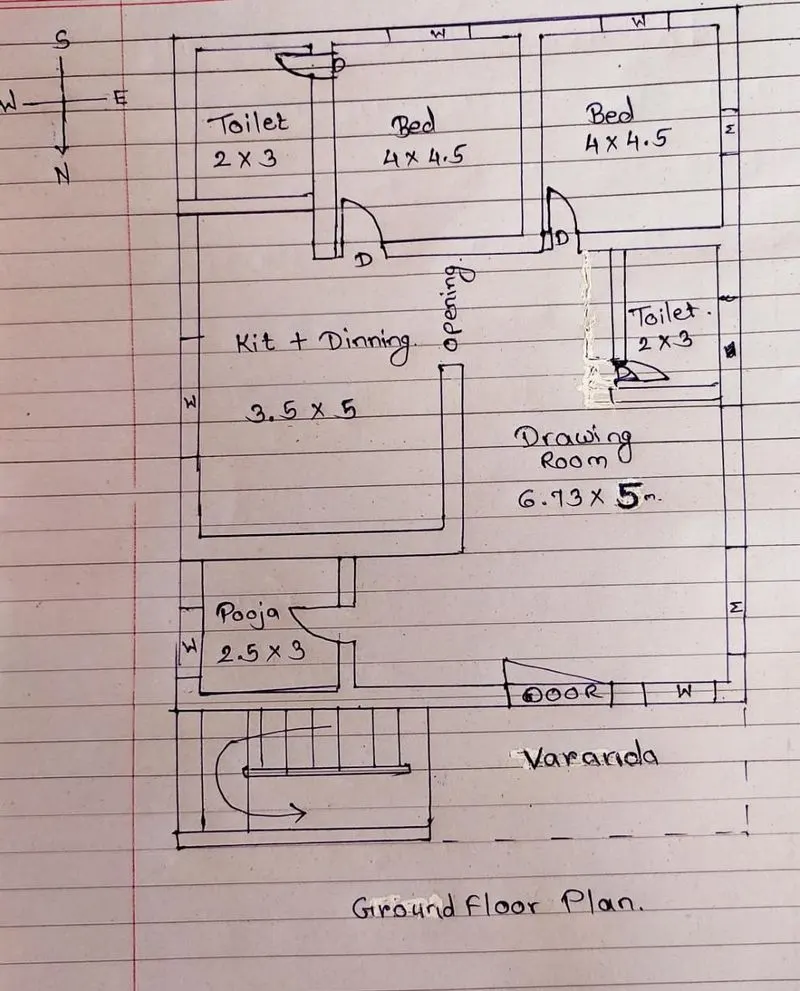
Diamension of Ground Floor Plan:
Drawing Room : 6.73 m x 5 m
Pooja Room : 2.5 m x 3 m
Kitchen + Dinning : 3.5 m x 5 m
Bed 1 : 4 m x 4.5 m
Toilet 1 : 2 m x 3 m
Bed 2 : 4 m x 4.5 m
Toilet 2 : 2 m x 3 m
Some open space kept as varandah
B. First Floor Plan:
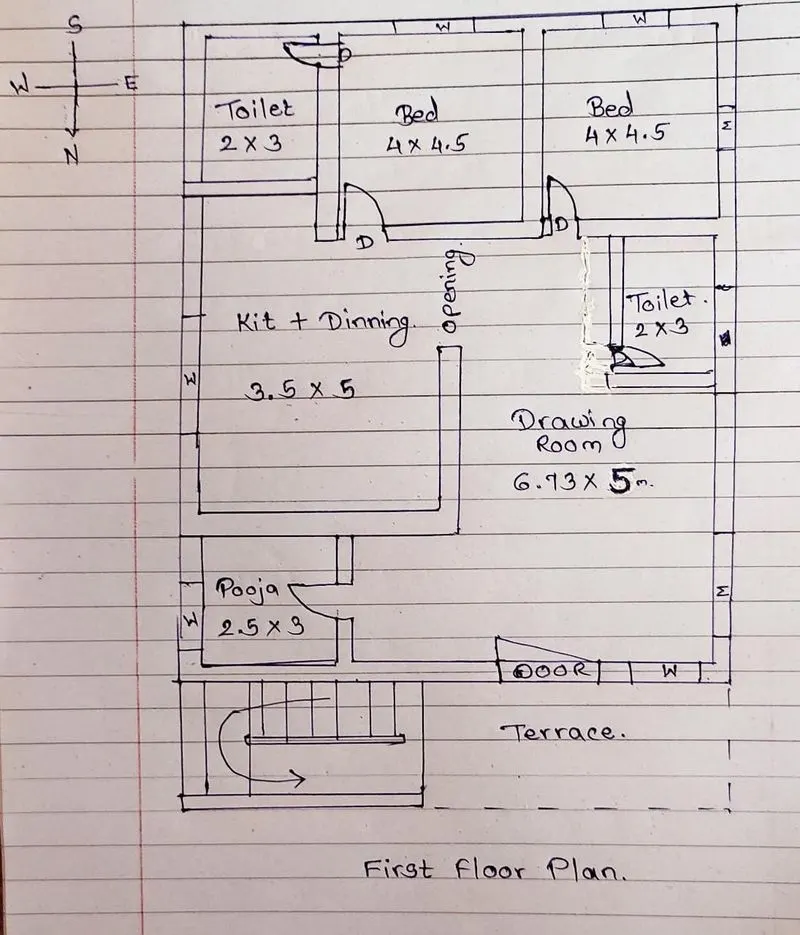
Diamension of First Floor Plan:
Drawing Room : 6.73 m x 5 m
Pooja Room / Store Room: 2.5 m x 3 m
Kitchen + Dinning : 3.5 m x 5 m
Bed 1 : 4 m x 4.5 m
Toilet 1 : 2 m x 3 m
Bed 2 : 4 m x 4.5 m
Toilet 2 : 2 m x 3 m
Open space kept as terrace
| Thickness of External/Internal Wall | - 0.23m (230mm) |
| Thickness of slab | - 0.25m (250mm) |
| Dimensions of column | - 0.3m x 0.3m |
| Dimensions of beam | - 0.3m x .45m |
| Height of the wall of Ground floor | - 4m |
| Height of the wall of First floor | - 3.5m |
1) Dead load Calculations :-
A) Dead load of Columns :-
- Dimension of column = 0.3m x 0.3m (300mm x 300mm)
- Height of column = (Slab thickness X 2) + Height of wall for ground floor + Height of wall for first floor
= (0.25 X 2) + 4 + 3.5 = 8 m
- Total volume of one Column = 0.3 x 0.3 x 8
= 0.72 m3
- Unit weight of RCC = 25 KN/m3 (as Conforming from IS 875 : Part-1)
- Dead load of one column = Volume of Column * Unit Weight of RCC
= 0.72 x 25
= 18 KN
B) Dead load of Beams :-
- Dimension of Beam = 0.3m x 0.45m (300mm X 450mm)
- Total volume of Beam per meter length = 0.3 x 0.45 x 1
= 0.135 m3m3
- Unit weight of RCC = 25 KN/m3m3 (as Conforming from IS 875 : Part-1)
- Dead load of Beam per unit meter length = 25 X 0.135
= 3.375 KN
C) Dead load of Slabs :-
- Slab is always designed for the span of 1 m2. Hence, assume size of slab as 1m x 1m
- Thickness of slab = 0.25 m (250 mm)
- Unit weight of RCC = 25 KN/m3 (as Conforming from IS 875 : Part-1)
- Total volume of Slab per Sq.meter span area = 1m x 1m x 0.25m
= 0.25 m3
- Dead Load of slab per Sq.m span area = 0.25 X 25
= 6.25 KN
D) Dead load of Walls :-
- Thickness of External/Internal wall = 0.23m (230mm)
- Unit Weight of Brick Masonry = 20 KN/m3 (as Conforming from IS 875 : Part-1)
- Height of Ground floor wall = 4 m
- Dead Load of Ground floor wall per unit meter Length = Volume of wall per meter length x Unit weight of Brick Masonry
= 4 x 0.23 x 1 x 20
= 18.4 KN
- Height of First floor wall = 3.5 m
- Dead Load of First floor wall per unit meter Length = Volume of wall per meter length x Unit weight of Brick Masonry
= 3.5 x 0.23 x 1 x 20
= 16.1 KN
- Total Weight of both Ground and First Floor Walls per unit meter Length = 18.4 + 16.1
= 34.5 KN
2) Live load Calculations :-
As per IS -875 Part-2, for residential building, Live Loads are taken as :-
- Living/Dining - 2 KN/m2
- Kitchen - 2 KN/m2
- Bed Room - 2 KN/m2
- Wash Room - 2 KN/m2
- Toilet - 2 KN/m2
- Store Room - 2 KN/m2
- Terrace - 3 KN/m2
- Staircase - 3 KN/m2
3) Wind load Calculations :-
- If the height of the building is more then 10 meters then building need to be designed for wind load.
- But, in this case, Height of the building is 8 meters. Thus, Wind Load need not to be considered.
Here , we plan the first floor and ground floor plan as two families can use it if needed thus we provide kitchen and all facilities on first floor too.
Result :
- The plan of Ground floor & First Floor Residential Building is prepared with consideration of Concept of Vaastu Shastra.
- The load calculations are done as per the IS code considerations.
References : IS 875 part 1 , 2 and 3