Sketch a G+1 residential plan according to Vaastu Shastra and Calculation of Loads as per IS code
Sketch a G+1 floor residential plan, according to Vaastu Shastra, and list down the names of the structural drawings required to be provided to the site for construction.
Aim:
To sketch a G+1 floor residential plan ,according to vaastu shastra and the names of the structural drawings required to be provided to the site for construction.
Introduction:
Vaastu shastra:(Hand made drawing)
As per vaastu tips for new home the main entry point of your house should face the north, east,or northeast direction. It must be built in a manner that when you step out,you face the north, east , or northeast direction.
Significance of eight directions:
we have four cardinal (north, south, east and west) and four intercardinal directions ( North-west, north-east,south-west,and south-east).Each direction signifies an aspect of life and is governed by various gods.While north is the direction for wealth, south is for dharma.
Few Basic Principles of Vastu Shastra
Shape:
The rooms of your house should preferably be square or rectangular.
Room Basics:
Rooms should be airy, well lit, bright, and clean. This rule also extends to the corners of each room.
Home Centre:
The centre of the house should be an empty space.
Stairs and Furniture:
Heavy furniture (like almira etc.) should be kept in the South-west direction. If you are planning to build a duplex house, building stairs in this direction is a good idea.
Water:
Avoid keeping plants and water features like water fountain, aquarium, painting depicting water etc. in the bedroom.
Dining Table:
Ensure that your dining space is near the kitchen and not the main door.
Mirror Placement:
Placing a mirror in the bedroom that reflects the sleeping couple is a strict no-no. If at all you place a mirror in the bedroom, ensure that the bed cannot be seen in it.
Gateway (entrance) of the House:
Positive energy can be harnessed right at the entrance of your house with these tips:
- Main door should be stronger and bigger than other doors in the house; it should preferably be made of teak wood.
- Never keep the place outside your main door dark. Remember good energy is always associated with bright and cheery places.
- Garbage bags, unwanted things, and shoes should be kept away from the main door. We don’t want visitors to cringe before entering your home.
- Ensure that the main door opens inward. Also regularly oil its hinges to avoid creaky sounds.
Drawing Room:
For a place where the family spends most time together, drawing room should have:
- An aquarium on the North or East wall for prosperity
- A bright picture of sunrise in the southern wall
- Shades of yellow, green, beige or blue on walls to infuse liveliness and vibrancy
Kitchen:
To improve the Vastu of your kitchen and ensure a healthy life for your family:
- Keep the water sink away from the gas stove.
- Place the fridge at the south-west corner of the kitchen.
- Never let your kitchen face the washroom or share a common wall with it.
Bedroom:
Bedrooms are a place for rest and repose and should have soothing wall colors for a peaceful aura. Remember to:
- Place the master bedroom in the South-west.
- Never sleep with your head in the north.
- Avoid overhanging beams in the room to enjoy good health.
- Use solid wooden beds instead of hollow wrought-iron beds.
Study Room:
A place where your child needs his/her full concentration! Even if you do not have a separate study room, these basic dos need to be kept in mind:
- Select a square or rectangular shape for the study table.
- Place the table so that one need not face a blank wall or window.
- Keep the table in the North-east, East, or West direction.
- Hanging bookshelves are best avoided.
Sketch drawings:
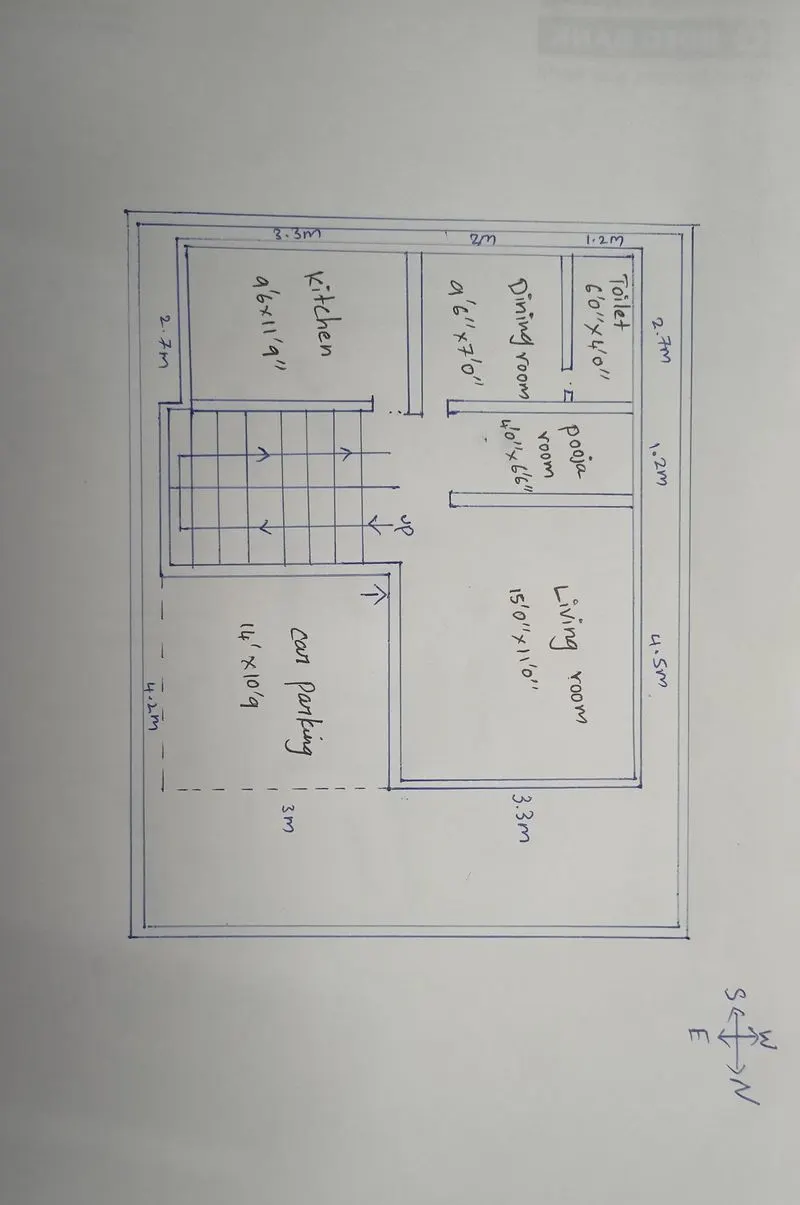
Ground Floor
Dimensions of ground floor plan :
- Living room = 4.5m * 3.3m
- Car parking = 4.2m * 3m
- Pooja room = 1.2m * 1.8m
- Kitchen room = 2.7m * 3.3m
- Dining room = 2.7m * 2m
- Toilet = 2.7m * 1.2m
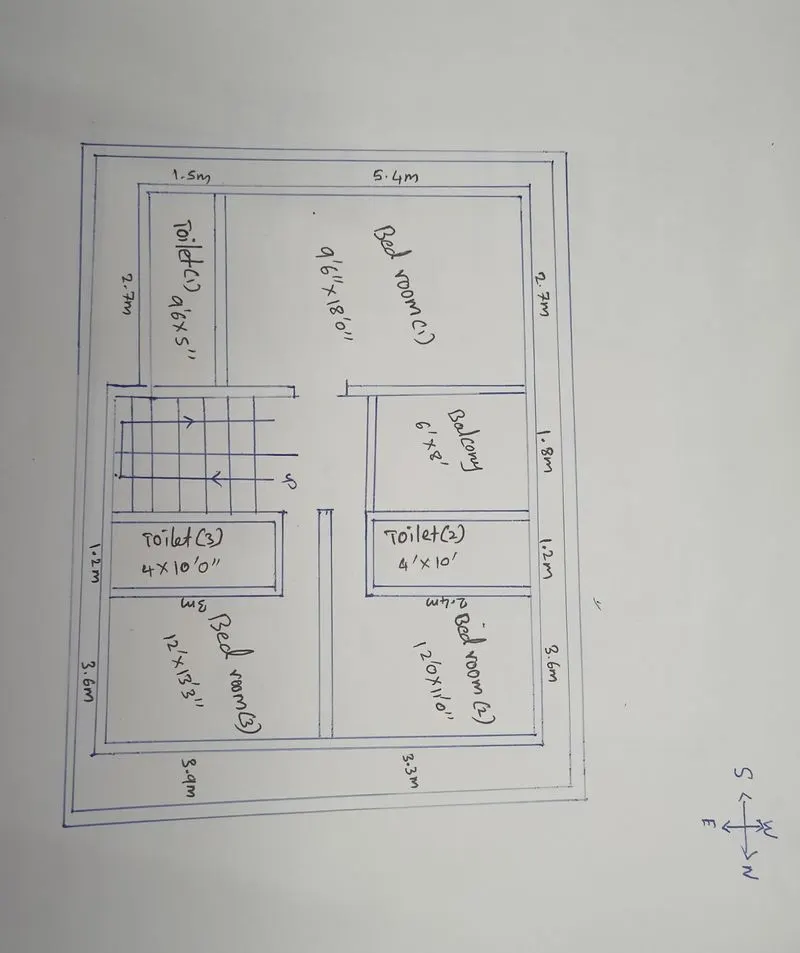
First Floor
Dimensions of first floor plan:
- Bed room(1) = 2.7m * 5.4m
- Bed room(2) = 3.6m * 3.6m
- Bed room(3) = 3.6m * 3.9m
- Balcony = 1.8m * 2.4m
- Toilet(1) = 2.7m * 1.5m
- Toilet(2) = 1.2m * 2.4m
- Toilet(3) = 1.2m * 3m
Other dimensions :
- Thickness of external/internal wall = 0.23m
- Thickness of slab = 0.25m
- Dimensions of column = 0.3m * 0.3m
- dimensions of beam = 0.3m * 0.45m
- Height of the wall ground floor = 4m
- Height of the wall first floor = 3.5m
Calculations of loads :
1. Dead load calculations
- Dead load of columns
Dimensions of column = 0.3m*0.3m
unit weight of RCC = 25KN/M^3
Height of column = (slab thickness *2)+Height of ground floor+Height of first floor
= (0.25*2)+4+3.5
= 8m
Total volume of 1 column = 0.3*0.3*8
= 0.72m^3
Dead load of 1 column = volume * unit weight of RCC
= 0.72*25
=18KN
- Dead load of beams
Dimensions of beams = 0.3*0.45m^2
Total Volume of beam per meter length = 0.3*0.45*1 = 0.135m^3
Unit weight of RCC=25kn/m^3
Dead load of beam perr unit lenght of beam = 0.135*25 =3.375kn
- Dead load of slabs
Slab is always designed for the span of 1m^3
Hence assume size size of slab is 1m*1m
Unit weight of RCC=25kn/m^3
Dead Load of span per square meter area =0.25*25=6.25kn
- Dead load of walls
Thickness external/internal =0.23m
Unit weight of brick masanory=20kn/m^3
Height of ground floor wall =4m
Dead load for ground floor wall per unit meter length = Volume of wall per meter length * Unit weight of brick masanory
= 4*0.23*1*20
= 18.4kn
Height of first floor wall =3.5m
Dead load for first floor wall per unit meter length = Volume of wall per meter length * Unit weight of brick masanory
= 3.5*0.23*1*20
=16.1kn
Total weight of both ground floor per meter length & first Floor length
=18.4+16.1
= 34.5kn
2. Live Load Calculations
As Per IS875 Part 2, for residential buildings live load has taken as,
- Living/Dining =2kn/m^2
- Kitchen/ Bedroom/toilet = 2kn/m^2
- Staircase = 3kn/m^2
3.Wind Load Calculations:
- If height of buildings is more 10m then building need to be designed for wind load.
- But in this case, the building of height is 8m thus, wind load need not to be considered.
- Site plan. A site plan is an aerial view of the construction site that includes the primary building and its adjoining constructions.
- Elevation
- Working plan
- Excavation Drawing
- Installation Drawings
- Plinth Beam Layout
- Roof slab Layout
- Component Drawings., Etc
Results:
- The plan for G+1 Residential building is prepared with considerations of concept of vaastu shastra.