Sketch a G+1 residential plan according to Vaastu Shastra and Calculation of Loads as per IS code
Project on G+1 residential plan according to Vaastu Shastra and Calculation of Loads as per IS code
AIM :
To sketch a plan on G+1 residential plan according to Vaastu Shastra and and listing down the name of the Calculation of Loads as per IS code to provide below
INTRODUCTION :
VAASTU SHASTRA :
- Vastu Shastra is an ancient Indian science which capitalizes on the concept of prosperity.
- It links person's health and happiness directly with layouts and construction of a building. ... As per their belief the science of “Vastu Shastra” controls forces of gravity and magnetic power of the earth.
- Vastu Shastra is an age-old concept of science that governed the conventional Indian architecture.
- The concept of Vastu Shastra for homes holds a blend of astrology, astronomy, science, and art incorporating the age-old Hindu and Buddhist beliefs.
- According to it, every element in a home should be placed in a specific place and direction.
- Vastu Shastra was initially designed as an art and later transformed as a science and astrological method for achieving peace and harmony.
- The architecture that it revolves on combines all earthly elements; fire, space, water, earth, and air.
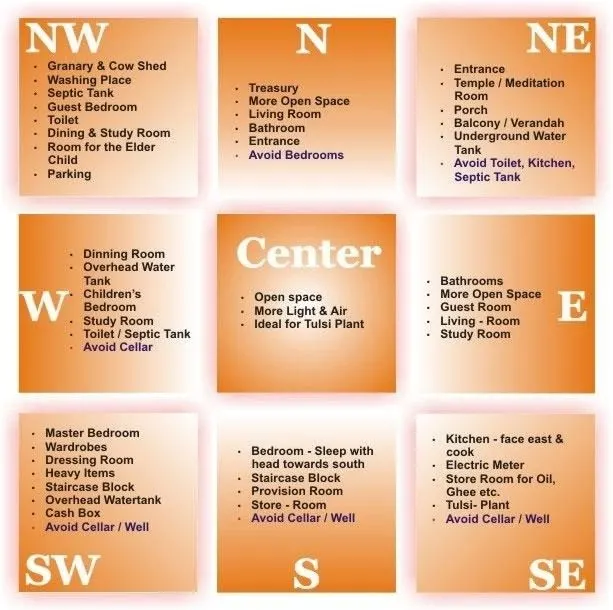
Significance of Eight Directions :
- We have four cardinal (North, South, East, and West) and four intercardinal directions (North-west, North-east, South-west, and South-east). Each direction signifies an aspect of life and is governed by various gods.
While North is the direction for wealth, south is for dharma. West and East are for prosperity and overall success.
Few Basic Principles of Vastu Shastra :
- Shape:
The rooms of your house should preferably be square or rectangular.
- Room Basics:
Rooms should be airy, well lit, bright, and clean. This rule also extends to the corners of each room.
- Home Centre:
The centre of the house should be an empty space.
- Stairs and Furniture:
Heavy furniture (like almira etc.) should be kept in the South-west direction. If you are planning to build a duplex house, building stairs in this direction is a good idea.
- Water:
Avoid keeping plants and water features like water fountain, aquarium, painting depicting water etc. in the bedroom.
- Dining Table:
Ensure that your dining space is near the kitchen and not the main door.
- Mirror Placement:
Placing a mirror in the bedroom that reflects the sleeping couple is a strict no-no. If at all you place a mirror in the bedroom, ensure that the bed cannot be seen in it.
PROCEDURE :
# SKETCH OF GROUND FLOOR PLAN
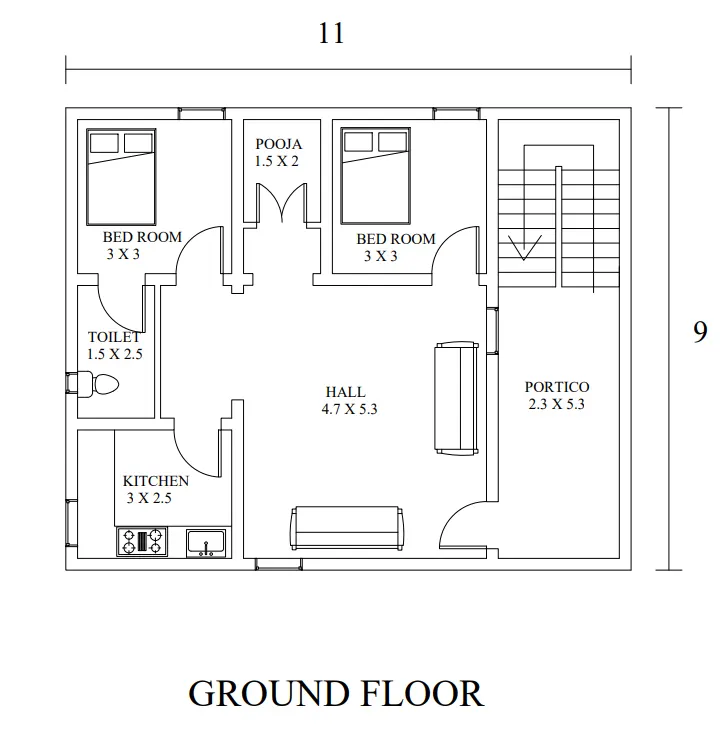
DIMENSION OF GROUND FLOOR PLAN -
- HALL/LIVING ROOM = 4.7 X 5.3
- KITCHEN ROOM = 3 X 2.5
- BED ROOM = 3 X 3
- BED ROOM 2 = 3 X 3
- TOILET = 1.5 X 2.5
- POOJA = 1.5 X 2
- PORTICO = 2.3 X 5.3
# SKETCH OF FIRST FLOOR PLAN
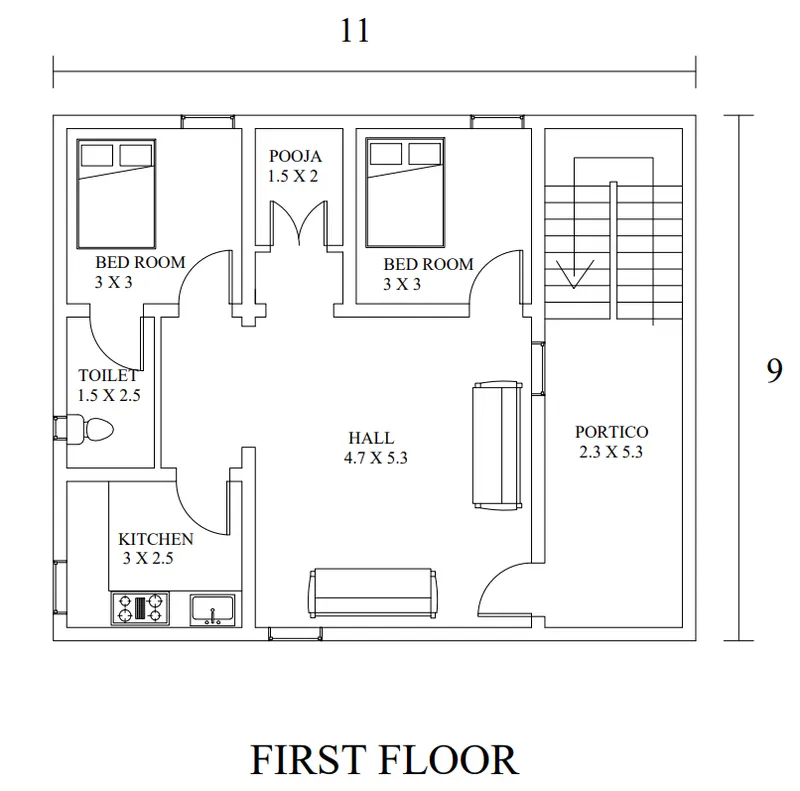
DIMENSION OF GROUND FLOOR PLAN -
- HALL/LIVING ROOM = 4.7 X 5.3
- KITCHEN ROOM = 3 X 2.5
- BED ROOM = 3 X 3
- BED ROOM 2 = 3 X 3
- TOILET = 1.5 X 2.5
- POOJA = 1.5 X 2
- PORTICO = 2.3 X 5.3
Other dimension :
- Thickness of internal wall- 0.15m (150mm)
- Thickness of external wall- 0.23m (230mm)
- Thickness of slab- 0.25m (250mm)
- Dimensions of column- 0.3m X 0.3m
- Dimensions of beam-0.3m X 0.45m
- Height of the wall of each floor- 3m
Vastu Shastra followed during planning is-
- Entrance of the house is provided in the east direction which is the symbol of progress in life.
- Living room is placed in north east direction.
- Master bedroom is placed in south west
position this direction brings good health and prosperity. - Kitchen is placed in south east direction.
Study room is placed in east direction.
Staircase is placed at Northwest corner.
Bathroom, WC and toilet is placed in West direction.
Structural drawings that is to be delivered to site for construction includes:
- Centerline drawing.
- Footing and column layout with reinforcement details.
- Column schedule with reinforcement details.
- Plinth beam layout with reinforcement details
First floor beam layout with reinforcement details. - First floor slab layout with reinforcement details.
These above mentioned drawings will assist the site engineer to carry out the construction process in a systematic manner.
# plan consider direction by vaatu :
- plan followed by vaastu like
1. plan faced by east facing house
2. living room placed by east
3. kitchen placed by south west
4. m.bed toilet placed by west
5. m.bed room placed by north west
6. pooja room placed by north
7. bed room placed by north east
CALCULATION OF LOADS :
- Basic load calculation as per IS 875 (part 1)
1. dead load
2. live load
3. wind load
Calculate load for :
1. Beam (300 x 300) mm
2. Column (230 x 230) mm
3. Slab - 150 mm thick
4. wall - 230 mm
Dead load :
- These are permanent loads acting on a structure throughout their life span
- These are stationary loads that occur mainly due to the self-weight of the structure
- Dead loads are called from the structural members, fixed partitions, fixed equipment etc.,
- For example, to build the structural elements we use reinforcement bars, concrete,
- shuttering etc., Reinforcement bars, concrete stays permanently in the structure, the
- formwork used for shuttering is rermoved once casted so it's a temporary member
- So weight of reinforcement bars and concrete in structural elements are considered as dead loads on a structure
Calculation of dead load on a structure:
- Dead loads are calculated by multiplying the quantity of each material with the unit we ight of that specific material
- The unit weight of the different materials are listed in the table:
PCC (Plain Cement Concrete) 24 KN/m^3
RCC (Reinforced Cement Concrete) 25 KN/m^3
Structural Steel 78.5 KN/m^3
Brick Masonry 20 KN/m^3
Stone Masonry 24 KN/mA3
Floor Finish (Varies on the type) 0.6-1.2 KN/m^3
a.) Column :
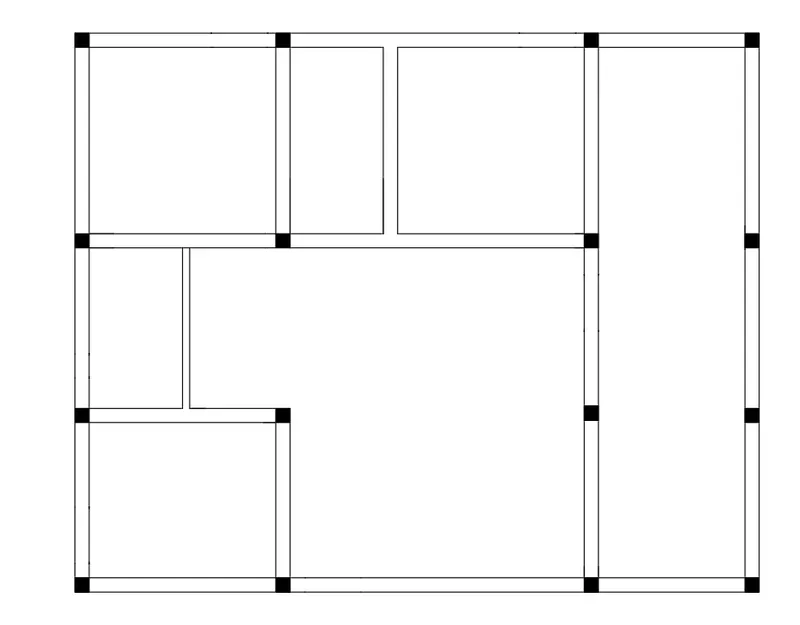
Total no of column = 16 , assumed height 3 m
Total volume of concrete = 0.23 x 0.23 x 3
= 0.15 m^3
Unit weight of concrete = 25 KN/m^3
Dead load of column = 25 x 0.15 = 3.75 KN
b.) Beam :
Total volume of concrete = 0.3 x 0.3 x 3
= 0.27 m^3
Unit weight of concrete = 20 KN/m^3
Dead load of beam = 25 x 0.27 = 6.75 KN
c.) wall :
Height of the wall = 3m
Thickness of wall = 230 mm
Unit weight of brick wall = 20 KN/m
Dead load of wall = 20 x 3 x 0.23 = 13.8 KN/m
d.) slab :
Self weight of slab = density x thickness of slab
= 2500 x 0.15
= 375 Kg/sqm
LIVE LOAD :
- Live loads are real-time loads
- Theses are also called as Imposed loads or sudden loads
- Live loads in a structure changes with respect to time
- Live load includes the weight of the furniture, people occupancy etc.,
- If the room is empty then the live load considerations for the specified room is zero and the same room will be packed at some cases
- So the loading details for design needs to be considered as per Indian code Is875: Part-2
- The specified code has clearly mentioned the minimum load to be considered for all type of building according to their occupancy in Table 1
LIVE LOAD CALCULATIONS :
According to IS 875 Part 2
- Bed room 2 KN/m^2
- Living room 2KN/m^2
- Bath 2 KN/m^2
- Terrace 3 KN/m^2
- Toilet 2 KN/m^2
- Staircase 3 KN/m^2
- Study room = 2 KN/m^2
- Kitchen = 2 KN/m2
WIND LOAD :
- Wind load is designed only when the height of building exceeds 10m
- The height of building is 6.5m which is less than 10m
- so calculation of WIND LOAD is not required
RESULT :
- The plan is doned by the vaastu shastra concept consideration
- The load calculation are done as per the IS CODE consideration