simulation of the pendulum motion in MATLAB
Aim: to write a program in Matlab that will simulate the pendulum motion
Governing Equation :
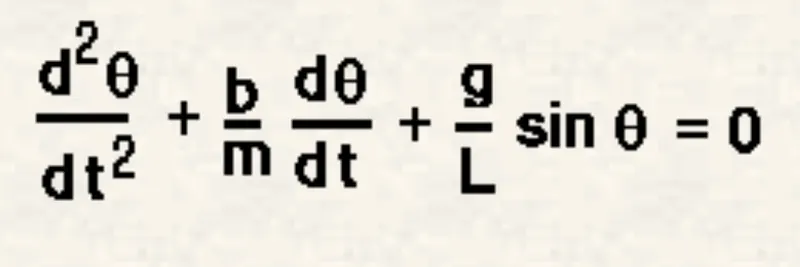
where,
g = gravity in m/s2,
L = length of the pendulum in m,
m = mass of the ball in kg,
b=damping coefficient.
theta is the angle made by the pendulum with the initial position.
Body:
code i) for ODE equation
b=0.05; %damping co-efficient
g=9.81; %gravitational constant
l=1; %length of the pendulum
m=0.1; %mass of the bob

%initial conditions

theta_0= [0;5];  %0 is initial displacement and 5 is initial velocity

%time points

t_span = linspace(0,10,500);

%solve ODE
[t,results] = ode45(@(t,theta) ode_fun(t, theta,b,g,l,m),t_span,theta_0);
%here ode_function is defined in another program

%plotting

plot(t,results(:,1))
hold on
plot(t,results(:,2))
xlabel('plot')
ylabel('time')

fig= 1;
for i = 1:length(t)

    %intial position of the pendulum

    x0= 0;
    y0= 0;

    %finel positon

    x1 = l*sin(results(i,1));
    y1 = -1*cos(results(i,1));

    %plotting
    figure(2)
    %base line
    plot([-1,1],[0,0],'linewidth',4,'color','y');
    % pendulum line
    line([x0 x1],[y0 y1],'linewidth',3,'color','r');
    hold on;
    %pendulum ball
    plot(x1,y1,'o','markersize',30,'markerfacecolor','b');
    grid on
    %o is the circular pointer which can be used to represent bob.
    axis([-2 2 -2 1]);
    pause(0.01);
    hold off
    M(fig) = getframe(gcf)
    fig= fig+1;
end
% for genarating and storing the video file in avi from at
movie(M)
videofile = VideoWriter('second_order_ODEs.avi','Uncompressed AVI');
open(videofile)
writeVideo(videofile,M)
close(videofile)
ii) to define the function ode_fun
function  [dtheta_dt] = ode_fun(t,theta,b,g,l,m)
theta1=theta(1)
theta2=theta(2)
dtheta1_dt=theta2;
dtheta2_dt=-(b/m)*theta2-(g/l)*sin(theta1);
dtheta_dt = [dtheta1_dt;dtheta2_dt];
endResult:
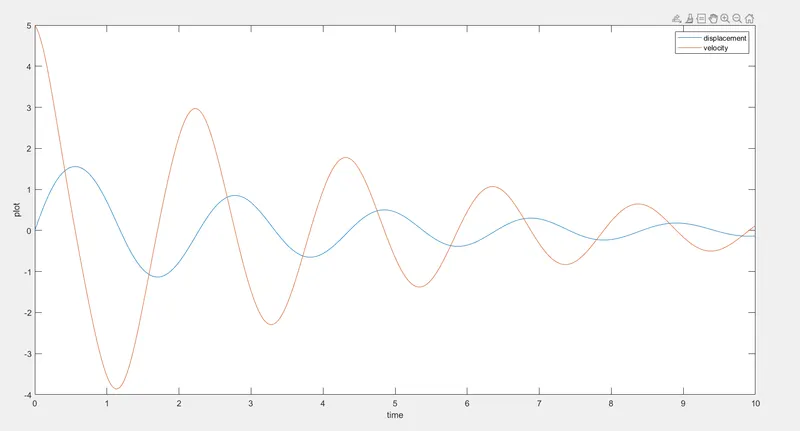
this plot shows how the displacement and velocity of the pendulum vary with respect to time.
this graph will be damped as the damping co-efficient (b) increases. Here displacement starts from zero but velocity doesn't because KE at theta = 0 is not zero i.e., velocity is not zero. At theta = max, velocity is max.
pendulum AVI:
https://drive.google.com/file/d/1YF3R5-n-tvvhVk60SnLla0Jbt84aEUPB/view?usp=sharing
with time the velocity and displacement of the pendulum motion comes down the same is shown graphically in the above plot