Section Modulus calculation and optimization
SECTION MODULUS CALCULATION FOR THE HOOD ASSEMBLY CROSS SECTIONAL AREA
Aim
To calculate section modulus for the designed hood assembly and for the improved section.
Section modulus
Section Modulus is a geometric property used to calculate the bending stresses in a structural member
There are two types of section modulus:
- Elastic Section Modulus- Elastic section modulus is calculated when we are to use the material behavior till the yield point. For general design purposes, we use elastic section modulus.
- Plastic Section Modulus- The plastic section modulus is used for materials where the elastic yield is acceptable and the plastic behavior is considered to be an acceptable range.
Here we are using elastic section modulus to calculate the section modulus of the hood assembly.
Mathematically,
It is defined as the ratio of the moment of inertia of a section about its centroidal axis and to the distance of the extreme layer from the neutral axis and It is denoted by S.
S= I/y
Where,
S = section modulus
I = Moment of inertia (min)
Y = distance between the neutral axis and the extreme end of the object
Moment of inertia
Moment of inertia also known as the angular mass or rotational inertia can be defined with respect to rotation axis, as a quantity that decides the amount of torque required for a desired angular acceleration or a property of a body due to which it resists angular acceleration.
Moment of inertia is always specified with respect to that axis and is defined as the sum of the products obtained by multiplying the mass of each particle of matter in a given body by the square of its distance from the axis.
Moment of inertia can be calculated directly by using the section inertia analysis tool in the SIEMENS NX cad and distance between the neutral axis and the extreme end of the object can be measured by using rapid dimension or by measuring tool.
CASE-STUDY-1 WITH ORGINAL SECTION
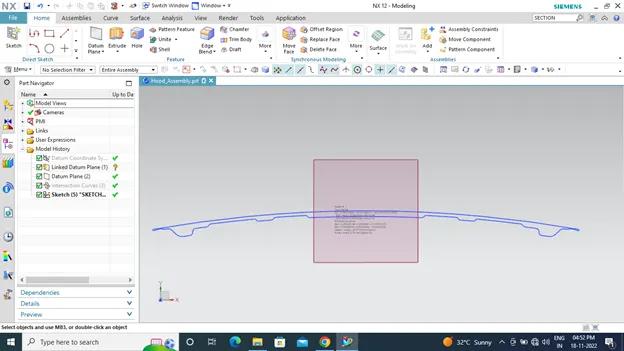
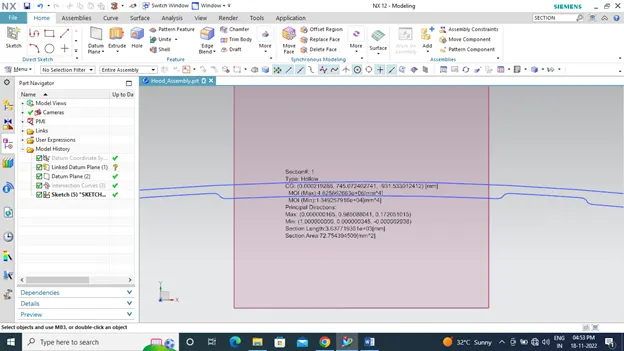
SECTION MODULUS OF HOOD CASE-STUDY-1
S=I/y
I=1.349258916*10^4 mm^4
Y=880.9/2
Y=440.45 mm
S=1.349258916*10^4/440.45
=13,492.57916/440.45
S=30.63 mm^3
CASE-STUDY-2 WITH IMPROVED CROSS SECTIONAL AREA
We can improve the original cross sectional area by offsetting the lower bottom curve of inner panel by 0.5mm downwards.
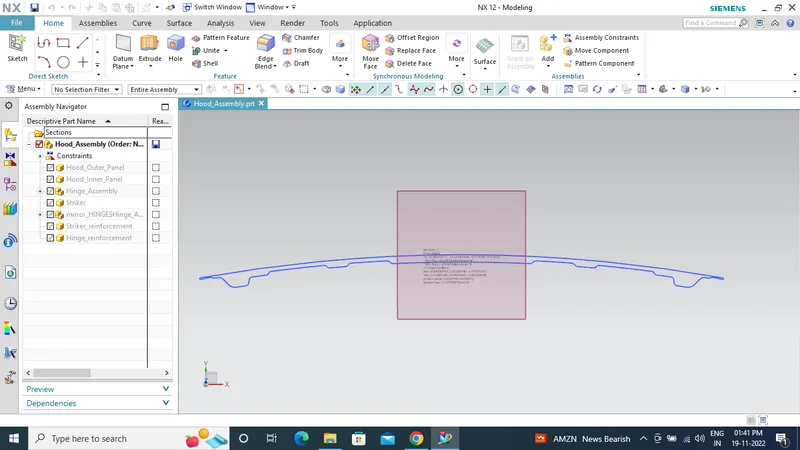
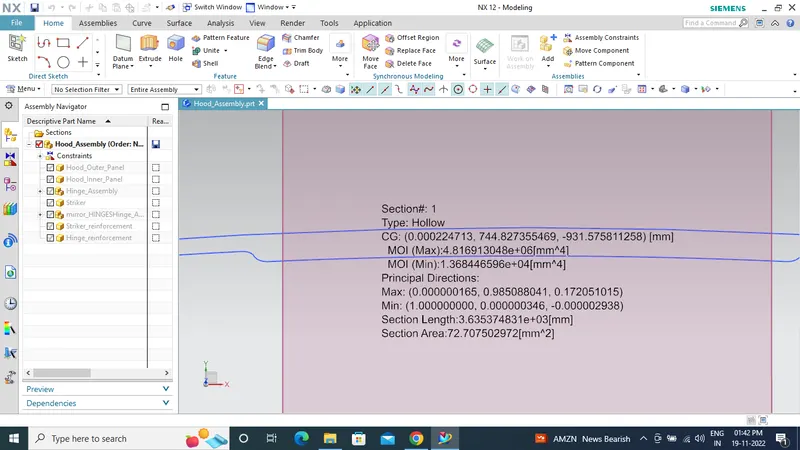
SECTION MODULUS OF HOOD CASE-STUDY-2
S=I/y
I=1.368446596*10^4 mm^4
Y=880.9/2
Y=440.45 mm
=1.368446596*10^4 /440.45
=13,684.46/440.45
S=31.07mm^3
Conclusion
In case study-2 we will get section modulus value a bit higher than the first case, which increase the impact resistance property of hood and thus by improves the overall performance of the vehicle.
If the section modulus of both case study is not satisfactory we can go for the case study-3 by adding embosses to the original section but here we concluded with the two case studies.