Section Modulus calculation and optimization
Aim
To calculate the section modulus of the hood before and after optimization and compare the results.
Section Modulus
Section modulus is defined as the ratio of moment resisted by the section to the stress in the extreme fibre. It gives us an idea about how much load a given structure can take. Increase in section modulus increases the load bearing capacity of the object.
This tool, 'Section inertia analysis' present in NX CAD calculates the centre of gravity, maximum and minimum moment od inertia, sectional length and sectional area of the given model.
The formula to calculate the section modulus is,
S = I/Y, where
S = Section modulus
I = Moment of inertia (minimum)
Y = Distance between nuetral axis and extreme end of the object.
Result
1. Before optimization
We take the hood assembly which we designed and create an intersection curve. We project the inersection curve and close off any gaps. We then use the tool 'Section inertia analysis' to calculate the moment of inertia and then we measure the distance from one end of the section to the other end and divide it by 2 to calculate Y.
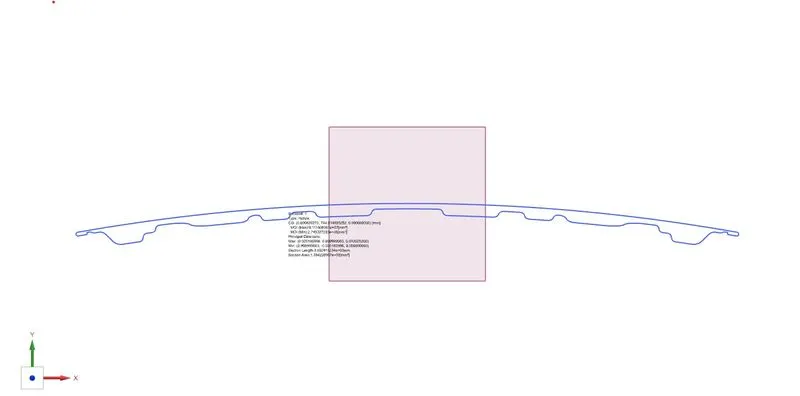
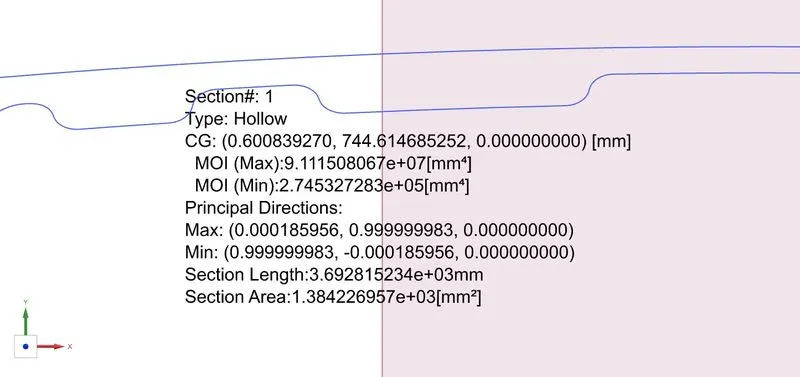
From the above data we get,
I = 2.74532728e+05 mm^4 = 274532.728mm^4
Y = 879.6329/2 mm = 439.81 mm
Therefore,
S = I/Y = 274532.728mm^4/439.81 mm = 624.207 mm^3
2. After optimization
For optimizing the section, we offset the inner curve (of inner panel) by 1mm. Then we close of the open boundaries and apply the section inertia analysis tool.
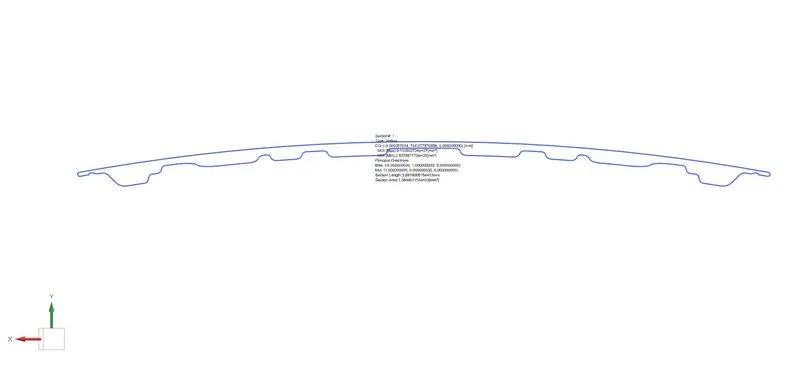
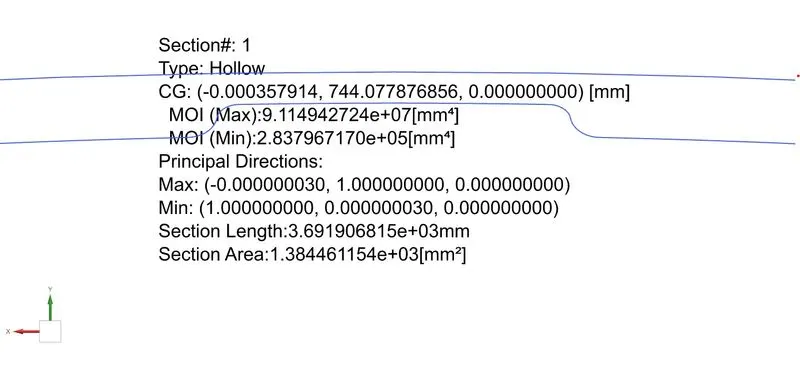
From the above data we get,
I = 2.837967e+05 mm^4 = 283796.717mm^4
Y = 879.6329/2 mm = 439.81 mm
Therefore,
S = I/Y = 283796.717 mm^4/439.81 mm = 645.271 mm^3
Conclusion
By comparing the cases before and after optimisation, wherein the section modulus after optimisation is greater than the one before optimisation, we conclude that when the area of the section is increased so did the section modulus and moment of inertia.