Section Modulus calculation and optimization
Use the Section from your Hood design and calculate the Section Modulus using the formula
S = I/y
Where,
S = Section Modulus
I = Moment of Inertia
y = distance between the neutral axis and the extreme end of the object
Come up with a new section that has an improved Section Modulus compared to the previous one and mention what changes you made which resulted in the increased strength.
Section modulus:
Section modulus is a geometric property for a given cross-section used in the design of beams or flexural members. Other geometric properties used in the design include an area for tension and shear, the radius of gyration for compression, and the moment of inertia and polar moment of inertia for stiffness.
There are two types of section moduli, the elastic section modulus, and the plastic section modulus.
It is termed the ratio of the second moment of area and distance from N. A (Neutral axis) to the extreme fiber. Also, it is the measure of the strength of a given member. The stress in the outermost section of the beam is computed with the help of section modulus. It was indicated by S
Section modulus is indicated as follows:
S = Section Modulus
I = Moment of Inertia
y = distance between the neutral axis and the extreme end of the object. Here, I is the “moment of inertia” and y is the distance from the “neutral axis” to the top or bottom of the fiber.
The unit of a “section modulus” is in (mm3).
Section modulus depends only on the cross-section shape of the beam. Cross section shapes like rectangular, square, circular, I section and T, composite section, etc.
For symmetrical sections, the value of “section modulus” is both above and below the centroid of the fiber.
An asymmetric section has two values for the top and bottom of the fiber due to different distances from the centroid to the top and bottom of the material, the maximum “section modulus” is S min, and the maximum section modulus is S min.
Section modulus can also be defined by using the simple bending theory as,
We know that M / I = σ / Y
Therefore, S = M / σ
i.e., section modulus is also expressed as the ratio of bending moment to the bending stress of a given object within the elastic limit.
SIGNIFICANCE OF SECTION MODULUS
The section modulus of the cross-sectional shape is of significant importance in designing beams. It is a direct measure of the strength of the beam. A beam that has a larger section modulus than another will be stronger and capable of supporting greater loads.
Section modulus is an important factor in the design of beams and flexural member
The higher the value of the section modulus, the higher the resistance of the member to bending
It is required to calculate stress in beams.
It is used to calculate the strength of the steel structure
The more the section modulus, it can withstand the load and it is also considered to be tougher.
- CATIA V5 software we have a command called Section Inertia, by this, we can automatically get the Moment of Interia values.
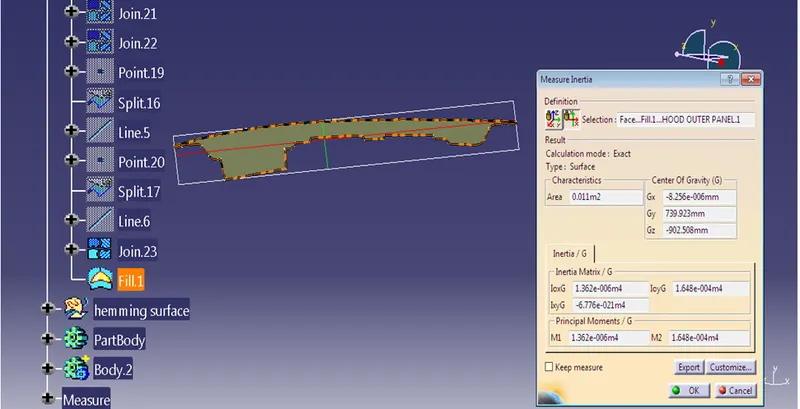
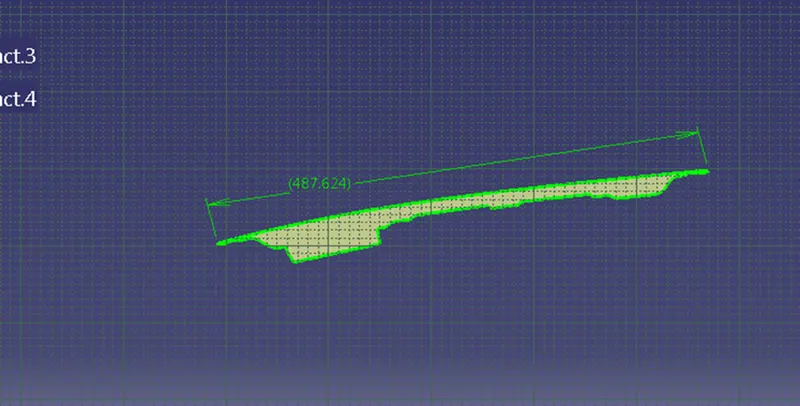
The calculation for the Hood Section of Modulus
Let,
Moment of Inertia (max. & min.) value of Hood part.
MOI (max) : (1.362e-006* 105) [mm4]
MOI (min) : (1.648e-004* 103) [mm4]
The total distance of the hood Y = (487.62 mm.)
The distance between the neutral axis to the extreme end = (487.62/2) = 243.81 mm.
Asymmetric has two values for the top and bottom of the centroid ie., S(max) and S(min).
For S(max) and S(min)
Section modulus is the ratio of the second moment of area and distance from N. A (Neutral axis) to the extreme end is given by S = I/Y
S(max) = I(max)/Y = (1.362e-006* 105) / (243.81 ) = (558.63) [mm3]
S(min) = I(min)/Y = (1.648e-004* 103) / ( 243.81 ) = (6.76) [mm3]
Now change the section & calculate the section modulus again
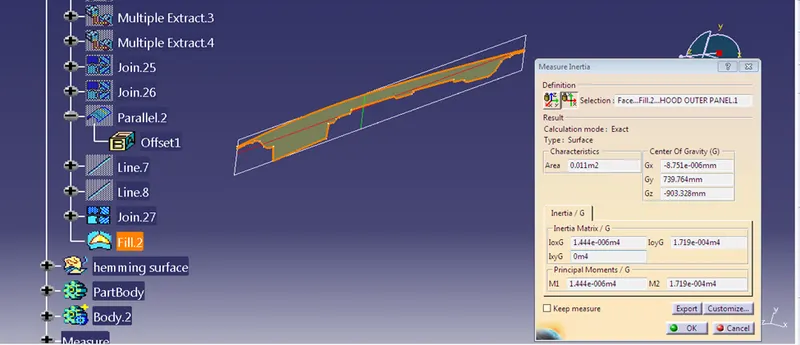
The calculation for the Hood Section of Modulus
Let,
Moment of Inertia (max. & min.)Value of Hood part.
MOI (max): (1.719e-004* 105) [mm4]
MOI (min): (1.444e-006* 103) [mm4]
The total distance of the hood Y = (487.62 mm.)
The distance between the neutral axis to the extreme end = 487.62/2) = 243.81 mm.
Asymmetrics have two values for the top and bottom of the centroid i.e., S (max) and S (min).
For S (max) and S (min)
Section modulus is the ratio of the second moment of area and distance from N. A (Neutral axis) to the extreme end is given by S = I/Y
S (max) = I (max)/Y = (1.719e-004* 105) / (243.81) = (705.05) [mm3]
S (min) = I (min)/Y = (1.444e-006* 103) / 243.81) = (5.92) [mm3]
CONCLUSION
Thus I calculated the section modulus of the Hood design and also there is an improvement in the section modulus of the previous section Finally I concluded that there is an increase in the Sectional area which increases the overall mass of an object and also the strength of an object.