Section Modulus calculation and optimization
SECTION MODULUS:
The structure constructed for carrying varying loads is measured for several factors to predict their stiffness, strength and rigidity.These include modulus of elasticity, moment of inertia and section modulus
MODULUS OF ELASTICITY: The ratio of stress to strain or the stiffness of the material of a structural member (resistance to deformation).It is essentialy a generic term to measure the overall stiffness of the material. So as the modulus of elasticity of the material increases so does the stiffness of the material.
MOMENT OF INERTIA: A structure is subjected to bending stresses at several locations.The bending stiffness of a structural member’s cross-sectional shape is measured using the moment of inertia.
Moment of inertia is a direct measure of the resistance offered by the body to angular acceleration about a gien axis.The mass is divided into several elemental masses and the sum of the product of each elemental mass and the square of their distance from the given axis gives the moment of inertia of the structure. If the moment of inertia of material is large then the bending stiffness of the structure is also high
SECTION MODULUS: The ratio of the maximum moment on a beam or any structure and the distance from the neutral axis.The top and the bottom fibers i.e the extreme fibres does the most work in the bending process , So they are built into the calculation.
The section modulus is used to to find the minimum required beam area that will support the bending load
The section modulus of the cross-sectional shape is of significant importance in designing beams because it is stronger and capable of carrying greater loads
The elastic modulus is denoted by Z. To calculate Z, the distance (y) to the extreme fibres from the centroid (or neutral axis) must be found as that is where the maximum stress could cause failure.
Case 1 : Section modulus of the initial hood structure
The hood design is taken and using the curve option and the percentage of the arc length selection, a datum plane is created in the middle of the hood section which bifurcates the hood into front and back sections.
Then interesection curve option is used to project the cross sectional curves onto the datum plane created.
The outer part of the inner and the outer panel is retained and all the other curves are trimmed off. And the resultinf sketch is joined using the spline curves , inferring a tangency constraint.
After the whole cross section is closed.It is ensured that there are no open areas.
Section inertial analysis is added to the home tab and the section is analysed for the CG point, Minimum moment of inertia and the maximum moment of inertia.Section length and teh Section area.

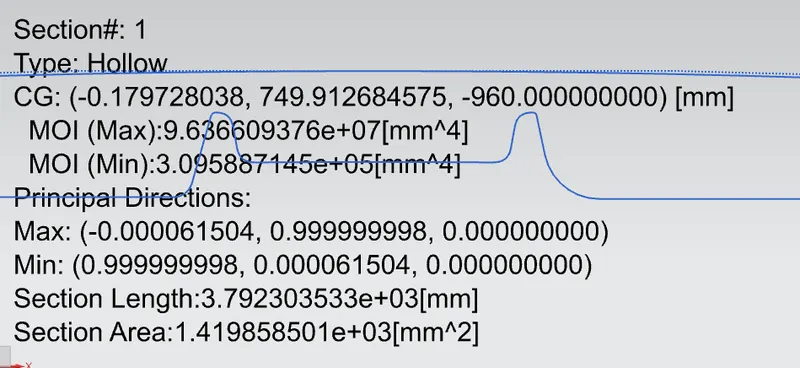
Case 2:Modified Hood
Section modulus of the hood structure with added embosses

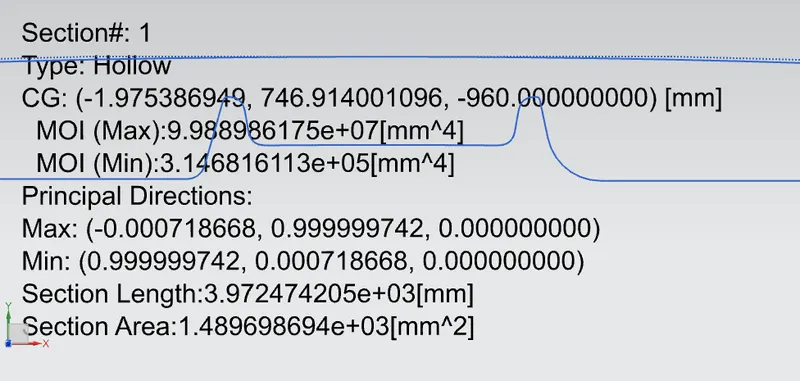
Calculations:

Section modulus (Z)=Minimum moment of inertia(I) /Distance of the extreme fibers from the neutral axis(y)
Z=I/y
Z1-Section modulus of the initial hood design
Z2-Section modulus of the final hood design with additional embossess to increase the section area , section modulus thereby increasing the strength of the material
Initial hood design - Section modulus
Z1=(3.096e5 mm^4)/(438.8343 mm)
Z1=705.505 mm^3
Modified hood design -Section modulus
Z2=(3.1468e5 mm^4)/(438.8343 mm)
Z2=717.505 mm^3
|
S.No |
Hood model |
Section Area |
Minimum Moment of Inertia |
Distance from the neutral axis |
Section modulus |
|
1 |
Hood model before modification |
1.419859e3 mm^2 |
3.096e5 mm^4 |
438.8343 mm |
705.505 mm^3 |
|
2 |
Hood model after modification |
1.489699e3 mm^2 |
3.1468e5 mm^4 |
438.8343 mm |
717.505 mm^3 |
Conclusion:
The section modulus of the material is the direct measure of the strength of the material.In the Case 1 , the hood design is designed and the section modulus is calclulated by taking into consideration of the minimum moment of inertia and the distance from the neutral axis.Similarly, some new embosses are also added in the structure to increase the strength which is reflected in the section modulus calculations.
The modified hood design shows a 5% increase in section area which causes an increase in section modulus by 1.65%