Section Modulus calculation and optimization
AIM: To find the section modulus of the Hood and optimization to improve the overall section modulus. Use the Section from your Hood design and calculate the Section Modulus using the formula.
OBJECTIVES: To find the Section Modulus from the previously done Hood design and calculate the Section Modulus using the formula. Here in this challenge, we come up with a new section that has an improved Section Modulus compared to the previous one and mention what changes you made which resulted in the increased strength.
DESCRIPTION:
If Z=S=I/y, then
Z=S= Section Modulus in mm3
I=Area Moment of Inertia in mm4
y=Distance from neutral axis to the outermost fiber in mm
Eg.: If there is a rectangular beam subjected to a load on a beam with it's cross-section of b×d as shown below,
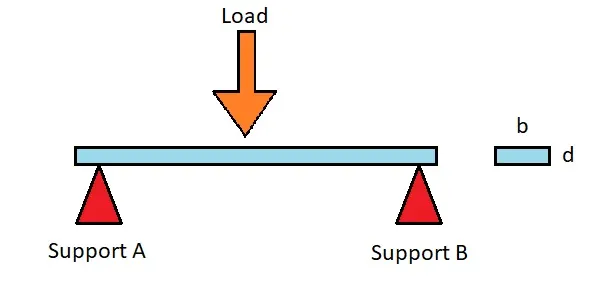
Then the Area Moment of Inertia will be I=bd3/12
and the Distance from neutral axis to the outermost fiber based on the direction of the load will be y=d/2
Then the Section Modulus will be S=I/y=bd2/6
Now,
If M= Bending moment ( resistance towards bending) in N-mm
σ=Bending stress in N/mm2
E=Young's Modulus in N/mm2
R=Radius of Curvature mm
Then the equation goes like;
M/I=σ/y=E/R
=>M/I=σ/y
=>M=(σ*I)/y
=>M=(I/y)*σ
=>M=S*y
where M is directly proportional to the section modulus and therefore to the area moment of inertia. By this we can say that if section modulus is more then the strength of cross section is more.
PROCEDURE:
Section Modulus:
1) Create a datum plane exactly at the center of the hood as shown in figure.
2) Create a datum plane using the on curve option and provide % arc length as 50% , So that we get exactly at the center of the hood. We provide a selection filter for the entire assembly as highlighted in the figure above.
3) Select the option of “intersection curve“ - select the datum plane that we have created in point 1.
4) Select the tangent faces of the outer panel as well as inner panel. Keep in mind that we are selecting filters for the entire assembly as shown in the figure.
5) Hide all the solid bodies and create a sketch on the datum plane we have created.
6) After creating a sketch , project the intersection curve into the sketch using the project curve option as shown in the image below and then hide the intersection curve.
7) Select the feature studio spline as shown above.
8) Select the option of ‘by poles’ and tick ‘single segment’. Select the starting point and ending point at that specific gap to close the open sketch.
9) Select the feature ‘ Section Inertia Analysis’ as shown in the image below. Provide the thickness as d=0.75mm.
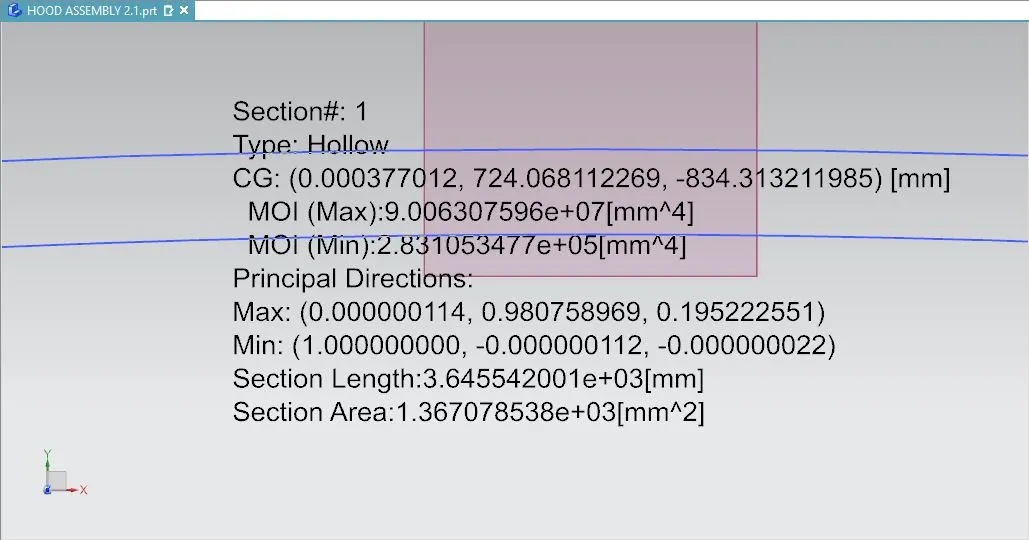
10) We will get a result as shown in the image below. Take the minimum Moment of Inertia (MOI) into consideration for calculating the section modulus.
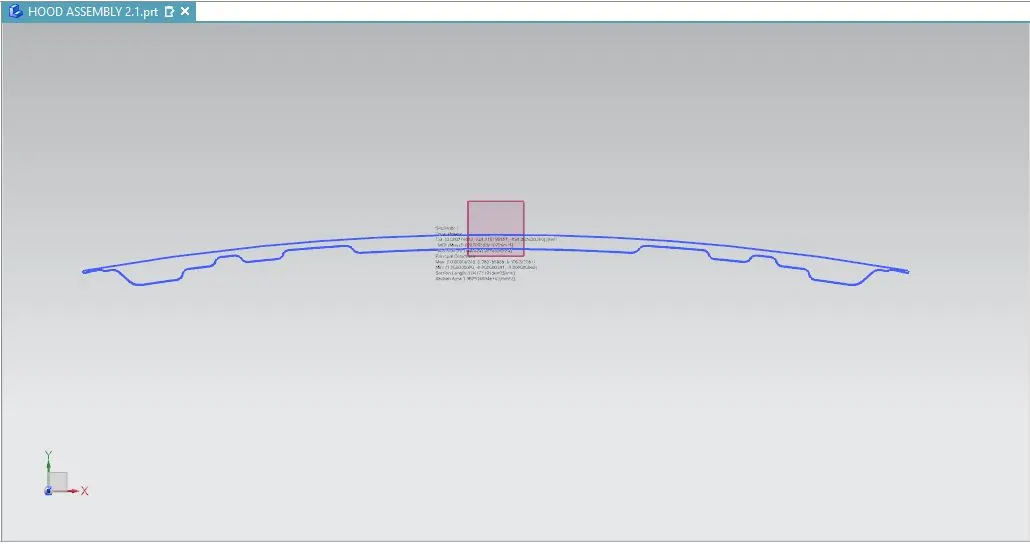
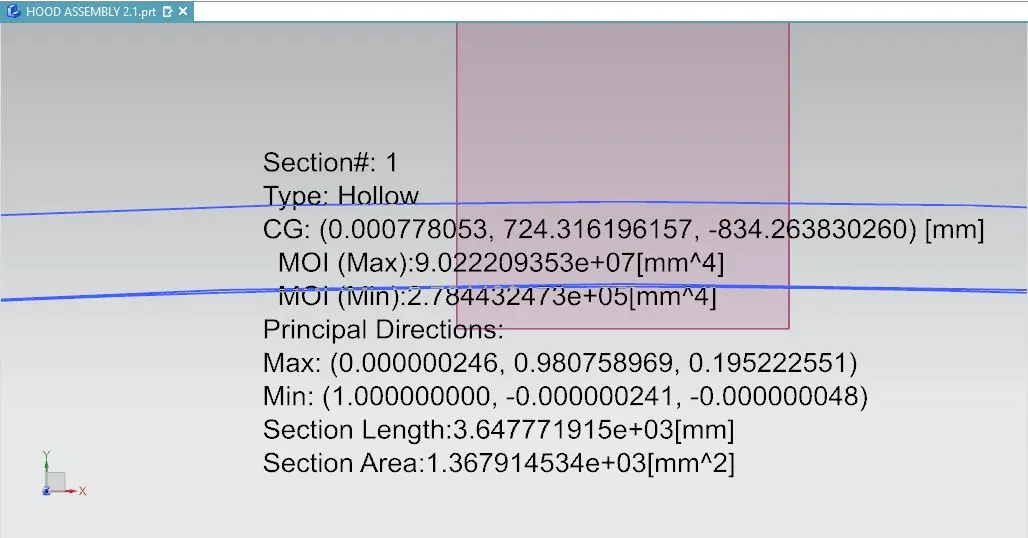
11) Now measure the distance from end to end of the section and divide the value with 2. This value which we get is the Y value in the section modulus formula.
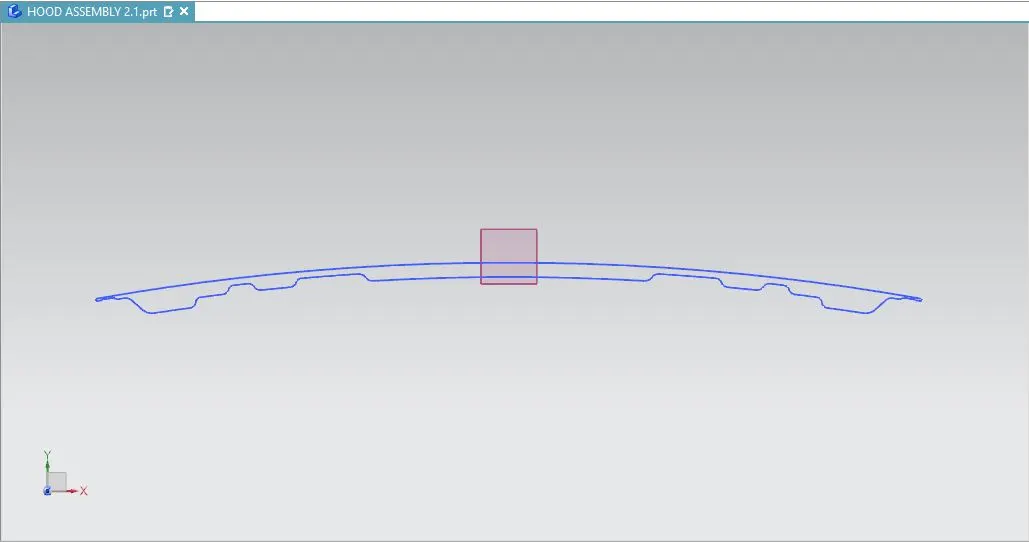
12) To modify the sketch in such a way that our minimum MOI value has to be increased so as to improve the section modulus. This is done by offsetting the below curve of the intersection curve.
Draft Analysis:
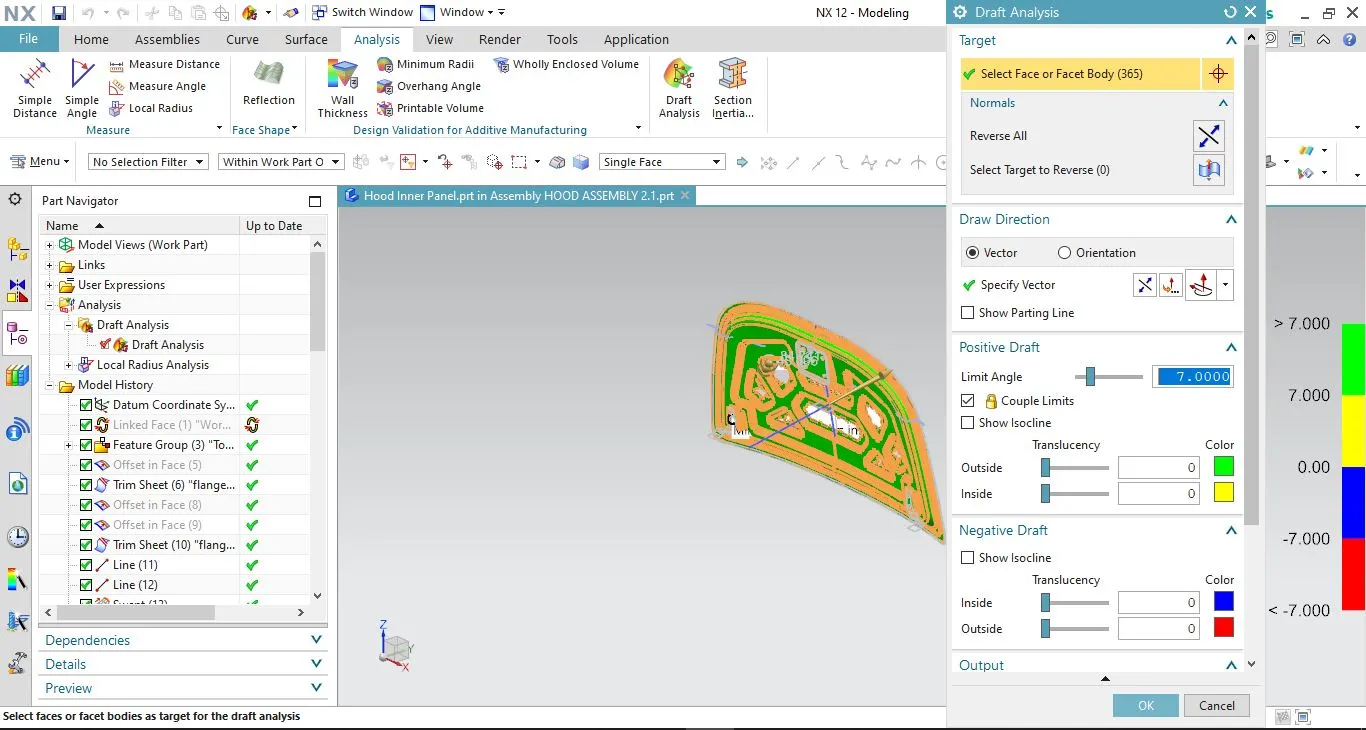
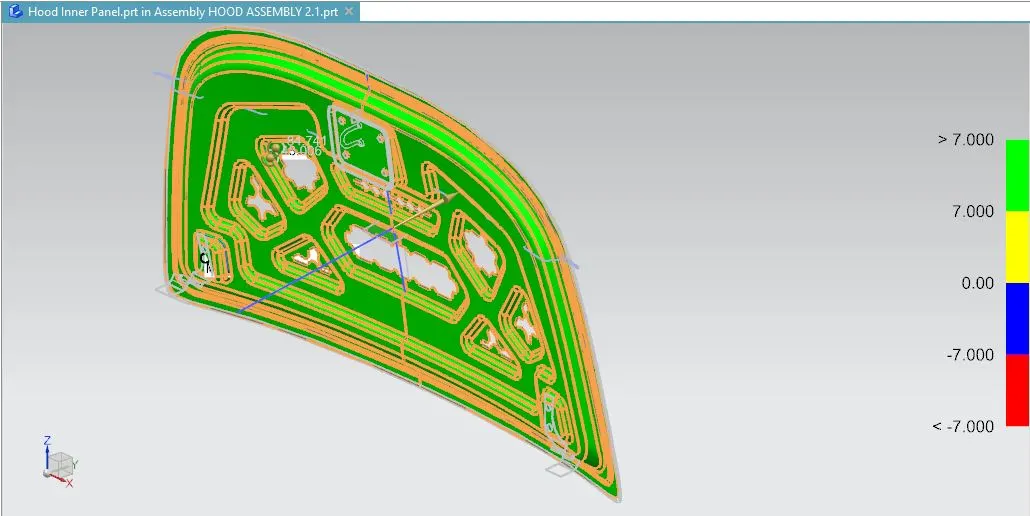
1) The draft analysis is only on Hood Inner Panel since that is where the design takes place.
2) Go to 'Draft Analysis' after making the inner panel as work part.
3) Select the surface for the draft analysis.
4) Select the tooling axis as the drawing vector.
5) Give the positive draft angle as 7 degrees.
6) Reverse the direction of the vector to adjust the tooling axis direction so as to get the positive clearance in the form of green colour.
CALCULATIONS:
Case 1:
Max MOI = 9.022*107mm4
Min MOI = 2.784*105mm4 = I
y=879.9985mm
Therefore, S=I/y=2.784*105mm/879.9985mm=316.364mm3
Case 2:
Max MOI = 9.006*107mm4
Min MOI = 2.831*105mm4 = I
y=879.9860mm
Therefore, S=I/y=2.831*105mm/879.9860mm=321.710mm3
INFERENCE:
The Section Modulus for the two cases was found out and we concluded that after modifying the sketch for 0.5mm offset we can increase the the section modulus. As we increase the section area, the moment of inertia & section modulus increase which means strength and load material also increase. Which the moment of inertia directly proportional to the strength of the material.