Section Modulus calculation and optimization
#Challenge 5 Fender design
Name: Sri Gokul P
Course: Automotive Sheet Metal Design using Siemens NX CAD / CATIA V5
Bending Stresses:
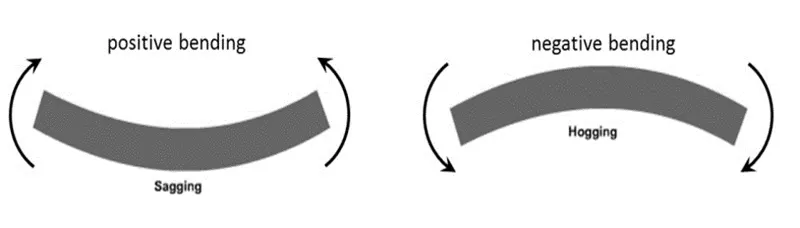
Bending results from a couple, or a bending moment M, which is applied. Just like torsion, in pure bending, there is an axis within the material where the stress and strain are zero. This is referred to as the neutral axis.
If the loads cause the beam to sag, the upper surface of the beam is shorter than the lower surface and the opposite is true for hogging
The strains in the upper and lower portions of the beam are different and knowing that stress is directly proportional to strain for a linear elastic material.
Pure Bending Equation:
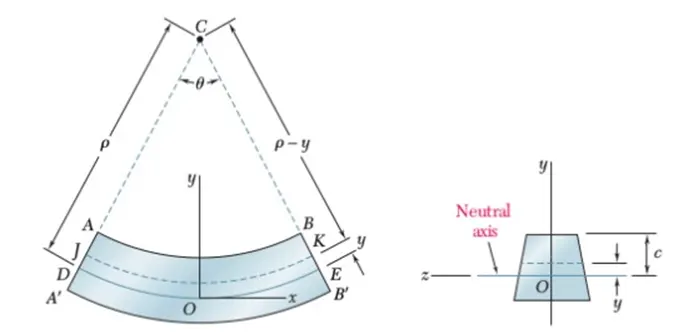
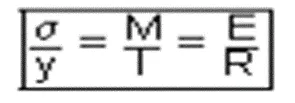
Where, σ – bending stress M- Bending Moment I- Moment of Inertia of area
y - Distance between the neutral axis and the extreme end of the object
E- Young modulus of elasticity R- curvature
Neutral Axis:
It is that in which the bending moment is constant along the length, i.e., the shear force is zero. Distance Y is directly proportional to the Neutral axis.
To calculates the Section Modulus using this formula:
S =I/Y
S = Section Modulus I = Moment of Inertia of area
y = distance between the neutral axis and the extreme end of the object
Section modulus represents the strength, so the section modulus depends on the area of the section. Section Modulus is directly proportional to the Moment of Inertia in the area
|
In the inner panel to check whether the strength improves with or without emboss. |
|
|
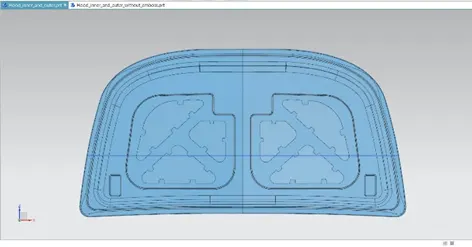
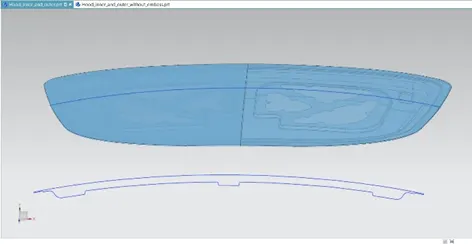
CASE 1: INNER PANEL CREATED WITH EMBOSS. I create emboss in inner panel to improve the strength of the hood.
|
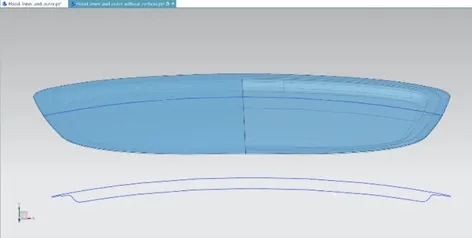
CASE 2: AN INNER PANEL CREATED WITHOUT EMBOSSING. I create it without emboss in inner panel to check whether improve the strength of the hood.
|
|
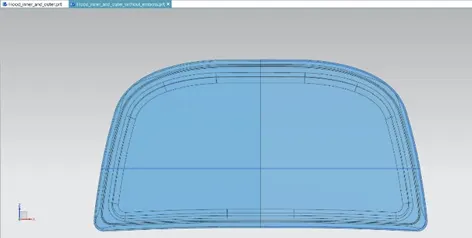
In the hood, I create an intersection curve and then use that curve as a projection.
|
In the hood, I create an intersection curve and then use that curve as a projection.
|
|
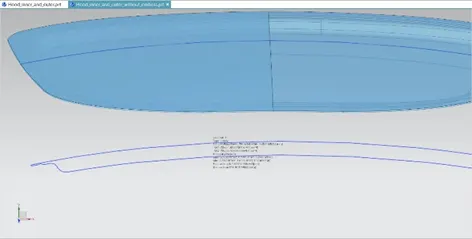
Finding section inertia analysis in hood.
|
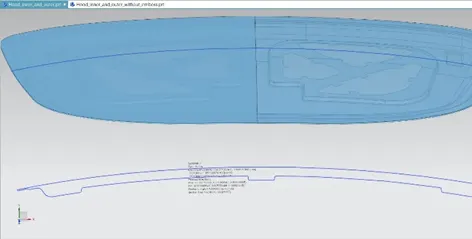
Finding section inertia analysis in hood.
|
|
Value of section inertia with emboss Section#: 1 |
Value of section inertia without emboss Section#: 1 |
|
Calculation: Finding distance of ‘y’ Using Y value, we can find neutral axis =Y/2 = 906.1/2 Y=453.05 Section modulus(s) = Imax/Y =1.089098871e+07/453.05 =2.50338x10^4 Section modulus(s) =Imin/Y =3.823952013e+04/453.05 =8.4403x10^3 |
Calculation: Finding distance of ‘y’ Using Y value, we can find neutral axis =Y/2 = 906.1/2 Y=453.05 Section modulus(s) = Imax/Y =1.020270910e+07/453.05 =2.2520x10^4 Section modulus(s) = Imin/Y =3.763884179e+04/453.05 =8.3078x10^3 |
CONCLUSION:
As result, emboss of the hood is more strength compared to without emboss by using section inertia analysis in Nx-siemens and calculated by section modulus formula.
|
WITH EMBOSS: Section modulus(s) =Imax/Y =2.50338x10^4 Section modulus(s) =Imin/Y =8.4403x10^3 |
WITHOUT EMBOSS: Section modulus(s) = Imax/Y =2.2520x10^4 Section modulus(s) =Imin/Y =8.3078x10^3 |