Section Modulus calculation and optimization
Aim :-
Use the Section from your Hood design and calculate the Section Modulus using the formula
S = I/y
Where,
S = Section Modulus
I = Moment of Inertia
y = distance between the neutral axis and the extreme end of the object
Objective :-
Come up with a new section that has an improved Section Modulus compared to the previous one and mention what changes you made which resulted in the increased strength.
Introduction :-
Section properties involve the mathematical properties of structural shapes. They are of great use in structural analysis and design. Note that these properties have nothing to do with the strength of the material, but are based solely on the shape of the section. It explains why some shapes are more efficient at supporting loads than others.
These properties are looked at in more detail following:
- centre of area (or centroid)
- second moment of area or moment of inertia (I)
- section modulus (Z)
- radius of gyration (r)
All of these values are generally calculated for both axes of symmetry (x-x and y-y on the standard coordinate plane). These axes are shown in the following diagram.
Second moment of area (I)
The second moment of area is also known as the moment of inertia of a shape. It is directly related to the area of material in the cross-section and the displacement of that area from the centroid. Once the centroid is located, the more important structural properties of the shape can be calculated. The axis that determines the centroid is also known as the neutral axis (N/A).
The second moment of area is a measure of the 'efficiency' of a shape to resist bending caused by loading. A beam tends to change its shape when loaded. The second moment of area is a measure of a shape's resistance to change.
Certain shapes are better than others at resisting bending as demonstrated in the diagram. Clearly, the orientation of the shape also influences bending.
Calculating the moment of inertia (I)
For simple shapes such as squares, rectangles and circles, simple formulas have been worked out and the values must be calculated for each case.
Because millimetres are used, large numbers are generated in the calculation.
A standard method of denoting moment of inertia is to write the values as: number x 106 mm4.
The 106 factor removes unwanted digits from the value.
The calculation is usually worked using four significant figures, so some rounding off is required and the decimal point may need to be moved to use the factor of 106.
Example: 73,473,278 mm4 is written as 73.47 x 106 mm4
Comparing beam A and beam B
A value for I is required about the x-x axis for a simple rectangle like the beam in the diagram which is shown in two orientations.
Calculating I
Use the formula: where b = breadth (width) and d = depth (height) to calculate the moment of inertia about the x-x axis for beams A and B using information from the diagram.
We can say that Structure A has greater moment of inertia as compared to B
Section modulus (Z)
Another property used in beam design is section modulus (Z).
The section modulus of the cross-sectional shape is of significant importance in designing beams. It is a direct measure of the strength of the beam. A beam that has a larger section modulus than another will be stronger and capable of supporting greater loads.
It includes the idea that most of the work in bending is being done by the extreme fibres of the beam, ie the top and bottom fibres of the section. The distance of the fibres from top to bottom is therefore built into the calculation.
The elastic modulus is denoted by Z. To calculate Z, the distance (y) to the extreme fibres from the centroid (or neutral axis) must be found as that is where the maximum stress could cause failure.
Calculating the section modulus
To calculate the section modulus, the following formula applies:
where I = moment of inertia, y = distance from centroid to top or bottom edge of the rectangle
For symmetrical sections the value of Z is the same above or below the centroid.
For asymmetrical sections, two values are found: Z max and Z min.
To calculate the value of Z for a simple symmetrical shape such as a rectangle:
where
and y =
This gives the formula for Z as:
Note: The standard form of writing the value of Z is to write it as a number x 103 mm3, eg a value of 2,086 is written as 2.086 x 10³.
Calculating Z
Section Modulus calculation for Case-1
We create a section of desiged hood in NX cad software. Then by using section inertia analysis command we find out the max. moment of innertia and min. moment of inertia and length of extreme edge from neutral axis is also measue by using simple measure command the observations as follows.
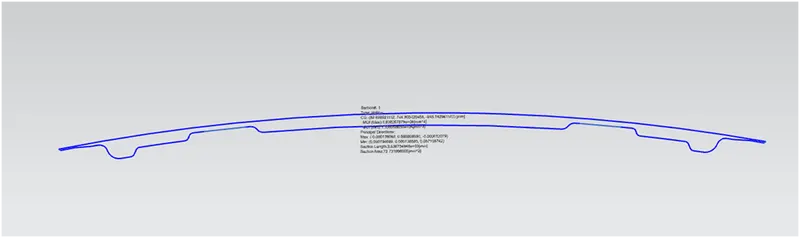
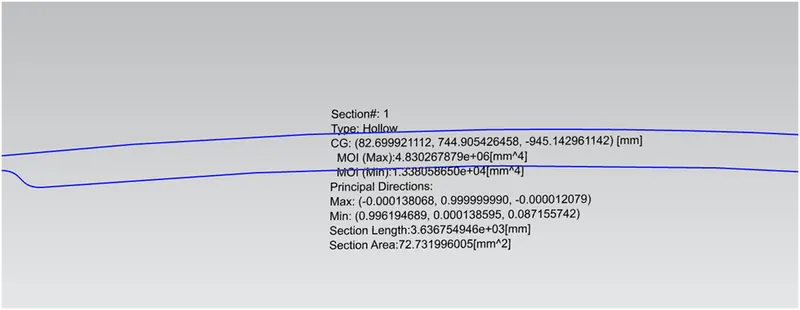
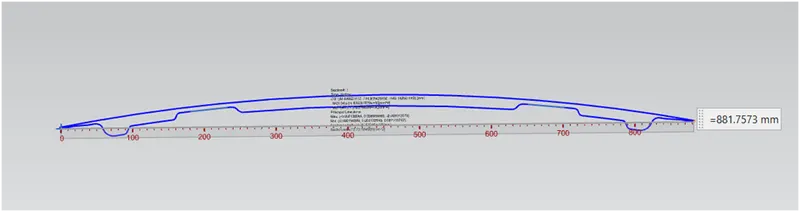
So as shown in above fig. we get Max. M.I and Min M.I. Also measure the distance,
so,
Max M.I = 4.83026879*10^6 mm^4
Min M.I = 1.338058650*10^4 mm^4
Ymax = 881.7573/2 = 440.87mm
S =I/Ymax
where,
s = Section Modulud
I = Moment of innertia at nuetral axis
Ymax = Maximum distance of outer edge from nutral axis
For design consideration we take min value far fail safe system
S = 1.338058650*10^4/440.87
S = 0.3035*10^2 mm^3 -1
Case 2 For optimised design of hood section modulus is :-
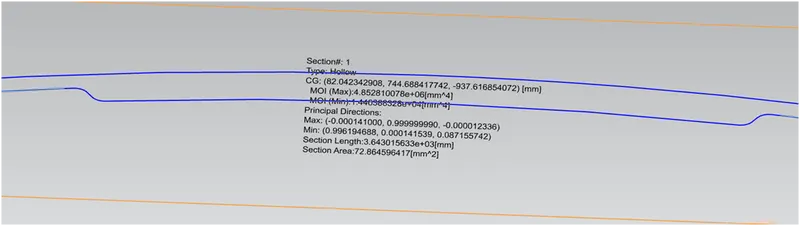
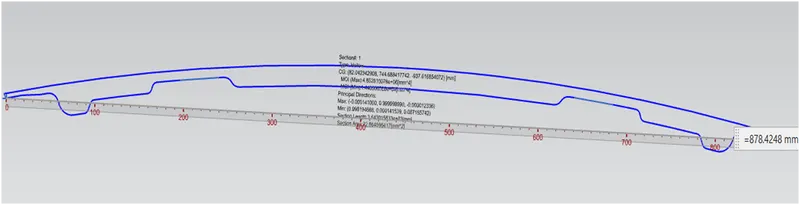
So in modefied design we increase cross section area and reduce distance of outer edge as shown beslow so we get the results as follows
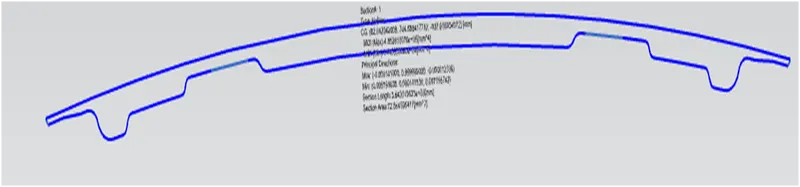
so we calculate the section modulus for above design we get,
Max M.I = 4.852810078*10^6 mm^4
Min. M.I = 1.440388328*10^4 mm^4
Ymax = 878.4248/2 = 439.2124 mm
So by considering Min M.I for design we get section modulus as
S = I/Ymax
S = 1.440388328*10^4/439.2124
S = 0.3279*10^2 mm^3 -2
Conclusion -
From Case 1 and case 2 rsult of section modulud we concluded that we get the better results in case 2 by modefiying it cross sectional area and length.