Section Modulus calculation and optimization
SECTION MODULUS OF AN HOOD
AIM
To calculate the section modulus of the previously designed hood for analyzing its strength and also optimizing the design to see the difference in the bending strength of the hood.
INTRODUCTION
SECTION MODULUS:
It is termed as the ratio of the second moment of area and distance from N.A (Neutral axis) to the extreme fiber. Also, it is the measure of the strength of the given member. The stress in the outermost section of the beam is computed with the help of section
modulus. It is indicated by S. Section modulus is indicated as follows:
S=I/Y
Here, I is "moment of inertia" and y is the distance from the "neutral axis" to the top or bottom of fiber.
The Unit of "section modulus" is in (`mm^3`)
Section modulus depends only on the cross-section shape of the structure. For symmetric sections, the value of "section modulus" is for both above and below of centroid of the fiber. An asymmetric section has two values for top and bottom of the fiber due to different distance from the centroid to the top and bottom of the material, the maximum "section modulus" is S max and the minimum section modulus is S min.
Moment of inertia is nothing but offering resistance against of moment, bending or twisting, ie if we applied any external load on the body, how much resistance its offering to tend to deform.
So, higher the value of moment of inertia, have higher resistance to deform under certain load, hence we can say that moment of inertia directly proportional to the strength of the material, and strength of the material can be calculated with the help of section modulus.
If we vary the neutral axis towards positive or negative side the overall strength of the body will decrease, because when nuetral axis line lies on the middle of the section only have higher strength at particular point, so, here 'Y' value was inversely proportional to section modulus.
Importance:
- It is significant for beam and flexural member design.
- More the section modulus, the more the member is resistant to the bending of the beam.
- It is easier to calculate stresses in the beam and an exact measure of the strength of steel.
- If two beams are made of the same material and comparing the "section modulus" of two beams, the beam with bigger section modulus will be tougher and more capable to withstand larger loads.
Case 1
Section modulus of Hood
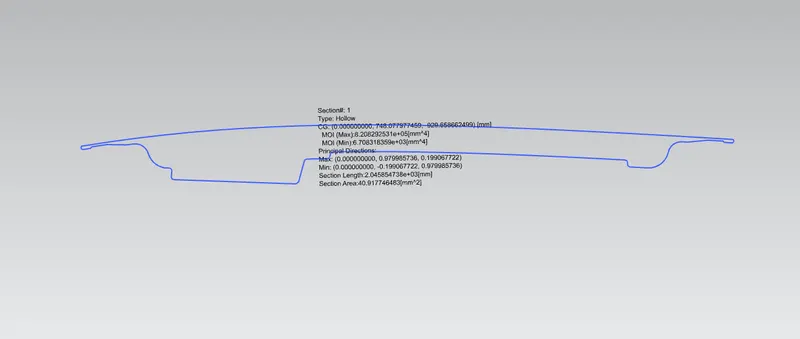
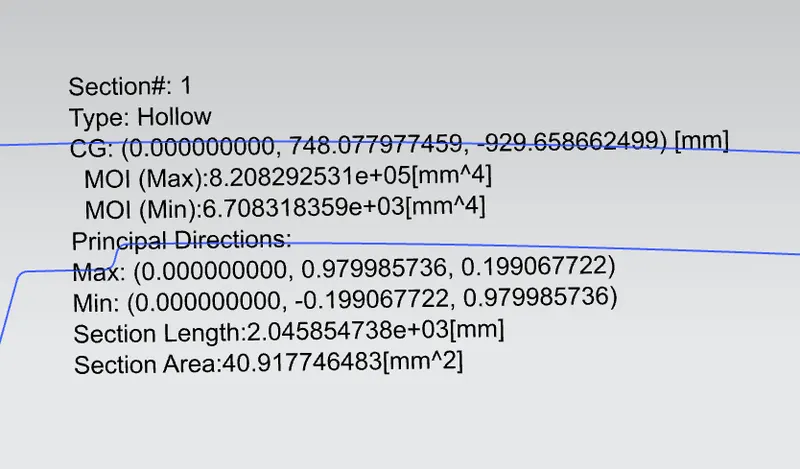
MOI (Max)= 8.208292531e+05[`mm^4`]
MOI (Min)= 6.708318359e+03[`mm^4`]
As per the section modulus equation,
S=I/Y
I = MOI (Min) is considered
Y = Total distance /2,
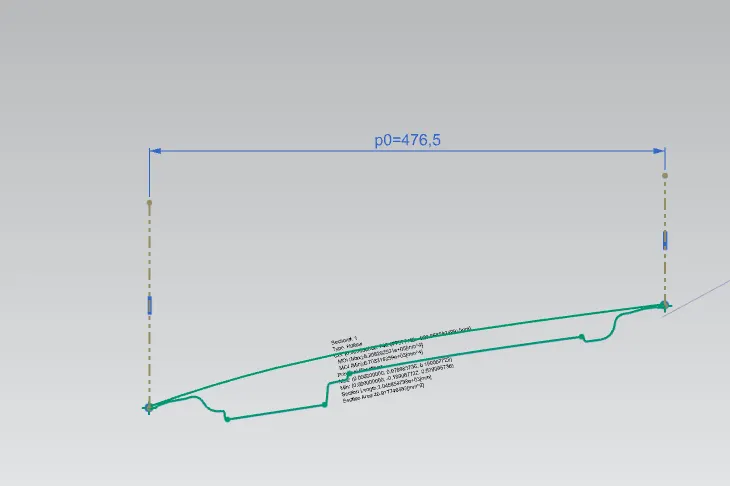
Total distance=476.5 mm
Y=476.5/2= 238.25 mm
Section modulus(S)= I/Y =(6.708318359x`10^3` )/238.25`
=28.156`mm^3`
Case 2
Inner panel offset to a distance of 0.5 mm outward
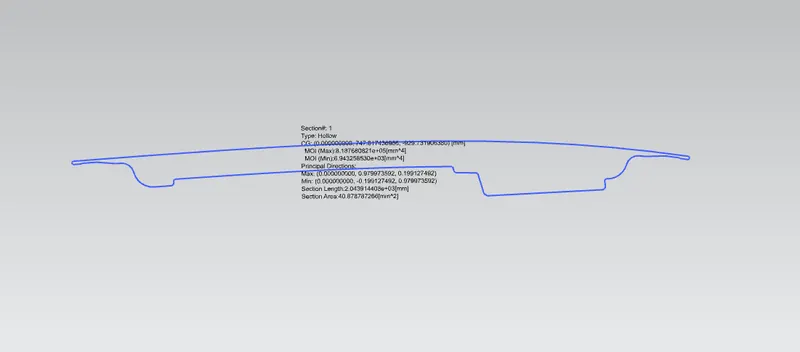
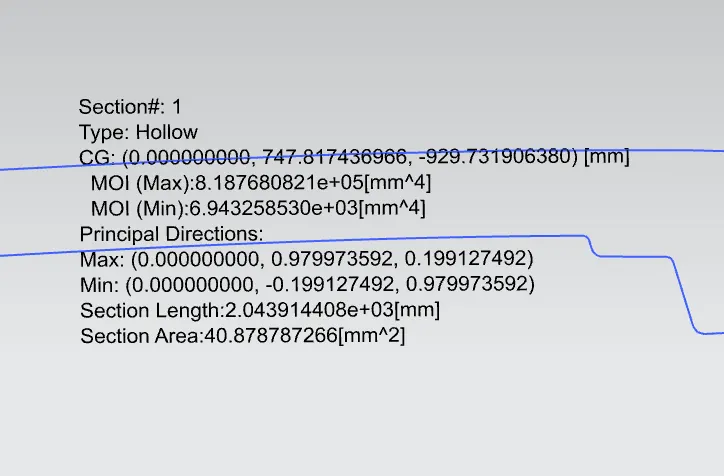
MOI (Max)= 8.187680821e+05[`mm^4`]
MOI (Min)=6.943258530e+03[`mm^4`]
Y= 238.25 mm
Section modulus(S)= I/Y=(6.943258530 x `10^3`)/ 238.25
S = 29.14 `mm^3`
Final result: Thus the stiffness of the car hood has been increased by increasing its area moment of inertia.
CONCLUSION
Section modulus is directly dependent on the area moment of inertia and the distance from the neutral axis. Hence, to improve the geometry of the carry more bending load, the section modulus can be improved by increasing the area MOI of a given section. We can increase the section modulus just increasing the gap between the outer & Inner panel.