Section Modulus calculation and optimization
Section Modulus calculation and optimization
Aim :
To create the section for hood and calculate section modulus and optimization the section modulus.
Theory :
Section properties involve the mathematical properties of structural shapes. They are of great use in structural analysis and design. Note that these properties have nothing to do with the strength of the material, but are only based on the shape of the section. Those properties are
- Centre of area (Centriod)
- Second moment of area (or) moment of inertia (I)
- Section modulus (S)
- Radius of gyration (r)
Though generally section modulus is calculated for the extreme tensile or compressive fibres in a bending beam, often compression is the most critical case due to onset of flexural torsional buckling. Generally tensile extreme fibres have a higher allowable stress or capacity than compressive fibres.
Centre of Area (Centriod) :
The centriod of a section is important in structural design and is like the centre of gravity of the shape. Many other simple shapes are symmetrical about the x-x and y-y axis and the centriod can easily be seen.
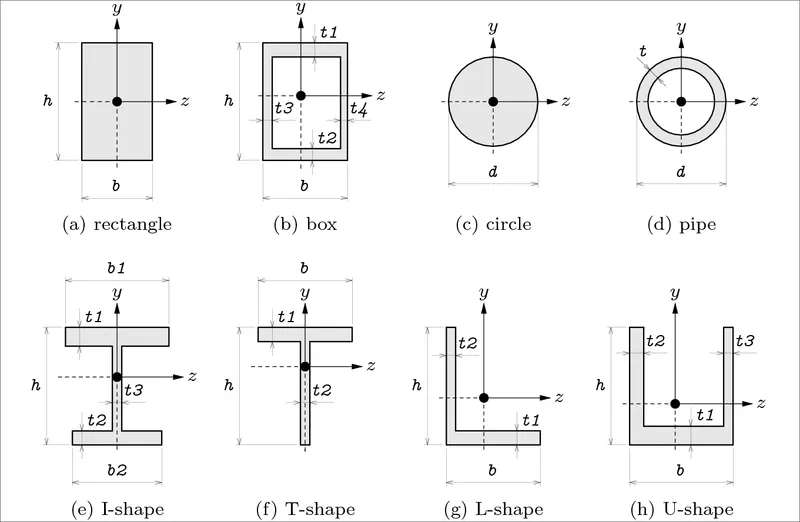
Moment of Inertia (I) :
The second moment of area is a geometrical property of an area which reflects how its points are distributed with regard to an arbitrary axis. The second moment of area is typically denoted with I. The second moment of area is also know as the moment of inertia of a shape. It is directly related to the area of material in the cross-section and the displacement of that area from the centroid. Once the centroid is located, the more important structural properties of the shape can be calculated. The axis that determines the centroid is also known as the neutral axis (N/A). The second moment of area is a measure of the "Efficiency " of a shape to resist bending caused by loading. A beam tends to change its shape when loaded. The second moment of area is a measure of a shape's resistance to change.
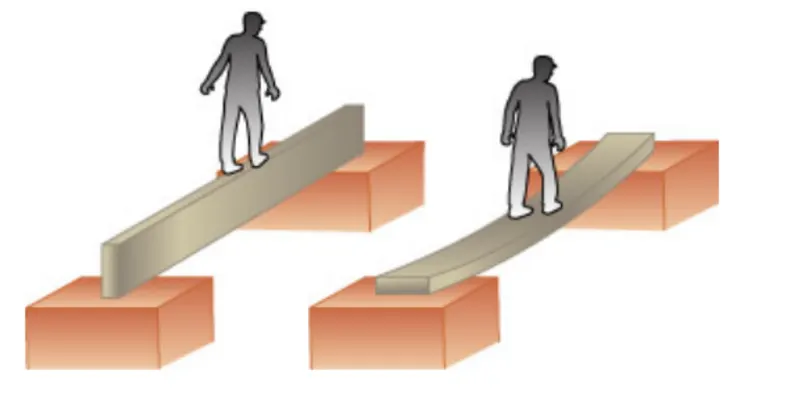
Certain shapes are better than others at resisting bending as demonstrated in the diagram. Clearly the orientation of the shape also influences bending.
Calculating the moment of inertia (I) :
For simple shapes such as squares, rectangles and circles, simple formulas have been worked out and the values must be calculated for each case.
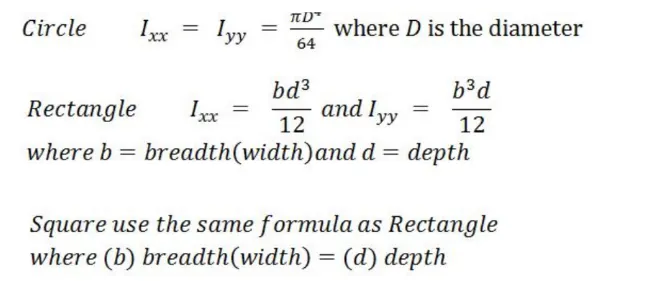
A standard method of denoting moment of inertia is to write the value mm^4.
Section modulus (S) :
The section modulus of the cross sectional shape is of significant importance in designing beams. It is a direct measure of the strength of the beam. A beam that has a larger section modulus than another will be stronger and capable of supporting greater loads.
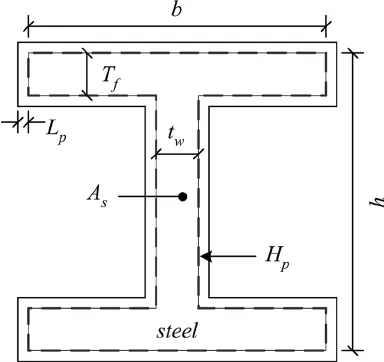
Section modulus is denoted by S. To calculate S, the distance (y) to the extream fibres from the centroid (or neutral axis) must be found as that is where the maximum stress could cause failure.
Calculating the section modulus by S=I/y
Where,
I - Moment of inertia.
y - Distance from centroid to top.
for symmetrical section the value of S is the same above or below the centroid. For a symemetrical sections, two values are found S max and S min.
Design and calculation :
Case 1 :
For calculating the section modulus we need to find out the moment of inertia and the y value for that we first open the body file of hood both inner and outer panel. Then we need to see the inter section of the hood panel in the y direction for that we use the tool intersection curve in the NX cad as shown in figure.
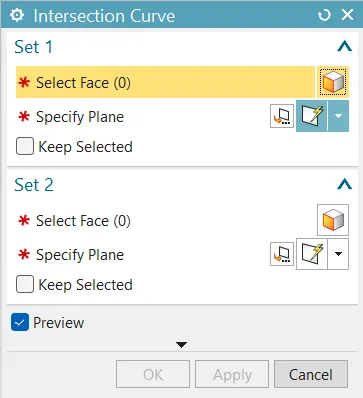
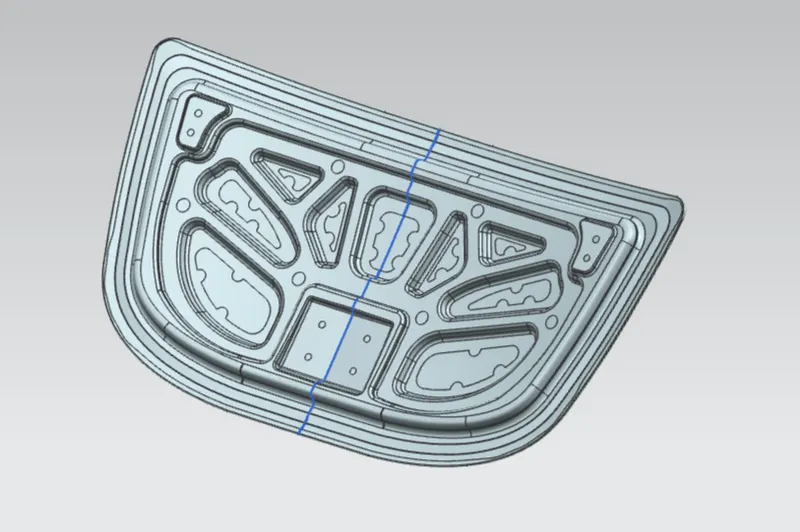
Then next is to hide the inner and outer bodies of the hood panel. Now we geting the required curve through hood panel. and from the we need the outer panel outer lines and for inner panel we need the outer lines. so need to select the sketch and project curve option we getting the curve in the plane and trim the the unwanted lines and curves and join the inner and outer panel in both ends as shown in figure.
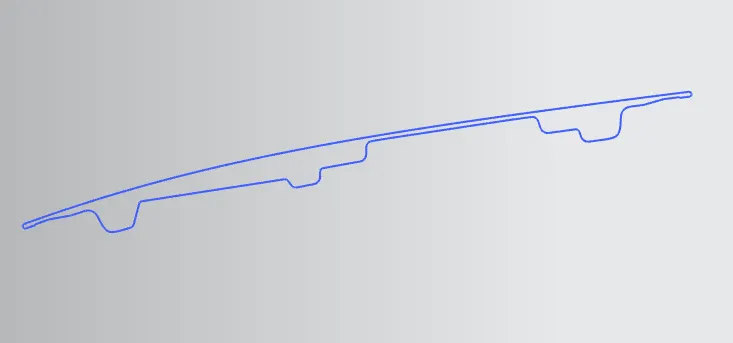
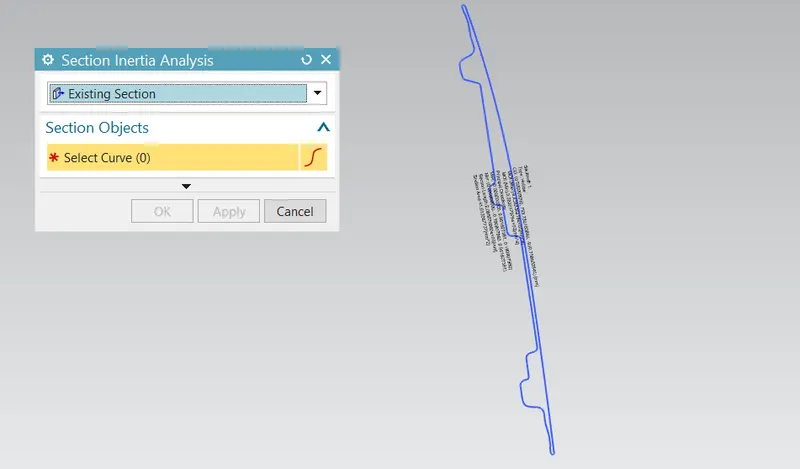
Now we have the required cross section of the hood panel. so we now try to find out the moment of inertia for this curve. For find the moment of inertia in NX cad it have tool called as Section inertia Analysis.
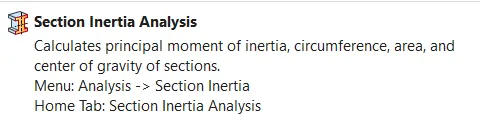
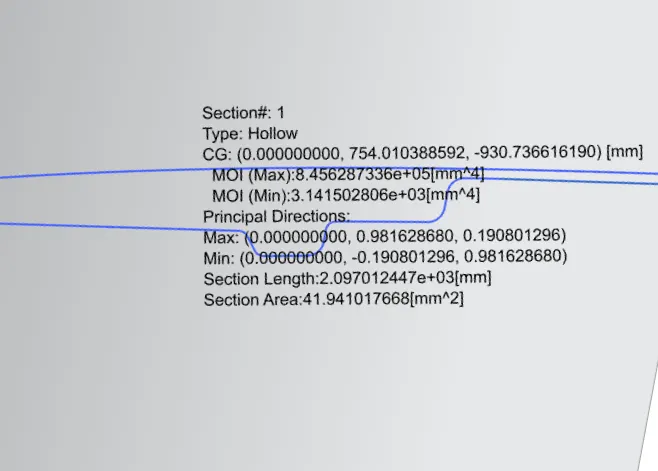
By use this tool in the created cross section curve we can find out the inertia value. so open the tool and in the select object we need to select the full curve of the hood section as shown in figure. Then it will show the results as shown infigure.
And for find out the y value we need to find the distance from the outer most end of the cross section by using dimension obtions as shown in figure. here the distance is we can say 478.2 mm.
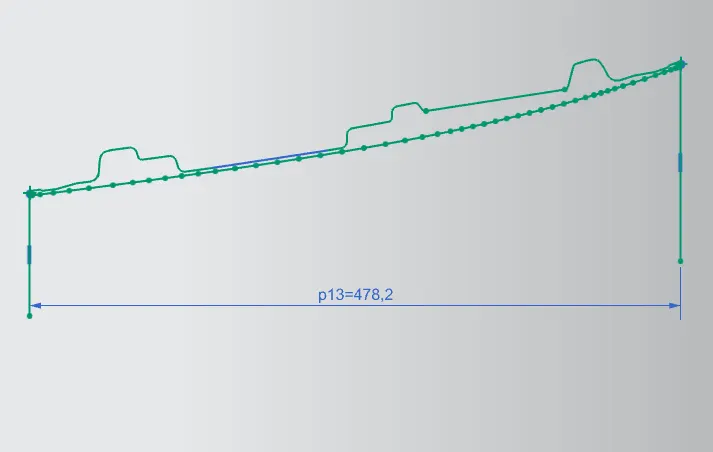
so, the total distance is 478.2 mm
The moment of inertia for this case 1 is,
MOI (max) = 8.456X10^5 mm^4
MOI (min) = 3.141X10^3 mm^4
As per the section modulus equation,
S=I/y
here,
I - MOI (min) we need to take
Y - Total distace/2 => 478.2/2 => 239.1 mm
S = (3.141X10^3) / 239.1
= 3141 / 239.1
S = 13.14 mm^3
Case 2 : (Offset by 0.5mm)
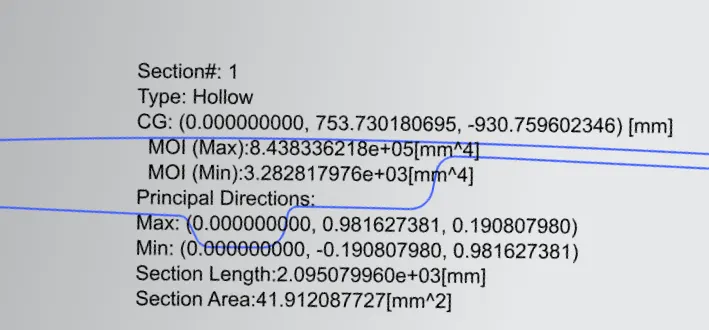
For this case 2 we now increase the depth for the hood panel for inprove the section modulus. so, for increase depth inner hood panel curve is offset by 0.5mm outwards and section inertia analysis is done same as case 1 for a closed curve. and by the same procedure followed in the case 1 is here also followed and finally we get the results as shown in figure.
so, the total distance is 478.2 mm
The moment of inertia for this case 1 is,
MOI (max) = 8.438X10^5 mm^4
MOI (min) = 3.283X10^3 mm^4
As per the section modulus equation,
S=I/y
here,
I - MOI (min) we need to take
Y - Total distace/2 => 478.2/2 => 239.1 mm
S = (3.283X10^3) / 239.1
= 3283 / 239.1
S = 13.73 mm^3
So, here we can see the section modulus has increased when compared to the case 1.
Conclusion :
Hence we create the section for hood and calculated section modulus and optimization the section modulus also done sucessfully.
- The section modulus value of case 2 is higher than the case 1.
- As we increase the section area, the moment of innertia and the section modulus increases which means strength and load withstand capacity of the material can be increase.