Section Modulus calculation and optimization
Section Modulus calculation and optimization:
Aim:- To calculate and compare the section modulus of the hood design and to conclude which one has a more strength.
Introduction of section modulus:
Section modulus is a geometric property for a given cross-section used in the design of beams or flexural members. Other geometric properties used in design includes area for tension and shear, radius of gyration for compression, and moment of inertia and polar moment of inertia for stiffness. Any relationship between these properties is highly dependent on the shape in question. Equations for the section module of common shape are given below.
There are two types of section modulus.
- Elastic section modulus
- Plastic section modulus.
Elastic section modulus.
- Ze is the elastic section modulus
- Resisting moment My = fy x Zy
- The elastic section modulus assumes the section remains elastic.
- If the failure is considered till the elastic zone then we consider elastic modulus.
- Elastic modulus is the steel modulus based on the stress strain curve before yielding.
- Ze is used to determine the maximum bending moment up to the point where the extreme fibre has yielding elastically. All other fibres will be below their elastic yield stress.
Plastic section modulus:
- Zp is the plastic section modulus.
- Resisting moment Mp = fy x Zp
- The plastic section modulus assumes the entire section yields.
- If the failure is considered till the plastic zone (breaking point) then we consider plastic modulus.
- The plastic modulus is after yielding.
- Zp is used to determine the maximum bending moment at the point where all fibres have yielding elastically and the entire section is behaving plastically. This is the point when the so called plastic hinge has developed.
Section modulus can be calculated using a formula:
S = I/Y
Where,
S = section modulus
I = Moment of inertia
Y = Distance from the neutral axis to the most extreme end of the object.
Section modulus:
CASE 1:
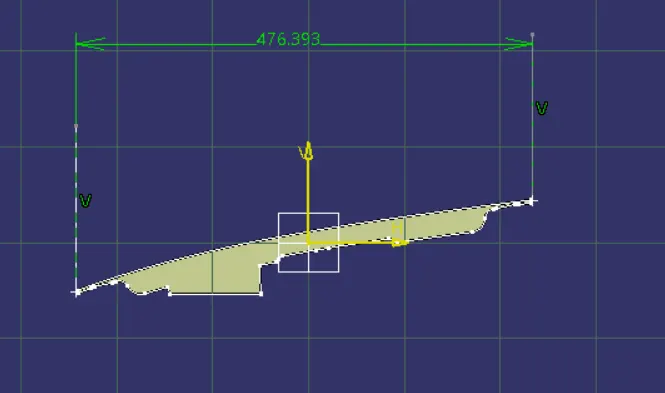
- Take an intersection of the designed car hood outer panel and the inner panel.
- Closed section intersection curve.
- Measure the moment of inertia by using the inertia command in the Catia v5.
- Measure the length from the neutral axis to the one of extreme and (y).
Put all the value obtained in a given formula to calculate moment of inertia.
i.e., S = I/Y
were,
I = 3.305722*10^-6 m^4 = 3.3057*10^4 mm^4
Y = 476.939/2 = 273.9657mm.
We get
S = 12.066 mm^3.
Case 2:
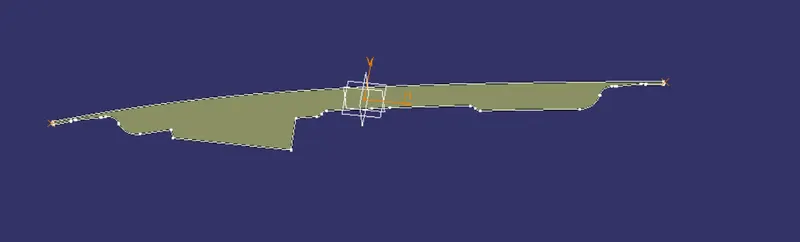
Increase the area of cross section of the hood by increasing the gap between the inner and thr outer panel by 0.5mm.
Measure the inertia by using inertia command.
With the same length (y) put all the values in the formula to get section modulus.
S = I/Y
Were,
I = 3.921*10^6 m^4 = 3.921*10^4 mm^4.
Y = 476.396/2 = 238.1965 mm.
We get,
S = 60.0862 mm^3
Comparison of case1 & case2 :
When we compare case1 of section modulus to the case 2 of section modulus, the case 2 section of modulus is more than case1, it means the section of modulus is directly proportional to the area of cross section, and we can also say strength and load bearing capacity is more case 2 compared to case 1.
Conclusion:
Thus the section of modulus increases, more strength the material have and section of modulus is directly proportional to the area of cross section.