Section Modulus calculation and optimization
Section Modulus :
Section Modulus is the geometric property of the given cross-section of any shaft or beam structures. It is the direct measure of the strength of the shaft section or the beam section. Higher the section modulus of a structure, the more the resistive it becomes to bending.
We can also that section modulus is defined as the ratio of polar moment of inertia to the radius of the shaft or the distance from the neutral axis to the outer fibres.
The common way of calculating Section_Modulus for a shaft requires is its diameters even if it is a solid or hollow shaft. If it is a beam (Square/rectangle in shape) then it will require the moment of inertia and the distance of the outer fibres from its neutral axes.
S = I / y
y = c, where c is the distance from the neutral axis to the most extreme fibre.
Moment of inertia :-
The moment of inertia (I) is defined as the product of mass of section and the square of the distance between the reference axis and the centroid of the section.
The moment of inertia I is also defined as the ratio of the net angular momentum L of a system to its angular velocity ω around a principal axis.
The units for section modulus are typically cubic inches / in^3 / mm^3. The bending moment that it takes to yield that section equals the section modulus times the yield strength. Various bending equipment has section modulus ratings.
There are two types of section modulus, the elastic section modulus (S) and the plastic section modulus (Z).
The elastic section modulus :-
The elastic section modulus is defined as S = I / y, where I is the second moment area (or area moment of inertia, not to be confused with moment of inertia) and y is the distance from the neutral axis to any given fibre. It is often reported using y = c, where c is the distance from the neutral axis to the most extreme fibre, as seen in the table below. It is also often used to determine the yield moment (My) such that My = S ⋅ σy, where σy is the yield strength of the material.
The plastic section modulus :-
The plastic section modulus depends on the location of the plastic neutral axis (PNA).The PNA is defined as the axis that splits the cross section such that the compression force from the area in compression equals the tension force from the area in tension. So, for sections with constant yielding stress, the area above and below the PNA will be equal, but for composite sections, this is not necessarily the case.
Section Modulus Calculation For Hood
case 1 :- For forantal crash analysis of main hood (with out change)
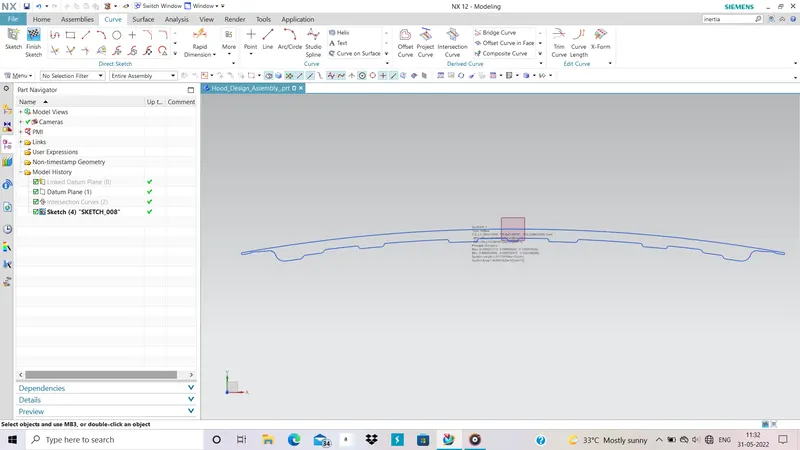
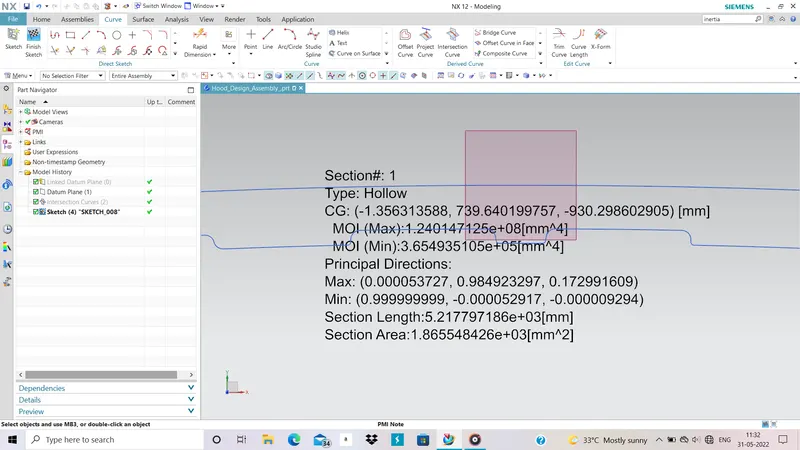
Moment of inertia (MOI)
I max. = 1.240147125e+08 [mm^4]
I min. = 3.654935105e+05 [mm^4]
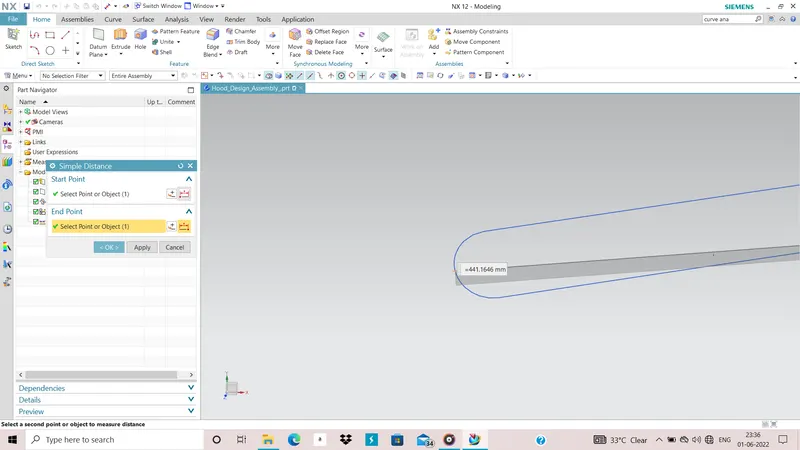
Distance between the netural axis / mid point of hood and the extreme end of the the hood,
Y = 441.1646 mm
Section modulus ,
S = Moment of inertia / Distance between the netural axis and the extreme end of the the hood
S = I / Y
For MOI Max. :-
S = 1.240147125e+08 mm^4 / 441.1646 mm
S =8.3796 mm^3
For MOI Min. :-
S = 3.654935105e+05 mm^4 / 441.1646 mm
S =1.22956 mm^3
Case 2 :- For forantal crash analysis of main hood.
After adding some emboss to hood inner panel sketch.
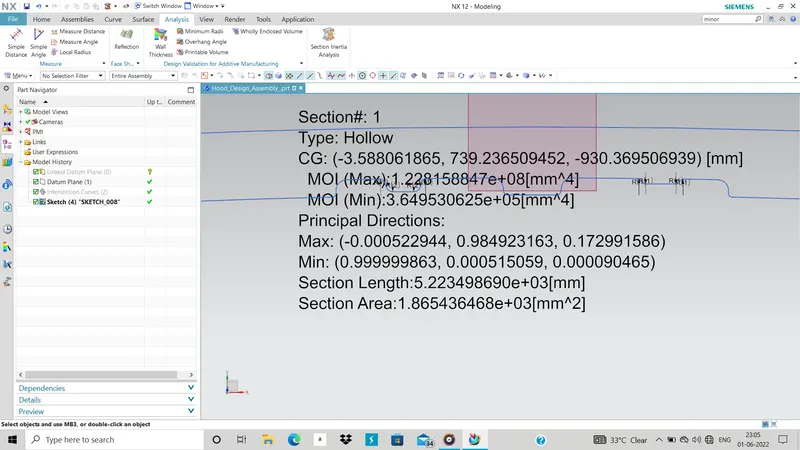
Moment of inertia (MOI)
I max. =1.228158847e+08 [mm^4]
I min. =3.649530625e+05 [mm^4]
Distance between the netural axis and the extreme end of the the hood,
Y = 441.1646 mm
Section modulus ,
S = Moment of inertia / Distance between the netural axis and the extreme end of the the hood
S = I / Y
For MOI Max. :-
S = 1.228158847e+08 mm^4 / 441.1646 mm
S =8.298693785 mm^3
For MOI Min. :-
S = 3.649530625e+05 mm^4 / 441.1646 mm
S =1.227746672 mm^3
Case 3 :- For forantal crash analysis of main hood.
After offset it to 3mm between inner and outer panel.
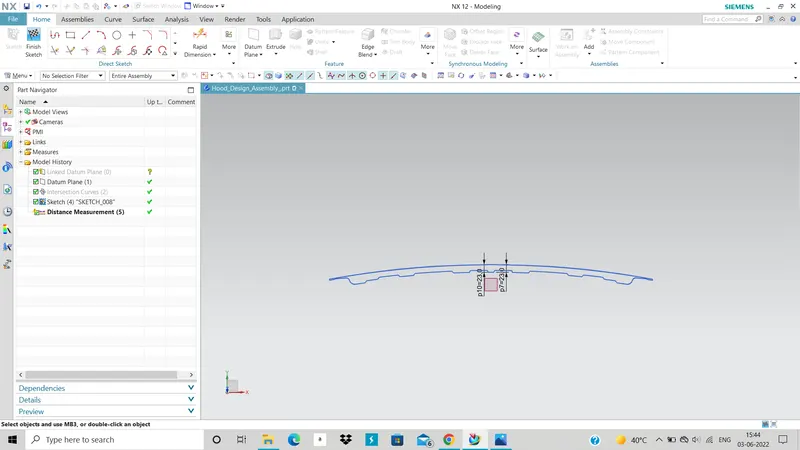
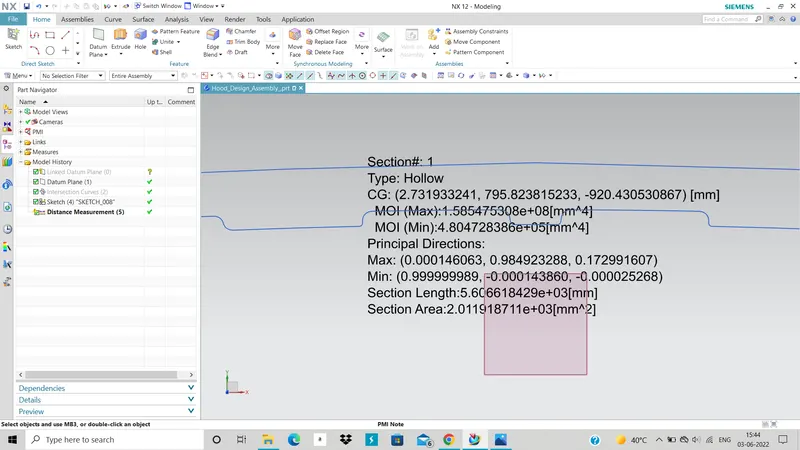
Moment of inertia (MOI)
I max. = 1.585475308e+08[mm^4]
I min. = 4.804728386e+05[mm^4]
Distance between the netural axis and the extreme end of the the hood,
Y = 441.1646 mm
Section modulus ,
S = Moment of inertia / Distance between the netural axis and the extreme end of the the hood
S = I / Y
For MOI Max. :-
S = 1.585475308e+08 mm^4 / 441.1646 mm
S =10.71308823 mm^3
For MOI Min. :-
S = 4.804728386e+05 mm^4 / 441.1646 mm
S =1.616369306 mm^3
Conclusion :-
From above calculation of section modulus of main hood and after modifying the hood. We can conclude that section modulus is directly proportional to the moment of inertia so if we increase the value of moment of inertia then section modulus increase but in the hood we can not go beyond the range due to other vehicle and engine parts.