Section Modulus calculation and optimization
SECTION MODULUS CALCULATION AND OPTIMIZATION
Objective :
To calculate the section modulus of the hood assembly and to analyze the strengths at various sections. Optimizing the design to improve the strength of the hood assembly.
Theory :
Section modulus -
It is a geometric property for a given cross-section used in the design of beams or flexural members. The property is depends upon the shape of the section.
There are two types of section moduli, the elastic section modulus (S) and the plastic section modulus (Z).
For general design, elastic section modulus is used, applying up to yield point for most metals and other common materials.
The elastic section modulus is defined as the ratio of second moment of area (or moment of inertia) to the distance from the neutral axis to any given fiber.
Section modulus S = I/y (mm^3)
where,
I = moment of inertia (mm^4)
y = distance from neutral axis to the selected fiber (mm)
Area moment of inertia -
The area moment of inertia is a property of a two-dimensional plane shape which characterizes its deflection under loading. It is also known as the second moment of area or second moment of inertia. The area moment of inertia has dimensions of length to the fourth power.
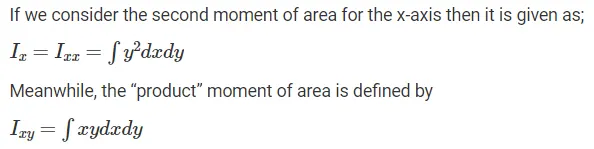
Second moment of inertia -
The second moment of inertia is also known as the moment of inertia of a shape. The moment of inertia of a material is directly proportional to the cross-section and the displacement of area from the centroid.
Any beam, carrying load, tends to change its shape. The second moment of inertia is a measure of a shape's resistance to change for the applied load on it.
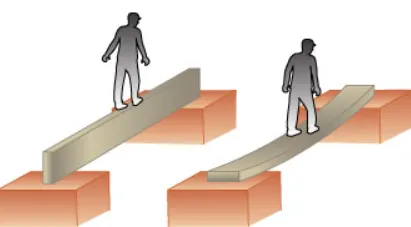
The above diagram shows a beam which is simply supported on both ends. As observed in above picture, as the cross-sectional area increased, the load carrying capacity is also increased.
Calculation :
CASE 1 - Initial Hood design
Creating section and measuring the length
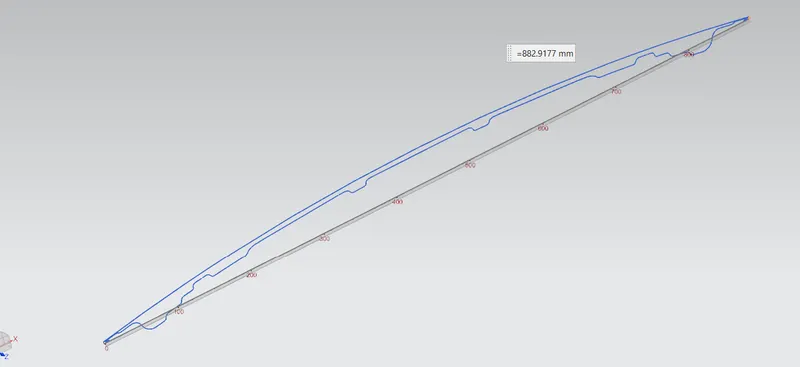
The length of the section is 883 mm
Calculating the moment of inertia
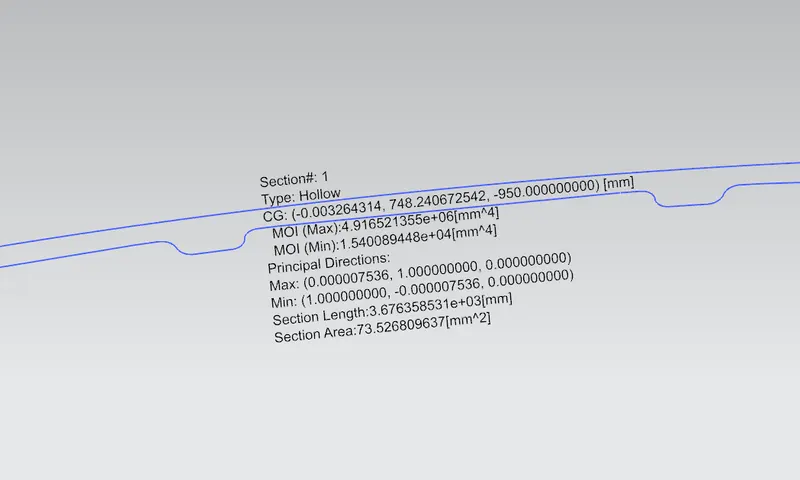
By creating the section analysis, we have the values
Center of gravity, 748.24 mm
moment of inertia 4916521.35 mm^4 (max), 15400.894 mm^4 (min)
Area of section 73.52 mm^2
We know that
section modulus `S = I / y`
Where, y = half of the total length of the section
`:. y = 883/2 = 441.5 mm`
`S = 15400.894 / 441.5 =34.88 mm^3`
CASE 2 - Optimal design
offsetting the inner panel to outer
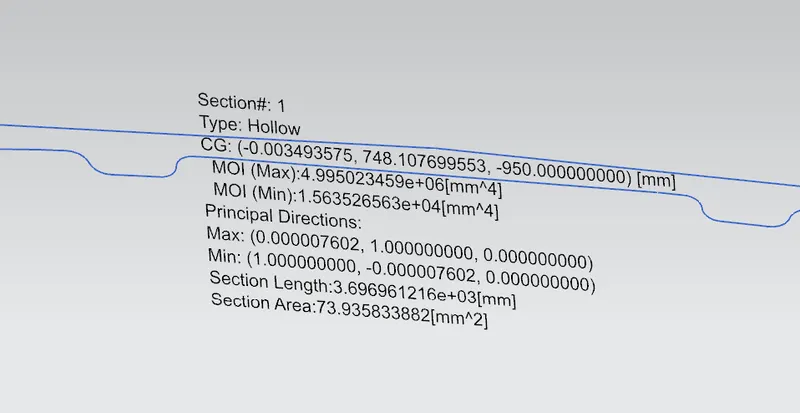
center of gravity 748.107 mm
moment of inertia 4995023.45 mm^4 (max), 15635.2656 mm^4 (min)
section area 73.93 mm^2
section modulus `S = I / y`
`S = 15635.26 / 441.5 =35.41 mm^3`
Conclusion :
From analyzing the section in two conditions, it is observed the increasing the section area will improve the section modulus.
Initially, the section modulus is 34.88 mm^3, after optimizing the model, the section modulus was 35.41 mm^3.
Finally, it has been concluded that, by increasing the area of section, will improve the section modulus.