Section Modulus calculation and optimization
Section Modulus calculation and optimization
Objective:
- To calculate the section modulus of hood design.
- Optimize the section obtained, to improve the section modulus and hence strength of the body.
Introduction:
Section modulus is the geometric property of a given cross-section used in the design of flexural members. Section modulus depends only on the cross-section shape of the beam or structure.
There are two types of section moduli, the elastic section modulus and the plastic section modulus.
Elastic section modulus
- For general design, the elastic section modulus is used, applying up to the yield point for most metals and other common materials.
- The elastic section modulus is defined as S= I / y, where I is the second moment of area (or area moment of inertia, not to be confused with moment of inertia) and y is the distance from the neutral axis to any given fibre. It is often reported using y = c, where c is the distance from the neutral axis to the most extreme fibre, as seen in the table below. It is also often used to determine the yield moment (My) such that My = S ⋅ σy, where σy is the yield strength of the material.
Plastic section modulus
- The plastic section modulus is used for materials where elastic yielding is acceptable and plastic behavior is assumed to be an acceptable limit. Designs generally strive to ultimately remain below the plastic limit to avoid permanent deformations, often comparing the plastic capacity against amplified forces or stresses.
- The plastic section modulus depends on the location of the plastic neutral axis (PNA).The PNA is defined as the axis that splits the cross section such that the compression force from the area in compression equals the tension force from the area in tension. So, for sections with constant yielding stress, the area above and below the PNA will be equal, but for composite sections, this is not necessarily the case.
- The plastic section modulus is the sum of the areas of the cross section on each side of the PNA (which may or may not be equal) multiplied by the distance from the local centroids of the two areas to the PNA.
- The Plastic Section Modulus is not the 'First moment of area'. Both relate to the calculation of the centroid, but Plastic Section Modulus is the Sum of all areas on both sides of PNA (Plastic Neutral Axis) and multiplied with the distances from the centroid of the corresponding areas to the centroid of the cross section, while the First moment of area is calculated based on either side of the "considering point" of the cross section and it is different along the cross section and depends on the point of consideration.
We know that yield strength (σ) in beam or structure is given by
σ/Y = M/I
σ = (M/I)*Y
Section modulus formula (S):
S = I/Y
where, I = Moment of inertia
Y = Distance from the neutral axis to the end surface
Therefore,
M = σ*S
Hence moment about neutral axis is directly proportional to section modulus and yield strength.
Master section for hood design:
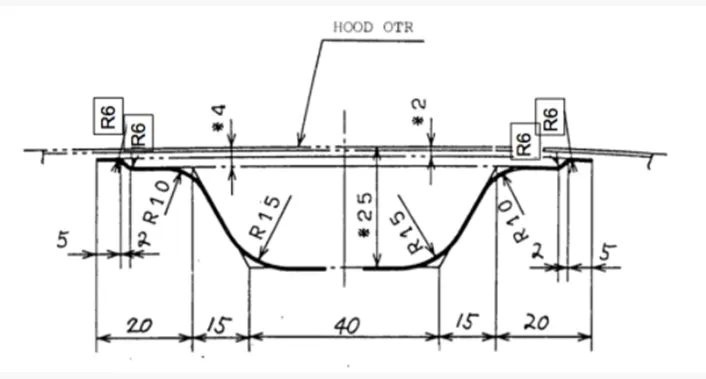
Now, let us calculate the section modulus for initial and optimized hood design
1. Section modulus of initial hood design
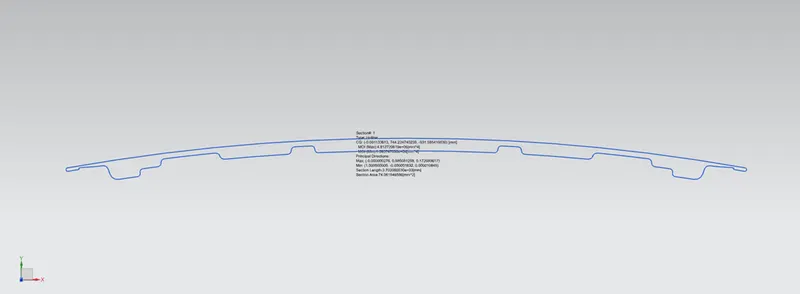
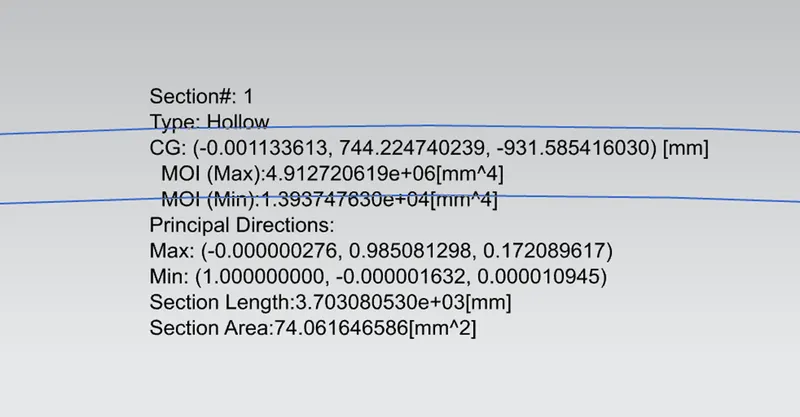
From the above analysis, following minimum and maximum moment of inertia are obtained
Imax = 4.912720619*10^6 mm^4
Imin = 1.393747630*10^4 mm^4
Y = 883.4/2 = 441.7 mm
Smax = Imax / Y
= 4.912720619*10^6 / 441.7
= 11,122.3 mm^3
Smin = Imin / Y
= 1.393747630*10^4 / 441.7
= 31.55 mm^3
2. Section modulus of optimized hood design
Section modulus can also be represented as
S = ∑miAi^2/Y
Where, A is the sectional area and M is mass of the body.
From the above equation we can conclude that section modulus is directly proportional to sectional area of the body or structure.
Hence in the below image, analysis is carried out by increasing the gap (3 mm) between inner and outer panel of the hood which will eventually increase the area of section.
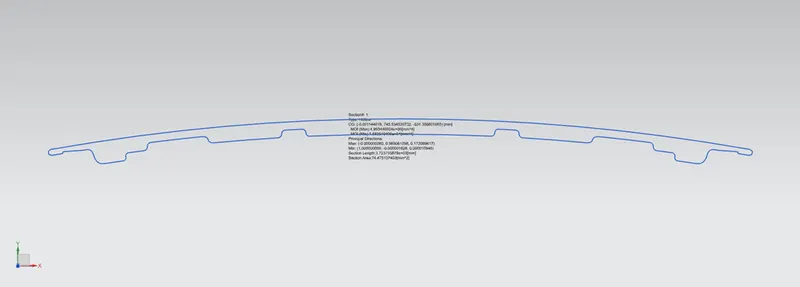
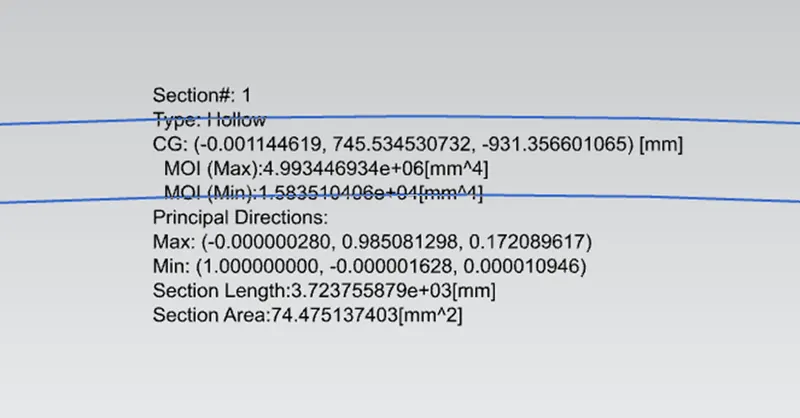
From the above analysis, following minimum and maximum moment of inertia are obtained
Imax = 4.993446934*10^6 mm^4
Imin = 1.583510406*10^4 mm^4
Y = 883.4/2 = 441.7 mm
Smax = Imax / Y
= 4.993446934*10^6 / 441.7
= 11,305.06 mm^3
Smin = Imin / Y
= 1.583510406*10^4 / 441.7
= 35.85 mm^3
Conclusion:
- On comparing section moduli values in both the cases, the section modulus (max) of the optimized hood design is increased by 1.64 %.
- If the gap between inner panel and outer panel of the hood is increased, length of section increases as well as moment of inertia increases.
- Moment of inertia increases with the increase in section area.
- Thus, the strength of section increases with increase in area with both minimum and maximum values.