Section Modulus calculation and optimization
SECTION MODULUS:
Section modulus is a geometric property for a given cross-section used in the design of beams or flexural members. Other geometric properties used in design include area for tension and shear, radius of gyration for compression, and moment of inertia andpolar moment of inertia for stiffness. Any relationship between these properties is highly dependent on the shape in question.
The elastic section modulus is defined as S = I / y, where I is the second moment of area (or area moment of inertia, not to be confused with moment of inertia) and y is the distance from the neutral axis to any given fibre.
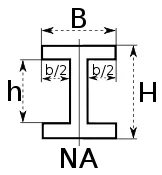
MOMENT OF INERTIA:
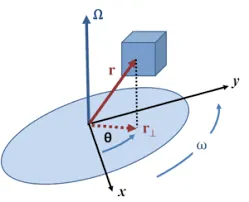
Moment of inertia, in physics, quantitative measure of the rotational inertia of a body i.e., the opposition that the body exhibits to having its speed of rotation about an axis altered by the application of a torque (turning force).
The f:ormula for moment of inertia is the “sum of the product of mass” of each particle with the “square of its distance from the axis of the rotation”. The formula of Moment of Inertia is expressed as I = Σ miri2.
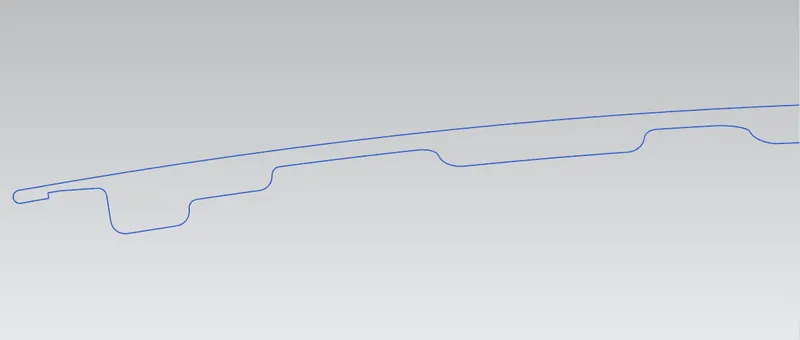
CASE 1: Initial hood design
MOI(min): 1.533541182e+04(mm^4)
Y distance=440.15
Area Moment of Inertia: I(min)
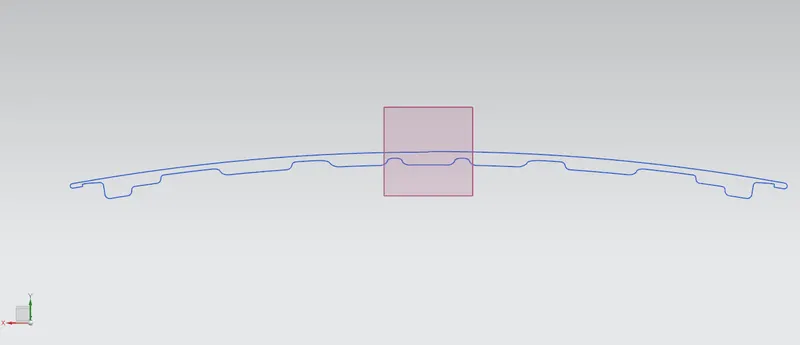
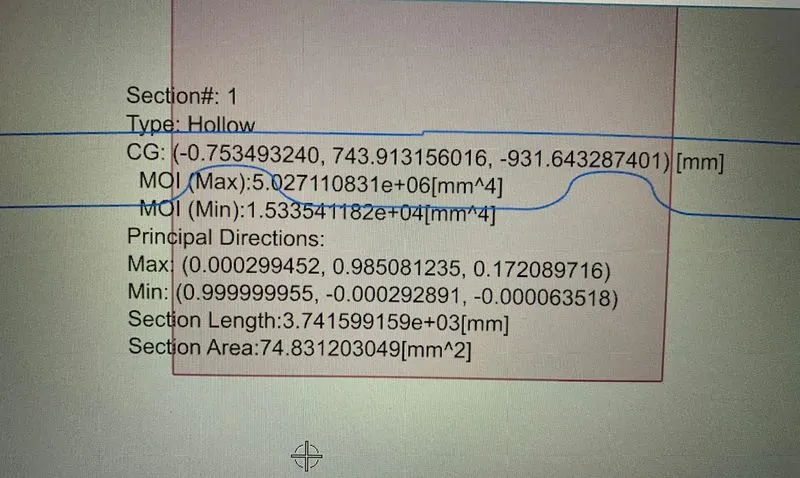
S=I/Y
S=1.533541182e+04/440.15
= 0.190227221 mm^4
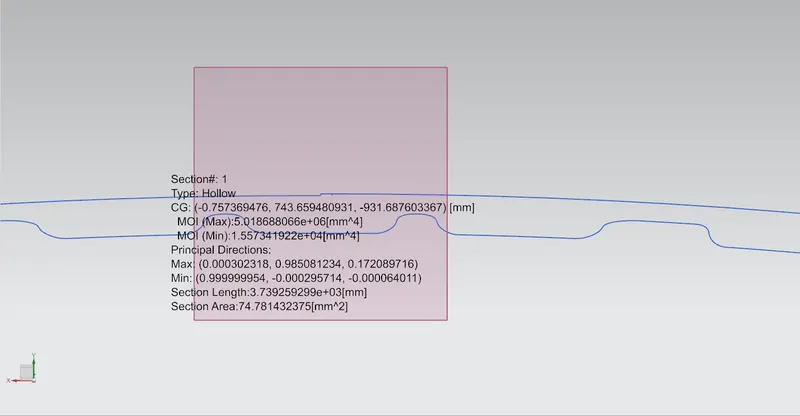
CASE 2: Optimized hood design
MOI(min): 1.557341922e+04(mm^4)
Y distance=440.15
Changes: (Offsetted the inner panel to 0.5mm)
S=I/Y
S=1.557341922e+04/440.15
= 0.19317957 mm^4
CONCLUSION:
Section modulus is directly dependent on the are of moment of inertia and the distance from the neutral axis. Hence to improve the geometry of the carry more bending load, the section modulus can be improved by increasing the area MOI of a given section. We can increase the section modulus just increasing the gap between the outer and inner panel.