Section Modulus calculation and optimization
Aim:
To find a section modulus and the moment of inertia in the hood assembly
Section modulus:
Section modulus is a geometric property for a given cross-section used in the design of beams or flexural members. Other geometric properties used in design include area for tension and shear, radius of gyration for compression, and moment of inertia and polar moment of inertia for stiffness. Any relationship between these properties is highly dependent on the shape in question. Equations for the section moduli of common shapes are given below. There are two types of section moduli, the elastic section modulus and the plastic section modulus.
|
Section modulus equations |
|||
|
Cross-sectional shape |
Figure |
Equation |
Comment |
|
Rectangle |
S = b h 2 6 {\displaystyle S={\cfrac {bh^{2}}{6}}} |
Solid arrow represents neutral axis |
|
|
doubly symmetric I-section (major axis) |
S x = B H 2 6 − b h 3 6 H {\displaystyle Sx={\cfrac {BH^{2}}{6}}-{\cfrac {bh^{3}}{6H}}} S x = I x y {\displaystyle Sx={\tfrac {Ix}{y}}} , with y = H 2 {\displaystyle y={\cfrac {H}{2}}} |
NA indicates neutral axis |
|
|
doubly symmetric I-section (minor axis) |
S y = B 2 ( H − h ) 6 + ( B − b ) 3 h 6 B {\displaystyle Sy={\cfrac {B^{2}(H-h)}{6}}+{\cfrac {(B-b)^{3}h}{6B}}} |
NA indicates neutral axis |
|
|
Circle |
S = π d 3 32 {\displaystyle S={\cfrac {\pi d^{3}}{32}}} |
Solid arrow represents neutral axis |
|
|
Circular hollow section |
S = π ( r 2 4 − r 1 4 ) 4 r 2 = π ( d 2 4 − d 1 4 ) 32 d 2 {\displaystyle S={\cfrac {\pi \left(r_{2}^{4}-r_{1}^{4}\right)}{4r_{2}}}={\cfrac {\pi (d_{2}^{4}-d_{1}^{4})}{32d_{2}}}} |
Solid arrow represents neutral axis |
|
|
Rectangular hollow section |
S = B H 2 6 − b h 3 6 H {\displaystyle S={\cfrac {BH^{2}}{6}}-{\cfrac {bh^{3}}{6H}}} |
NA indicates neutral axis |
|
|
Diamond |
S = B H 2 24 {\displaystyle S={\cfrac {BH^{2}}{24}}} |
NA indicates neutral axis |
|
|
C-channel |
S = B H 2 6 − b h 3 6 H {\displaystyle S={\cfrac {BH^{2}}{6}}-{\cfrac {bh^{3}}{6H}}} |
NA indicates neutral axis |
|
Moment of inertia:
The moment of inertia, otherwise known as the mass moment of inertia, angular mass, second moment of mass, or most accurately, rotational inertia, of a rigid body is a quantity that determines the torque needed for a desired angular acceleration about a rotational axis, akin to how mass determines the force needed for a desired acceleration. It depends on the body's mass distribution and the axis chosen, with larger moments requiring more torque to change the body's rate of rotation.
To find moment of inertia using nx cad:
Case 1: default case
After creating a hood assembly, we create a datum plane and intersection curve for a sketch
Use section inertia analysis tool, to find moment of inertia…we take the minimum moment of inertia and make the calculation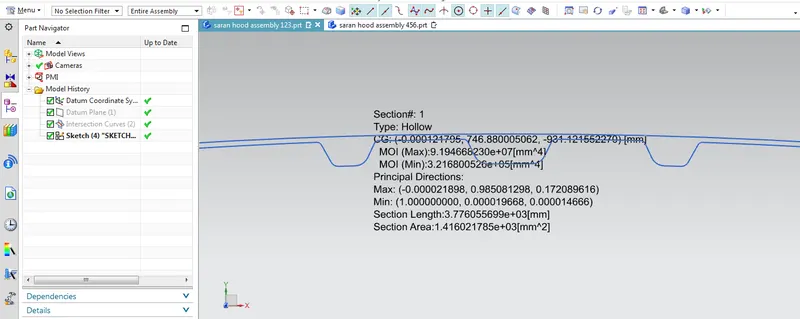
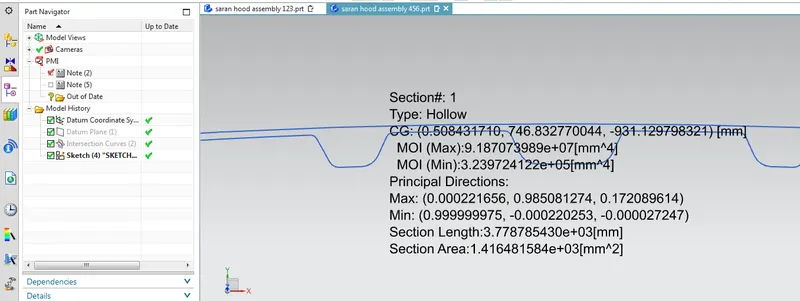
Case 2:
Then , we increase the offset surface by 0.5mm to increase moment of inertia if we increase the area , section modulus also increases
Bending moment is directly proportional to the moment of resistance(inertia) . Inertia is internal resistance to change of motion. It is the tendency to maintain the status .
Create the new datum plane and create sketch., we consider only minimum moment of inertia ..then calculate.
we find moment of inertia ,as a beam bends in downward direction wetake as negative valve is known as ahogging momen for upward directionwe
consider as positive known as shagging moment
Case 3:
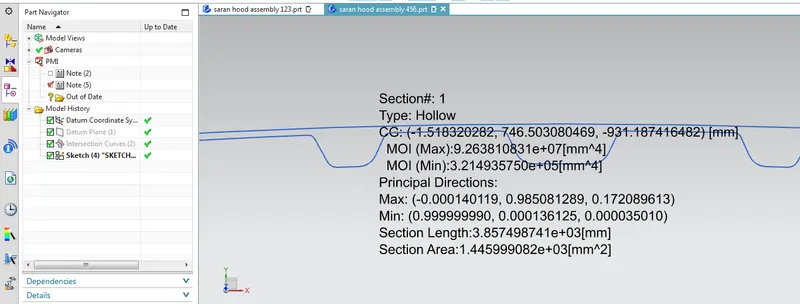
To specify moment of inertia modifying the inner panel sketch to add additional emboss the calculate the moment of inertia. As we modify sketch the area increase moment of inertia increase
M/I=E/R, THEN S=I/Y
I= MOMENT OF INERTIA;Y=DISTANCE BETWEEEN CENTRE AXIS AND EITHER ONE OF THE END ;E=YOUNG;S MODULUS
Bending stress at where bending moment is constant valve is called neutral axis .the unbalanced moment at a section of abeam is called as a bending moment, so we take minimum moment of inertia .
Conclusion:
So, here the difference can be seen in the moment of inertia and change in the section modulus change can be seen in the design (depth)