Section Modulus calculation and optimization
SECTION MODULUS:
Section Modulus is also referred to as the Polar Modulus or the Torsional Sectional Modulus. It is denoted by Zp. Section Modulus is the geometric property of the given cross-section of any shaft or beam structures. It is the direct measure of the strength of the shaft section or the beam section. Higher the section modulus of a structure, the more the resistive it becomes to bending.
- Section modulus is defined as the ratio of polar moment of inertia to the radius of the shaft or the distance from the neutral axis to the outer fibres.
Zp = Ip / R
Polar moment of inertia: Polar moment of inertia measures the resistance to torsion. Polar Moment of Inertia is also called the second polar moment of area. It is usually denoted by IZ. However, sometimes J or JZ is also used. Polar Moment of Inertia can be represented mathematically with the given by
I = r^2 dA
Location of neutral axis: For axi-symmetric, istropic sections the neutral axis is located at centroidal axis. For curved sections teh neutral axis is located at the point where tensile stresses are equal to compressive stresses.
SECTION MODULUS OF HOOD:
section modulus refers to the strength of the hood against loading conditions. For hood we obtain moment of inertia of the design in software and we calculate section modulus in order to optimize the strength of the hood.
Formula : S = I / Y
where I = area moment of inertia.
Y = distance from neutral axis to extreme layer.
Section Modulus for default design of hood:
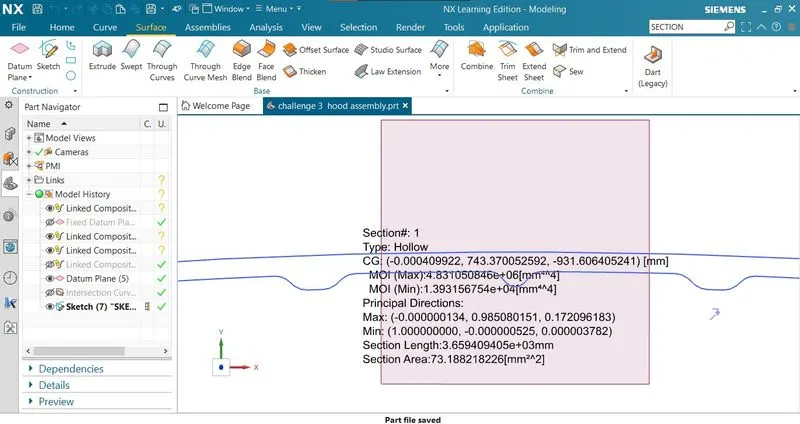
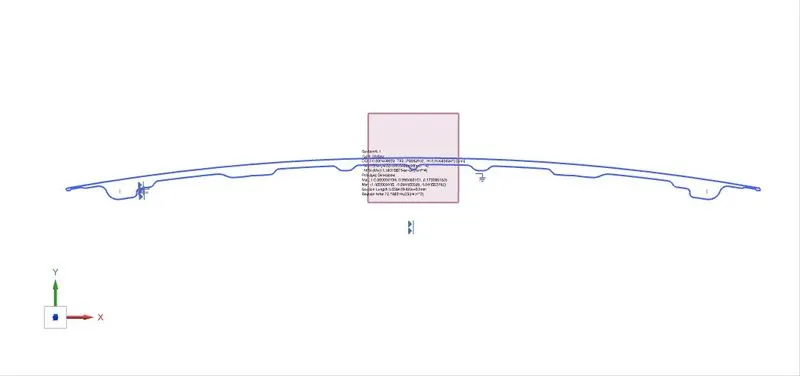
For design consideration minimum value of 'I' should be considered,
I min = 1.3931 * 10^4 mm^4.
Section Modulus for optimized Hood:
For improving strength , the geometry of the section at ribs is modified. Then using the section inertia analysis we obtain the area moment of inertia of the hood as fallows
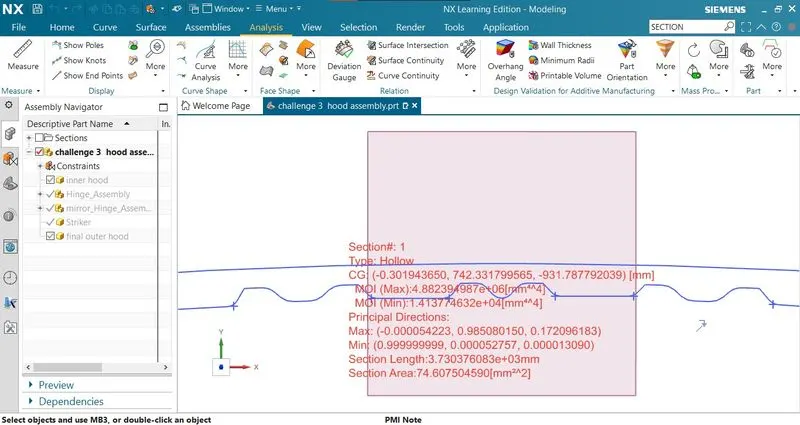
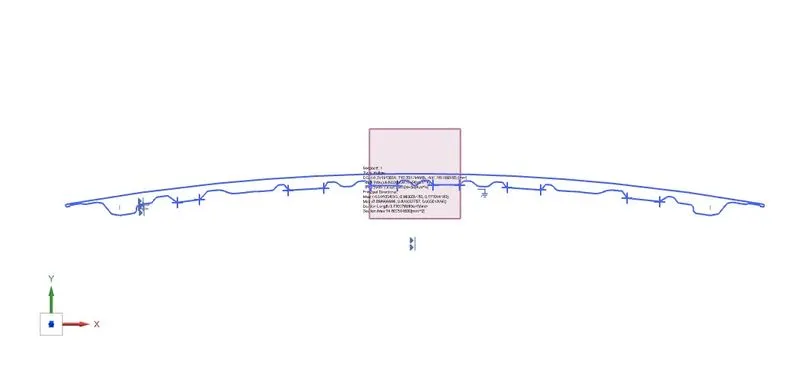
I min = 1.4137* 10^4 mm^4
COMPARISON:
- In the first model the area moment of inertia is found to be I min = 1.3931 * 10^4 mm^4, where as in second model the area moment of inertia is I min = 1.3931 * 10^4 mm^4.
- Strength of component is directly proportional to the area moment of inertia (Section Modulus)
- Therefore second model shows more resistance towards the external load.
- This is achieved by implementing geometrical modification at the rib sections of the model. Therefore design is optimized.