SECTION MODULUS CALCULATION AND OPTIMIZATION FOR CAR BONNET DESIGN
SECTION MODULUS CALCULATION AND OPTIMIZATION FOR CAR BONNET DESIGN
OBJECTIVE:
The main objective is to Calculate the section modulus of the Car Bonnet design and to upcome with the new changes to improve the section modulus of the given bonnet design.
Software used:SIEMENS NX_CAD 12.
WHAT IS SECTION MODULUS:
Section modulus is a geometric property of the cross section used for designing beams and flexural members. It does not represent anything physically.
To define section modulus, it may be defined as the ratio of total moment resisted by the section to the stress in the extreme fibre which is equal to yield stress.
Types of section modulus:
- Elastic section modulus(S)
- Plastic section modulus(Z)
Elastic Section Modulus
For general design, the elastic section modulus is used, applying up to the yield point for most metals and other common materials.
The elastic section modulus is defined as S = I / y, where I is the second moment of area (or area moment of inertia, not to be confused with moment of inertia) and y is the distance from the neutral axis to any given fibre. It is often reported using y = c, where c is the distance from the neutral axis to the most extreme fibre, as seen in the table below. It is also often used to determine the yield moment (My) such that My = S × σy, where σy is the yield strength of the material.
Plaistic Section Modulus
The plastic section modulus is used for materials where elastic yielding is acceptable and plastic behavior is assumed to be an acceptable limit. Designs generally strive to ultimately remain below the plastic limit to avoid permanent deformations, often comparing the plastic capacity against amplified forces or stresses.
The plastic section modulus is the sum of the areas of the cross section on each side of the PNA (which may or may not be equal) multiplied by the distance from the local centroids of the two areas to the PNA:

CALCULATION OF SECTION MODULUS FOR CAR BONNET DESIGN
CASE 1: Section modulus of initial Hood Design
Here the intersection curve for the outer and inner panel is created by using the Intersection tool in NX cad.
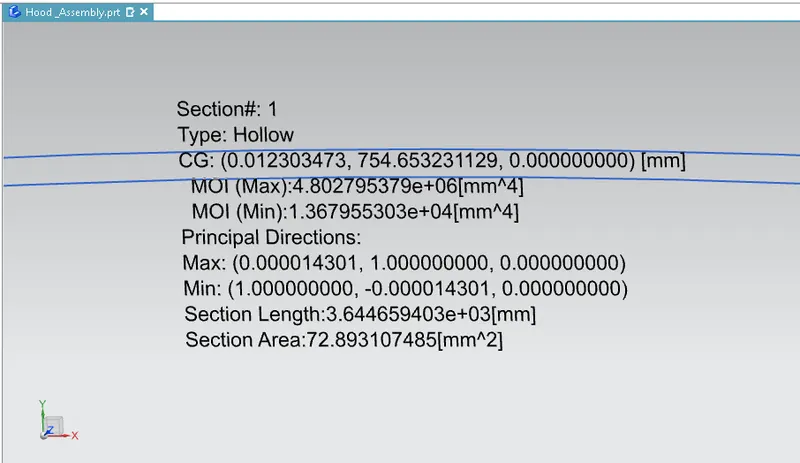
(fig.1.1 scetion inertia analysis using NX)
Section Modulus, S = Moment of Inertia (MOI), I / Distance between the neutral axis and the extreme end of the object (y)
S = I/y
From the above section inertia analysis we get,
Moment of Inertia (MOI), Imax = 4.80279537 x 10^6 [mm^4]
Moment of Inertia (MOI), Imin = 1.367955303 x 10^4 [mm^4]
Distance between the neutral axis and the extreme end of the object,
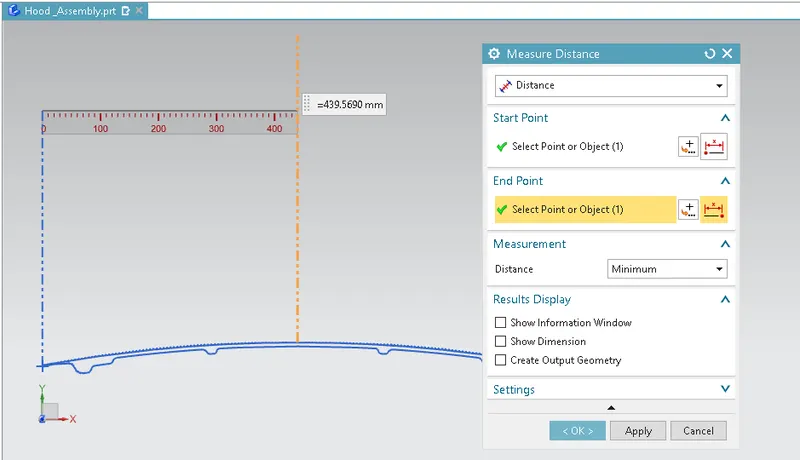
y = 439.57 mm
For Maximum (MOI),
S = I/Y
=(4.80279537 x 10^6 mm^4) / ( 439.57 mm)
S1= 10926.12 mm^3
For Minimum (MOI),
S2= (1.367955303 x 10^4 mm^3) / ( 439.57 mm)
S2= 3112.03 mm^3
CALCULATION FOR SECTION MODULUS FOR OPTIMIZED BONNET DESIGN:
case-2: Section modulus of optimized Hood Design
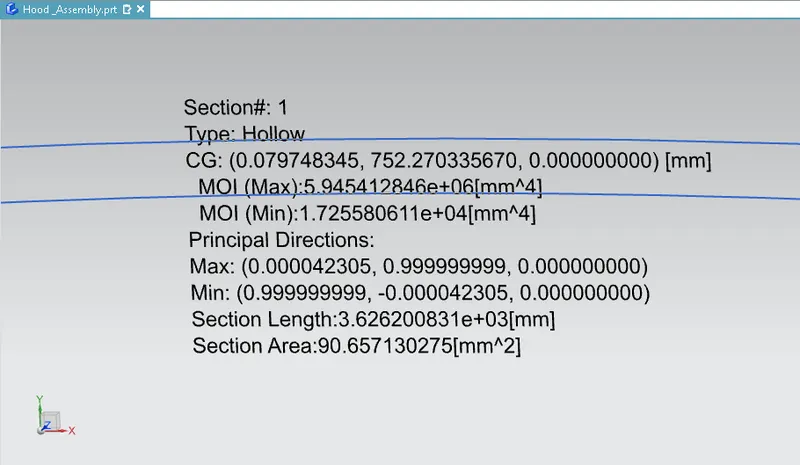
Here the section area is increased by reducing the embossing depth and offsetting the outer panel by 5 mm.
Section Modulus, S = Moment of Inertia (MOI), I / Distance between the neutral axis and the extreme end of the object (y)
S = I/y
From the above section inertia analysis we get,
Moment of Inertia (MOI), Imax = 5.945441284 x 10^6 [mm^4]
Moment of Inertia (MOI), Imin = 1.725580611 x 10^4 [mm^4]
Distance between the neutral axis and the extreme end of the object,
y = 439.57 mm
For Maximum (MOI),
S = I/Y
=(5.945441284 x 10^6 mm^4) / ( 439.57 mm)
S1= 13525.58 mm^3
For Minimum (MOI),
S2= (1.725580611 x 10^4 mm^3) / ( 439.57 mm)
S2= 3925.61 mm^3
CONCLUSION
- Section modulus of initial Hood Design, S=10926.12 mm^3
- Section modulus of optimized Hood Design, S=13525.58 mm^3
Thus,section modulus for my hood design is calculated.Inorder to improve the section modulus new changes(like, reducing the embossing depth and offsetting the outer panel by 5 mm) has been done to increase the area of cross section because the section area is directly propostional to the MOI,i.e if section area increases MOI also increases which will leads to increase in section modulus and strength of the structure. Hence I'm concluding that when the area of cross section of the hood increases the stiffness and resistance of the hood will also be increased.