Section Modulus calculation and optimization for Automotive Hood using NX10.0
Objective:
Section modulus optimization of the hood using NX cad
Tools used:
Sketch, intersection curve, offset curve, measure, section inertia analysis
Description:
Section modulus is a geometric property for a given cross-section used in the design of beams or flexural members. Other geometric properties used in design include area for tension and shear, radius of gyration for compression, and moment of inertia and polar moment of inertia for stiffness.
Generally the center of gravity of the section lies at the diagonals of the rectangular section.
The tendency of a body to resist to change in motion is called inertia and resistance of a body to a rotatory motion is called moment of inertia. It is denoted by letter ‘I’.
Section modulus is generally known as load bearing capacity of a part. Moment of inertia is directly proportional to the section modulus, if moment of inertia goes up the section modulus also goes up. So for a good design the moment of inertia should always be higher. Higher the moment of inertia higher the load bearing capacity.
There are two types of section modulus
- Plastic section modulus
- Elastic section modulus
For general design, the elastic section modulus is used, applying up to the yield point for most metals and other common materials.
Formula for section modulus
S =I/Y
Where I =moment of inertia
Y = distance from the neutral axis to the extreme end
S = section modulus
Procedure:
- Create a datum plane I the middle of the hood
- Use curve intersection tool to intersect the hood outer panel and inner panel and the created datum plane
- We will get a 3D curve
- Create a sketch and then using project 3d curve to create a 2D sketch
- As the hood have thickness only the outer profile of the hood is considered for calculating section modulus
- Edit the sketch and make corners and trim extra projections
- Go to section inertia analysis and then in that select existing section, make sure that the profile is in hollow.
- We get the value of the minimum and maximum moment of inertia i.e., 1.382859279×10^4
a
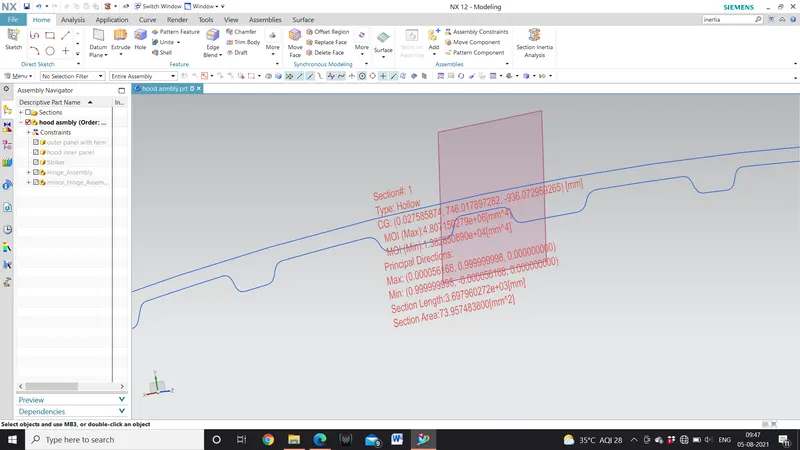
- Now using measure tool measure the distance between the hood center and the hood outer most pat to get the distance from the neutral axis to the extreme point of the hood.
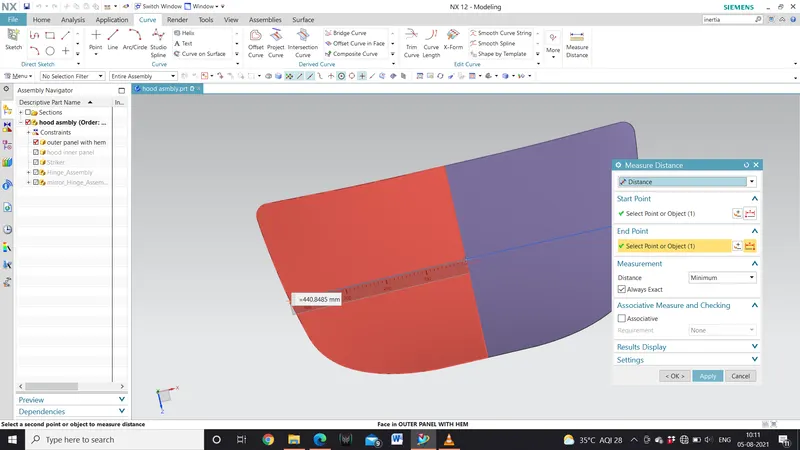
- For me the Y value is 440.85mm
- Using formula S =I/Y mm^3
Where I =moment of inertia
Y = distance from the neutral axis to the extreme end
S = section modulus
Calculate the section modulus i.e., (1.382859279×10^4 )/440.8552 = 31.3676508749. mm^3
- Now we should Modify the section and adjust the embosses without compromising the minimum distance for applying sealant
- In my case I offsite the hood outer panel to 0.8mm
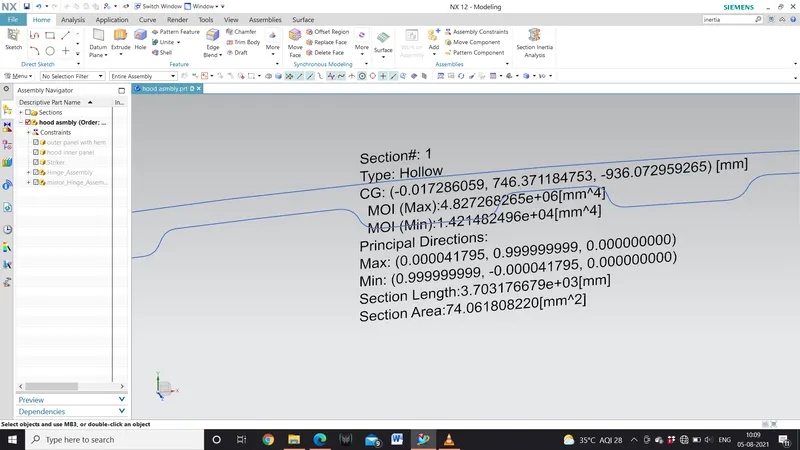
- And got the optimized section modulus value i.e., (1.421482496×10^4 )/4408552 is 32.24375502382 mm^3
- Hence the section modulus of the hood is complete.
Conclusion:
Comparing both the designs the optimized hood section has more moment of inertia resulting in higher strength here we can observe that the moment of inertia and section modulus are directly proportional to each other, so strength increases with increase in sectional area of the component. The optimized section value is 32.24.