Section Modulus calculation and optimization
Section modulus
It is a ratio of the moment of inertia of a section about the neutral axis to the distance of the outermost layer from the neutral axis.
A higher section modulus indicates that a shape has a greater capacity to resist bending stresses. It essentially reflects how far the material in a cross-section is distributed from the neutral axis. Shapes with larger section moduli are more efficient in carrying bending loads, making them suitable for structural applications where bending strength is crucial.
Section modulus is a fundamental parameter in structural engineering and design. Engineers use it extensively to analyse and design various structural components, ensuring that they meet safety and performance requirements. By calculating the section modulus, engineers can determine the adequacy of a structural member in withstanding bending loads and optimize its design for maximum efficiency and safety.
Z = I/y
Whereas,
Z = section modulus
I = Moment of inertia
y = Distance from the neutral axis and the end of the object
Mathematically, section modulus Z is defined as the ratio of a shape's moment of inertia I about a particular axis to the maximum distance Y from the neutral axis to the outermost end of the shape.
The automotive industry constantly strives for innovation to enhance performance, safety, and aesthetics. One critical aspect of car design is the structural integrity of components like the hood, which not only protects the engine but also contributes to the overall safety of the vehicle.
Section modulus calculation
Case 1
In case 1, we are considering I as the minimum moment of inertia because we have to always design for a minimum strength for the factor of safety.
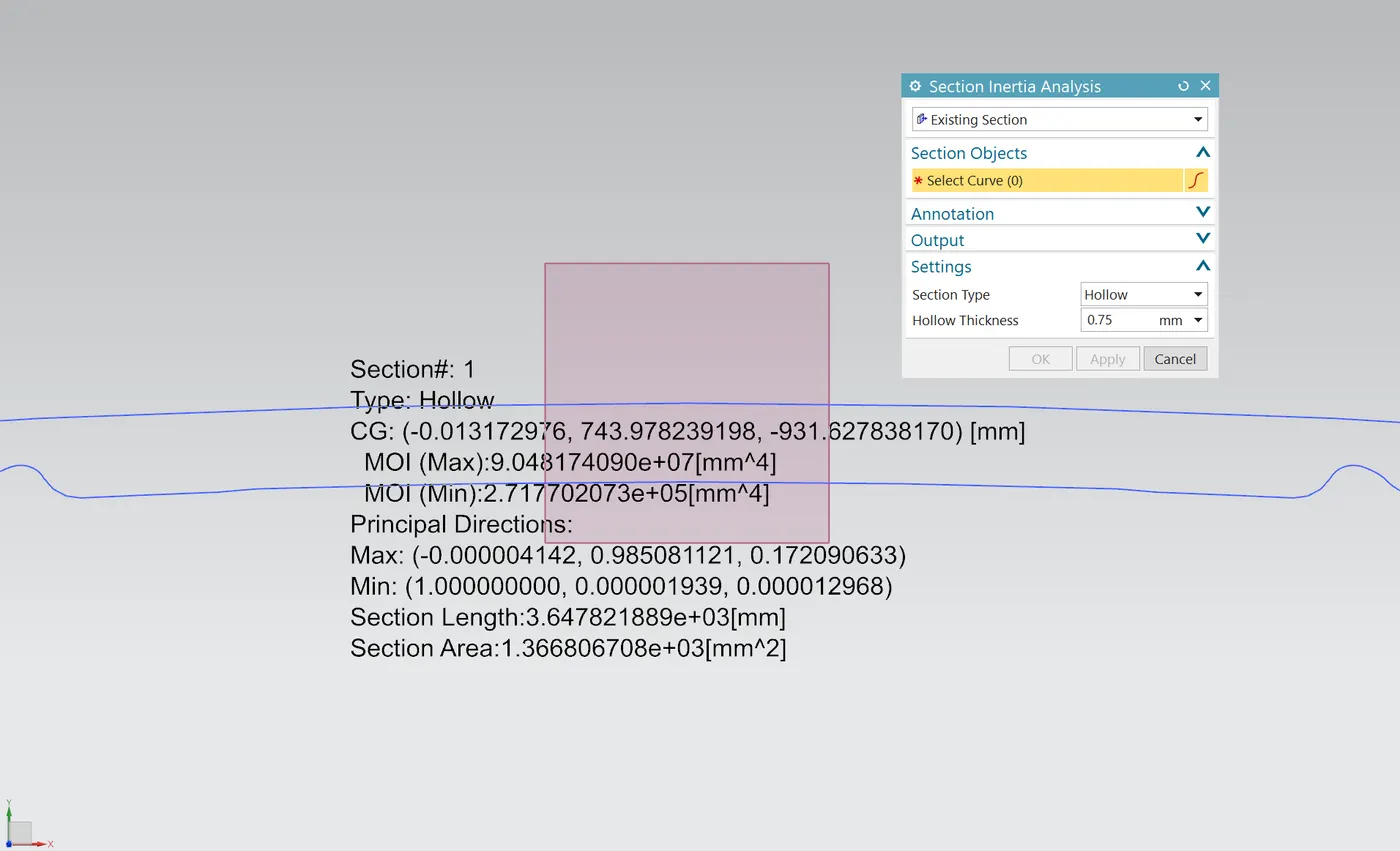
I max : 9.0481*10^5mm^4
I min : 2.7177*10^5mm^4
I = 2.7177*10^5mm^4
y = d/2
y = 25.8595/2
y = 12.95975
Z = I/y
Z = 2.7177.10^5mm^4/12.95975mm
Z = 2.0970*10^4mm^3
Case 2
In case 2, we have to modify the particular section. In such a way that our minimum MOI value will improve. There are many ways to improve the strength. We can increase the emboss, or instead of changing the design, we can modify the particular cross-section. After modifying the cross-section, the MOI values are
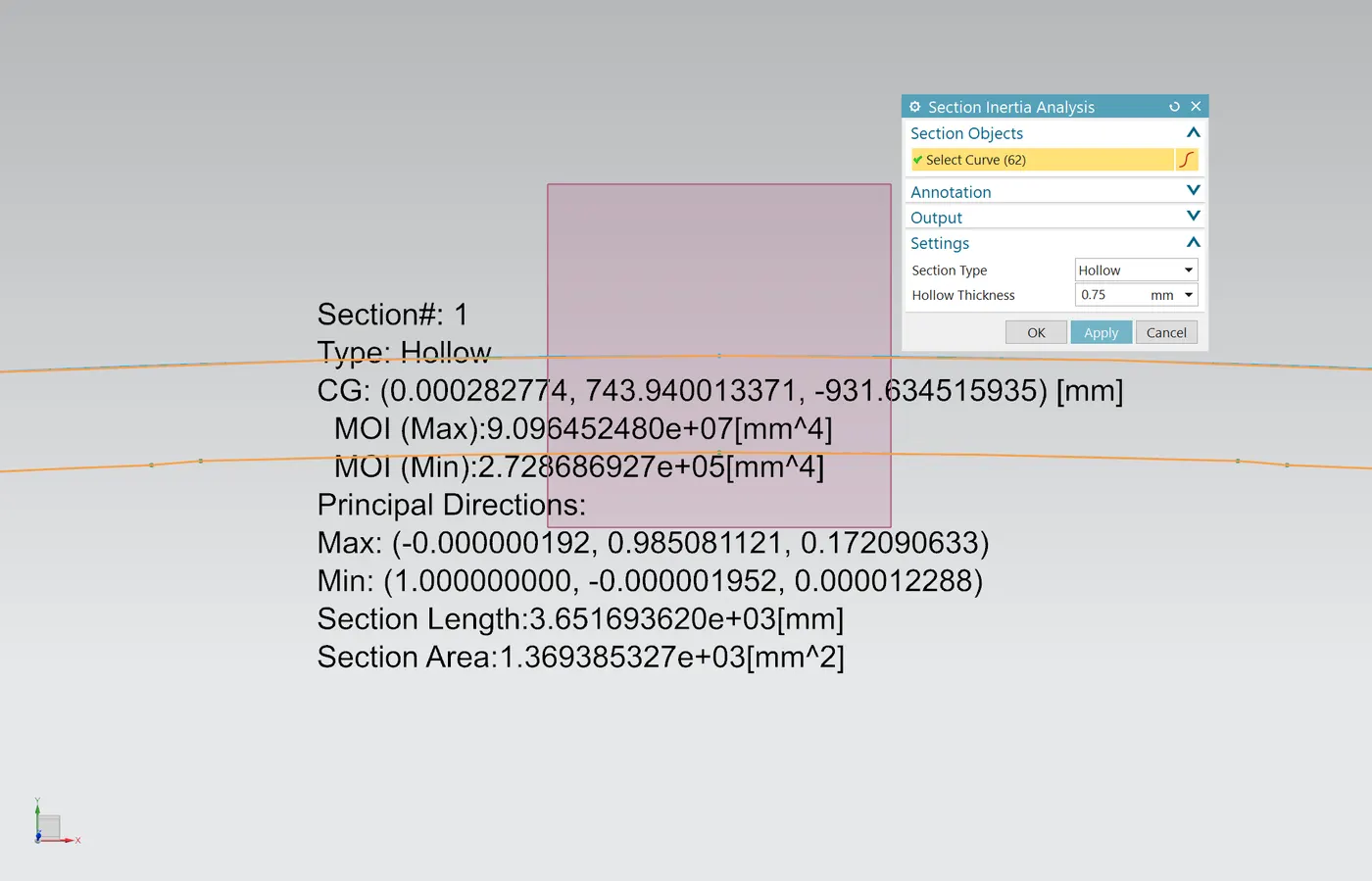
I max : 9.0964*10^7mm^4
I min : 2.7286*10^5mm^4
Considering I as the minimum moment of the inertia
Z = I/y
I = 2.7286*10^5mm^4
y = 12.95975
Z = 2.7286*10^5mm^4/12.95975mm
Z = 2.1054*10^5mm^3
Therefore, I2 > I1
The shape and dimensions of the hood significantly influence its section modulus. Factors such as curvature, thickness, and overall design impact the distribution of stresses and bending moments experienced by the hood.
The choice of materials, such as steel, aluminium, or composite, affects the hood's mechanical properties and, consequently, its section modulus. Different materials have varying stiffness, density, and strength characteristics that must be considered in the design process.
Factors such as aerodynamic forces, frontal impact, and weight distribution play a role in determining the required stiffness of the hood.
Section modulus optimisation
Optimizing the section modulus of a car hood involves finding the optimal balance between weight reduction, structural integrity, and performance. By maximizing the section modulus relative to the material used, engineers can design hoods that are lightweight yet robust, enhancing fuel efficiency and vehicle handling while ensuring safety in the event of collisions.
Choose materials with high strength-to-weight ratios to maximise stiffness while minimising weight. Advanced materials offer excellent mechanical properties and allow for significant weight savings compared to traditional steel or aluminium.
Utilize computer-aided design (CAD) software and finite element analysis (FEA) tools to optimise
the hood's geometry for maximum stiffness. Fine-tuning curvature, thickness distribution, and reinforcement patterns can enhance the section modulus without compromising aesthetics.
Implement an iterative design process that involves simulation, analysis, and testing to refine the hood's geometry and material selection iteratively. By continuously evaluating and optimizing design iterations, engineers can achieve the desired balance between performance, safety, and manufacturability.
Conclusion
A car hood's design must consider section modulus computation and optimization since it affects both performance and safety. Automotive engineers may create hoods with the best stiffness, weight savings, and structural integrity by utilizing cutting-edge engineering tools and optimization techniques. In the end, a well-designed car hood improves safety, fuel economy, and vehicle performance, which adds to a better driving experience and happier customers.