Section Modulus calculation and optimization
SECTION MODULUS
Section Modulus: It is the ratio of area moment of inertia about the neutral axis and to the distance of outermost fiber from the neutral axis.
`Z = I/Y` [ units: mm3 or m3 ]
Where as,
Z = Section Modulus
I = Area moment of inertia
Y = Distance from neutral axis to the outermost fiber
Area moment of inertia: Area moment of inertia will depict the resistance offered by the body towards bending due to its cross section.
Neutral Axis: the line in a beam or other member subjected to a bending action in which the fibers are neither stretched nor compressed or where the longitudinal stress is zero.
Example: Consider a bar as shown in figure below
CASE 1: Bar is subjected to the load at center by fixing at both ends with the help of support A and B. Cut section view is shown to the right side of the bar with dimensions of b and d.
Area moment of inertia of the above mentioned cross section is `= bd^3 /4`
CASE 2: The bar mentioned above is rotated to 90 degrees. Compared to CASE 1 , in CASE 2 the bar is difficult to bend.
Area moment of inertia of the above mentioned cross section is `= db^3 /4`
By visual inspection itself we can say bd. Area moment of inertia in CASE 2 is greater than CASE 1. Therefore resistance offered by a cross section towards bending is more in the case of case 2 so as the strength.
We can also prove it by bending equations.
`M/I = σ /Y = E /R
We will consider the first two terms and we will rearrange them.
`M = I/Y * σ`
Where as,
M- bending moment ( resistance towards bending)
I - area moment of inertia
Y - distance from outer most fiber to neutral axis
σ - Bending stress.
Here I / Y is section modulus. So M is directly proportional to the section modulus and therefore to the area moment of inertia. By this we can say that if section modulus is more then the strength of cross section is more.
Section 1
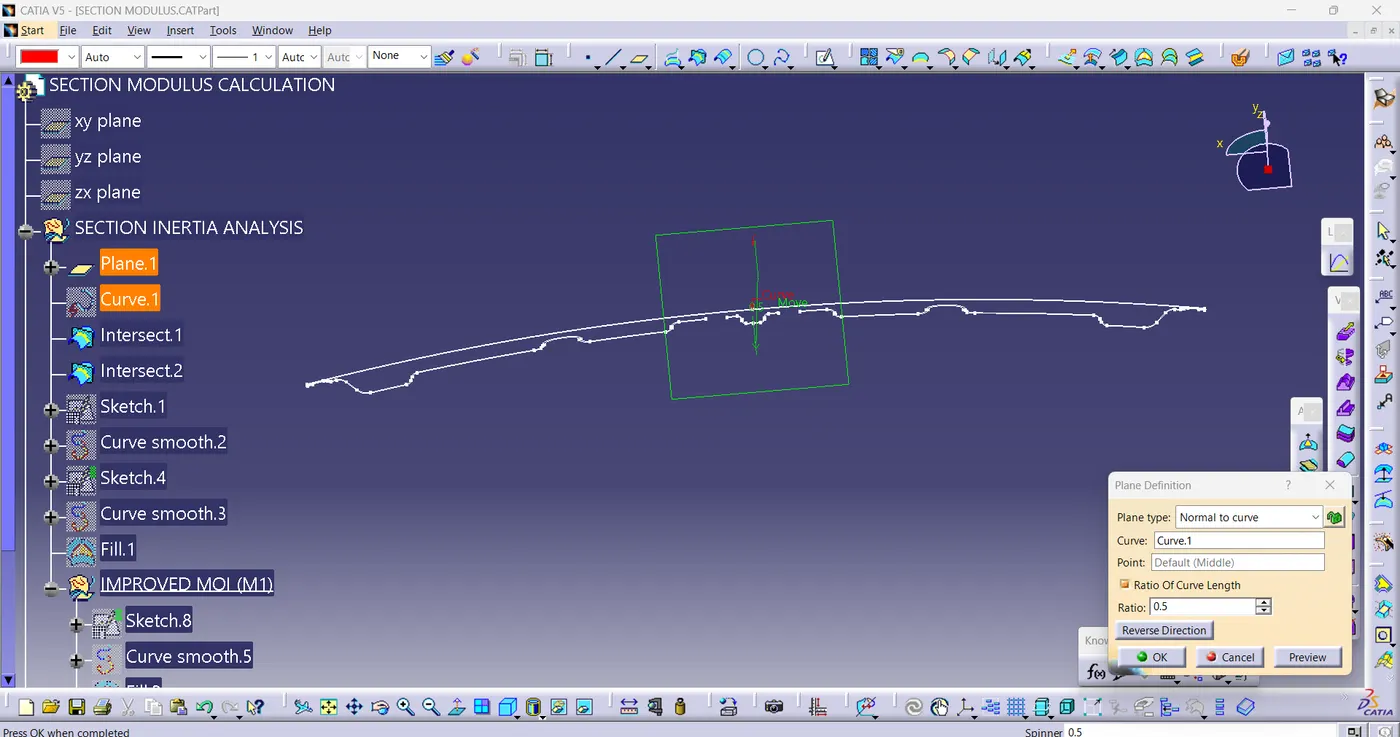
To calculate the moment of inertia 'M' we need to take the intersection of hood inner & outer panel about a central datum plane as shown below
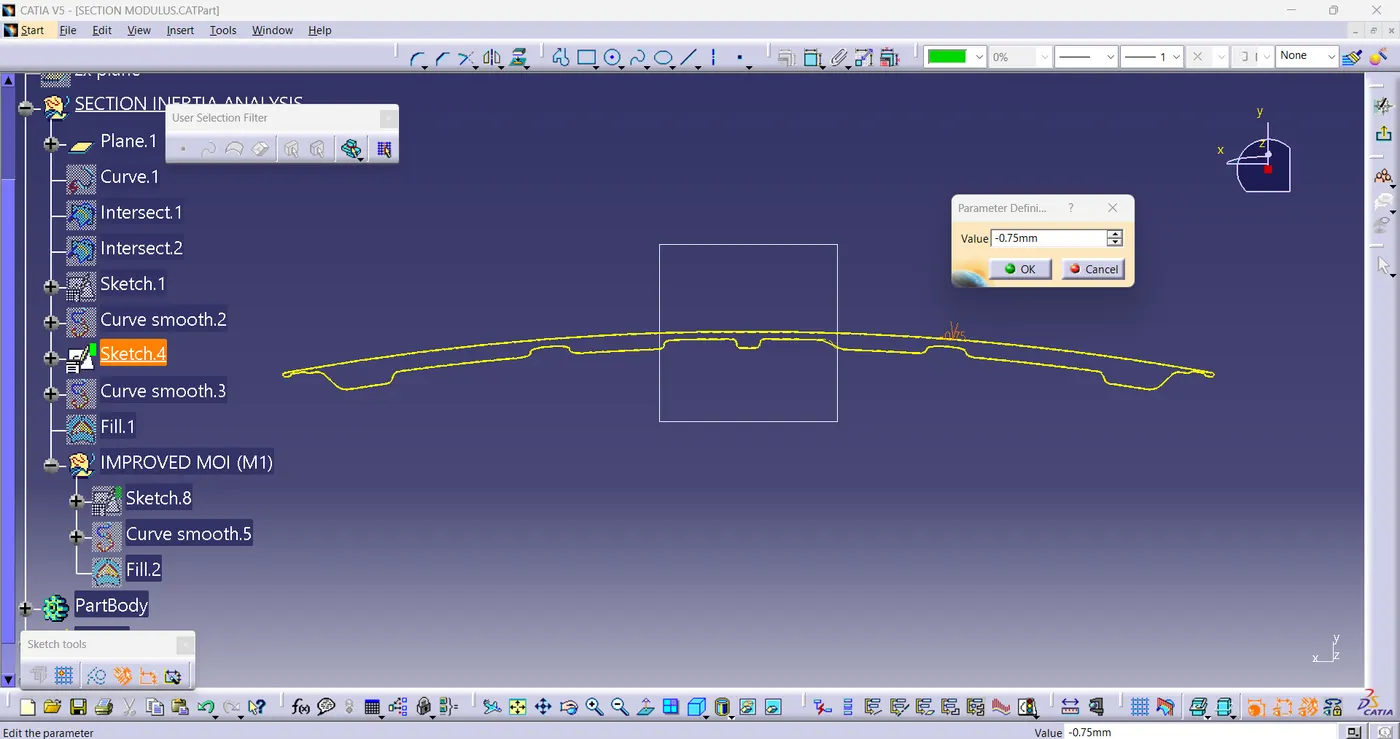
In this case 1 the distance between the inner & outer panel is offseted to 0.75 mm based on our primary condition shown in the below image
Now, Let's calculate the Moment of inertia (Min. Moment of inertia) i.e M1 at Section 1 without changing the design parameters of the Hood Assembly and find section modulus (Z) about Section 1.
Here I have calculated the value of 'M' using tool CATIA V5
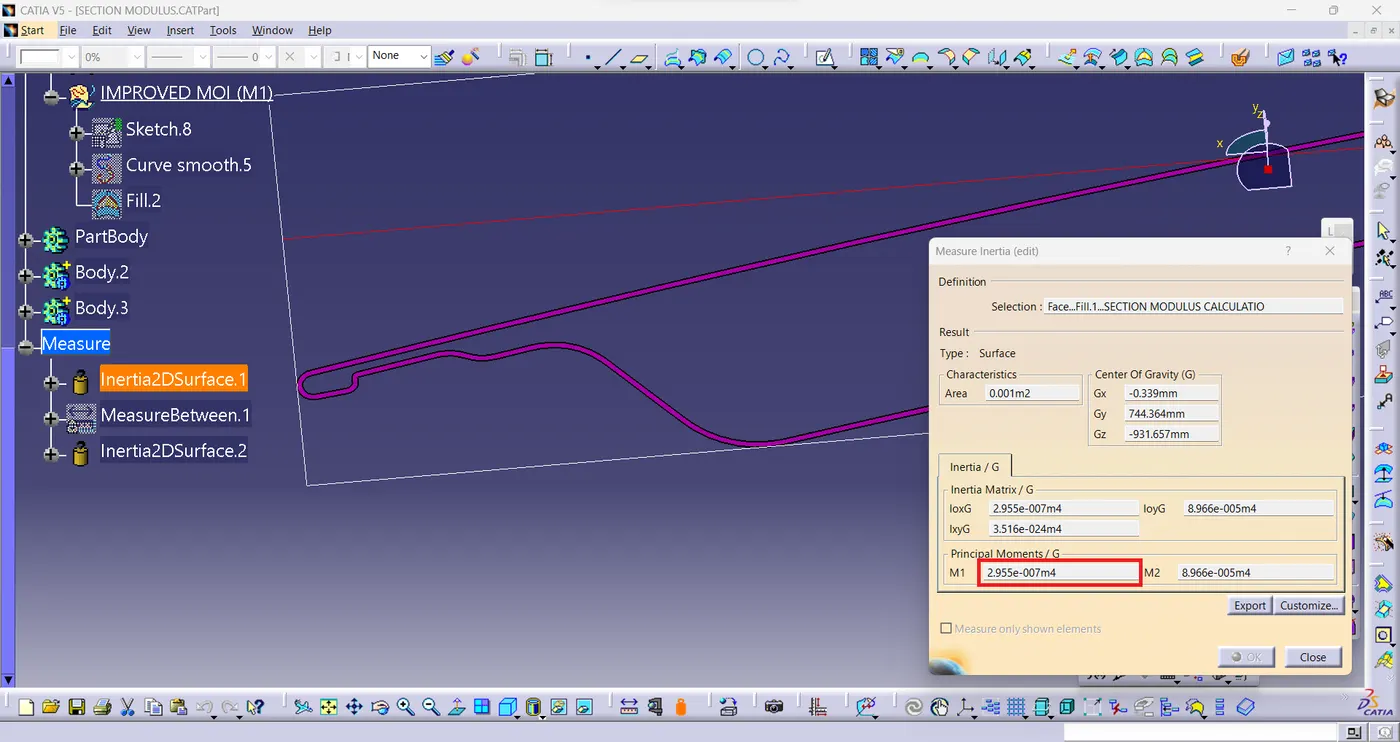
As shown in the above image you can see that we got the value of Moment of Inertia at Section 1
so in the industry we always look into Min. Moment of inertia value (i.e M1) in the design consideration for improving the strenght of the particular product.
Here we got, M1 = 2.955e-007m^4
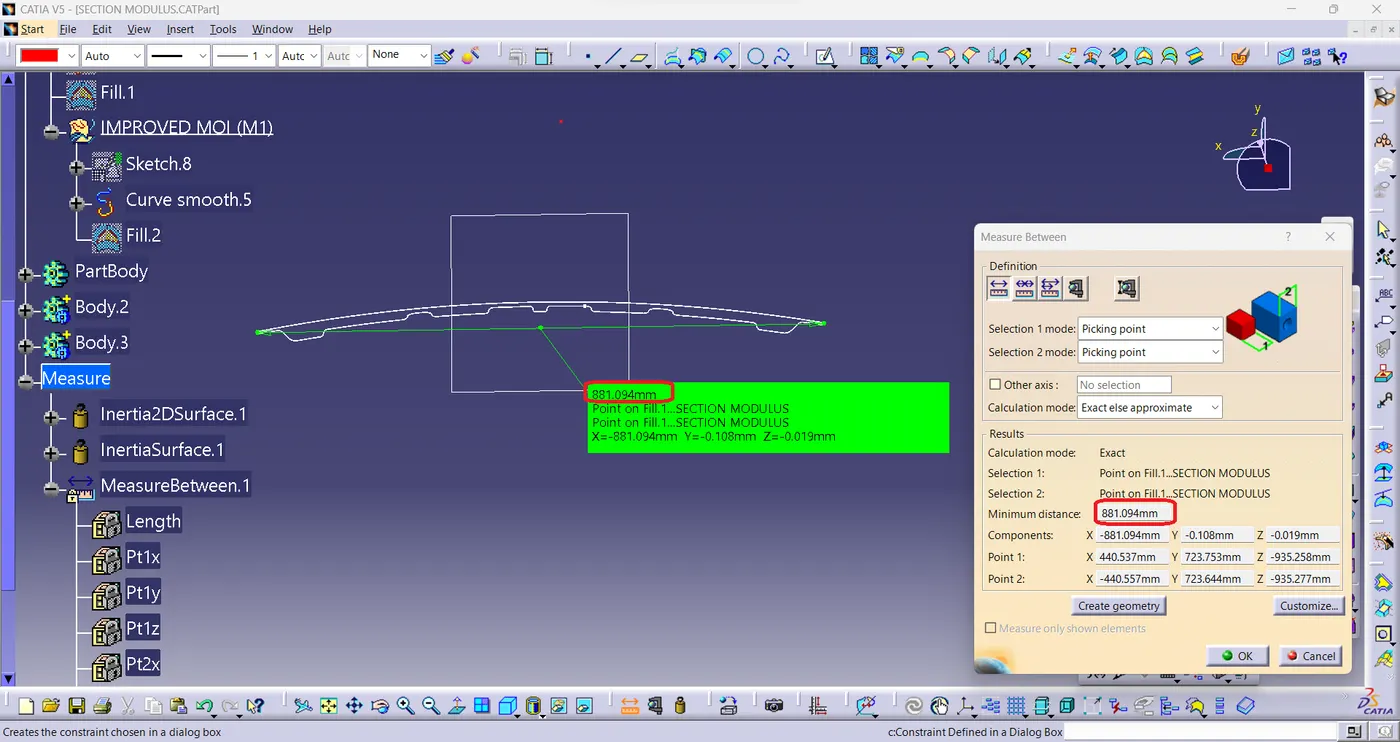
Now, if you see the above image we have the total distance of outer panel is 881.094 mm
hence the distance can be measured be measured between the extreme ends about the neutral axis would be 440.54 mm
i.e Y = 440.54 mm
Now, to find the strenght of the hood design we need to calculate the value of Section modulus which can be calculated using the formula is given by,
Z = M/Y
The unit conversion and the calculation is shown in the below image.
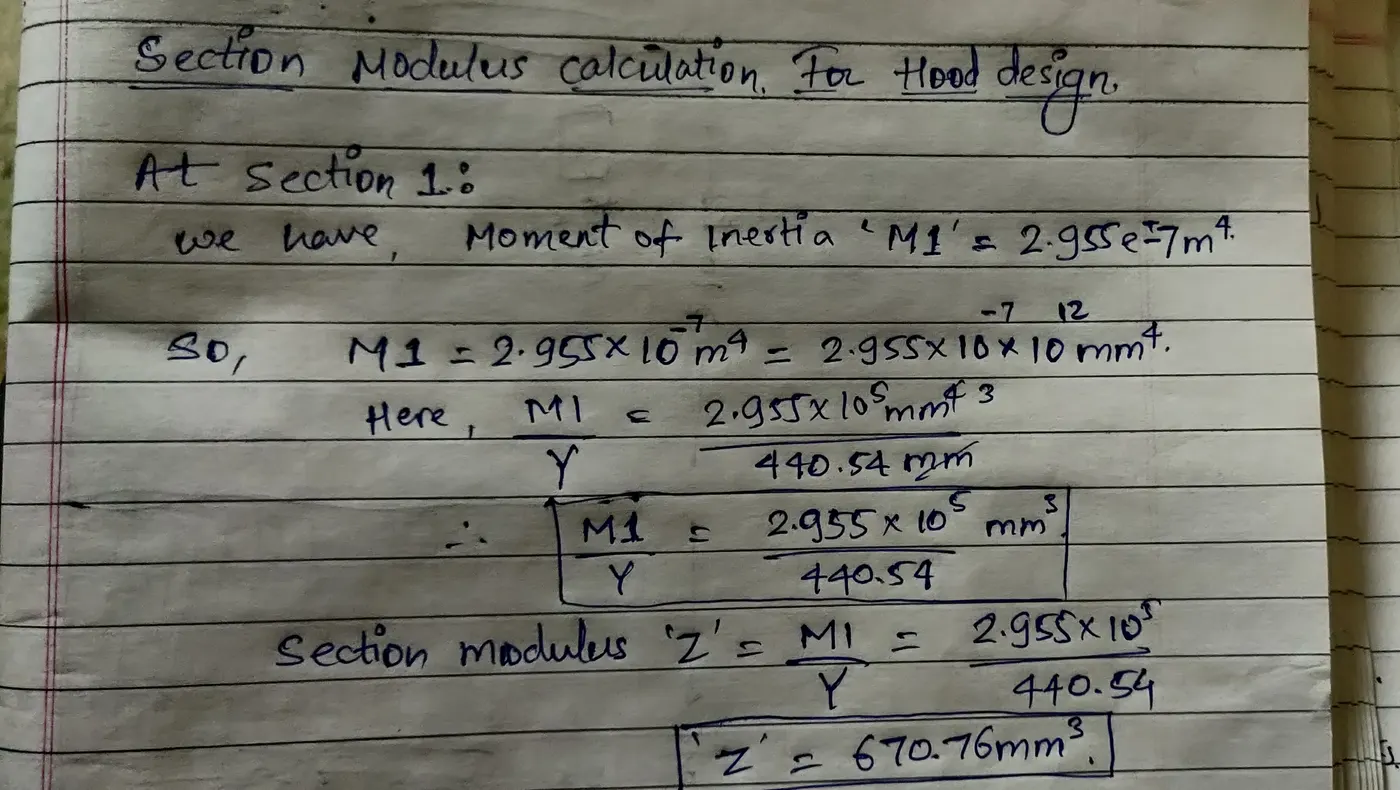
So here, we got the value of Section Modulus 'Z' is 670.76 mm^3
Now, to improve the strength of the above Section 1 we need to increase the value of 'Z' as the value of moment of inertia increase then the value of 'Z' ultimately increase whcich leads to enhance the strenght of the hood design.
Section 2
In this case we need improve our existing values from Section 1 by changing some design parameters in the intersection itself for example we can improve the strenght of the part by providing more emboses to a design and also by increasing the offset value
Below here we have offset to a distance of 0.8 mm (Means 0.5 mm more then the previous data) for improving the strength
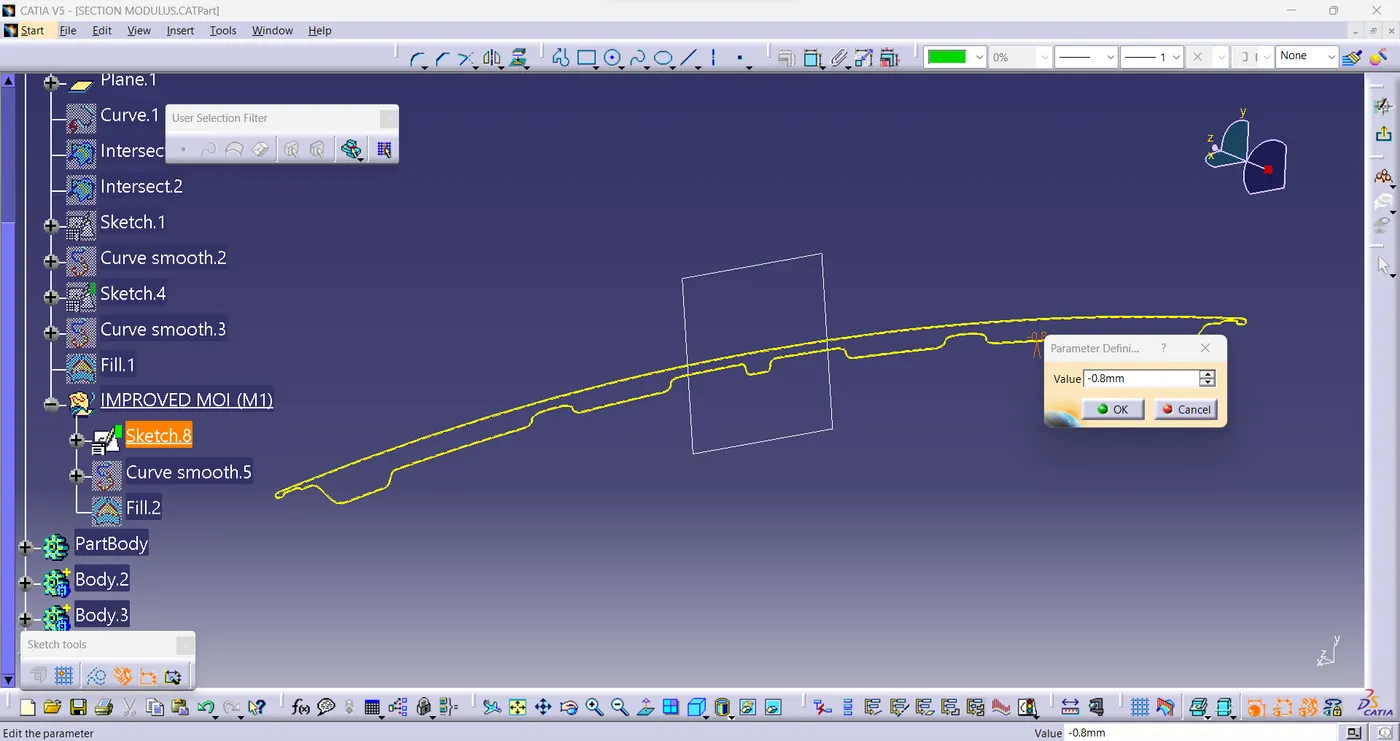
Now, let's see the results we got by increasing the offset value to 0.5 mm
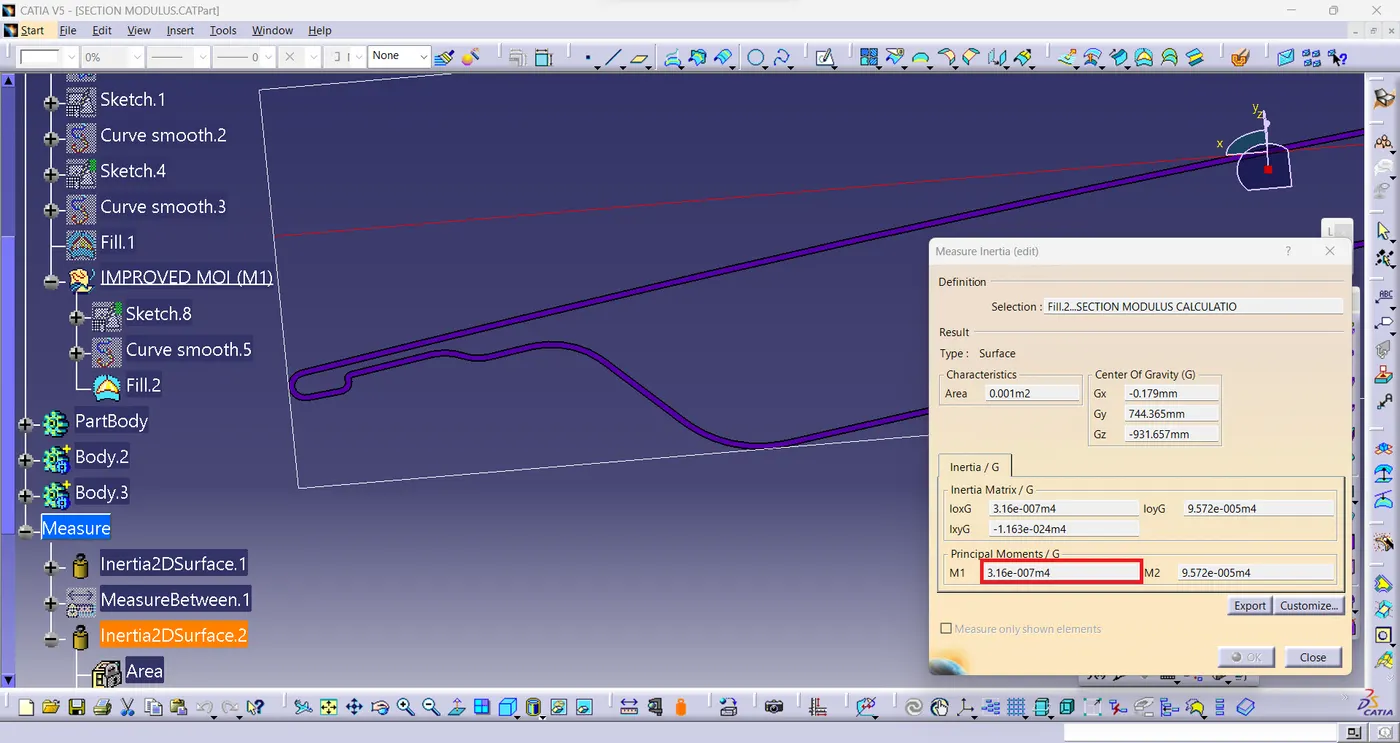
From the above image shown we can see that the value of Moment of inertia 'M' increses by changing the offset value.
Here we got, M1 = 3.16e-007m^4
and we have, Y = 440.54 mm
Hence we can calculate the value for Section Modulus 'Z' which is given by formula,
Z = M/Y
The calculation is shown in the below image
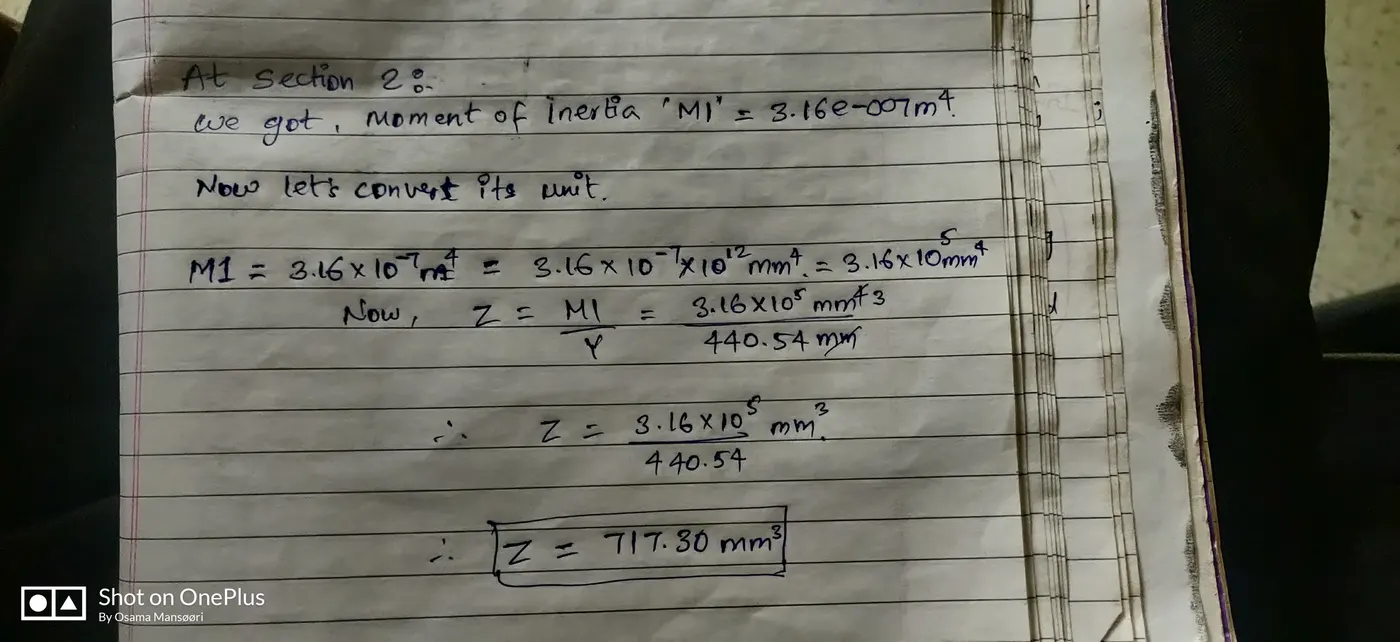
Here, we got value of section modulus 'Z' = 717.30 mm^3 which is greater then previous one
CONCLUSION:
Hence based on the calculations and analysis above we can predict that our part strenght has been improved by maximizing the cross sectional value from the intersection of Hood design