Section Modulus calculation and optimization
Introduction:
Section modulus is a geometric property used in structural engineering to measure a structural member's ability to resist bending. It is particularly important in the design and analysis of beams and other flexural members. The section modulus (Z) is defined as the ratio of a cross-sectional moment of inertia to the maximum distance from the neutral axis to the outermost fibers of the section.
Mathematically, the section modulus (Z) can be expressed as:
Z=I/Y
where:
- Z is the section modulus,
- I is the moment of inertia of the cross-sectional area,
- y is the distance from the neutral axis to the outermost fibers (also known as the distance to the extreme fiber).
Area moment of inertia:
The area moment of inertia, often simply referred to as the moment of inertia or second moment of area, is a geometric property of a cross-sectional shape. It plays a crucial role in determining the resistance of a structural member to bending and torsional deformations.
The moment of inertia (I) is mathematically defined as the sum of the products of each elemental area (dA) in a cross-section multiplied by the square of its distance (y) from an axis:
I=∫y^2dA
For a discrete set of elements, the formula becomes a summation:
I=∑y^2i⋅Ai
Where:
- I is the moment of inertia,
- y is the perpendicular distance from an elemental area to the axis,
- dA is an elemental area,
- A is the total cross-sectional area.
The moment of inertia is a key parameter in the calculation of bending stress in a beam or structural member. It helps in understanding how the material in the cross-section is distributed with respect to a given axis. The larger the moment of inertia, the more resistant the member is to bending.
Designed Hood:
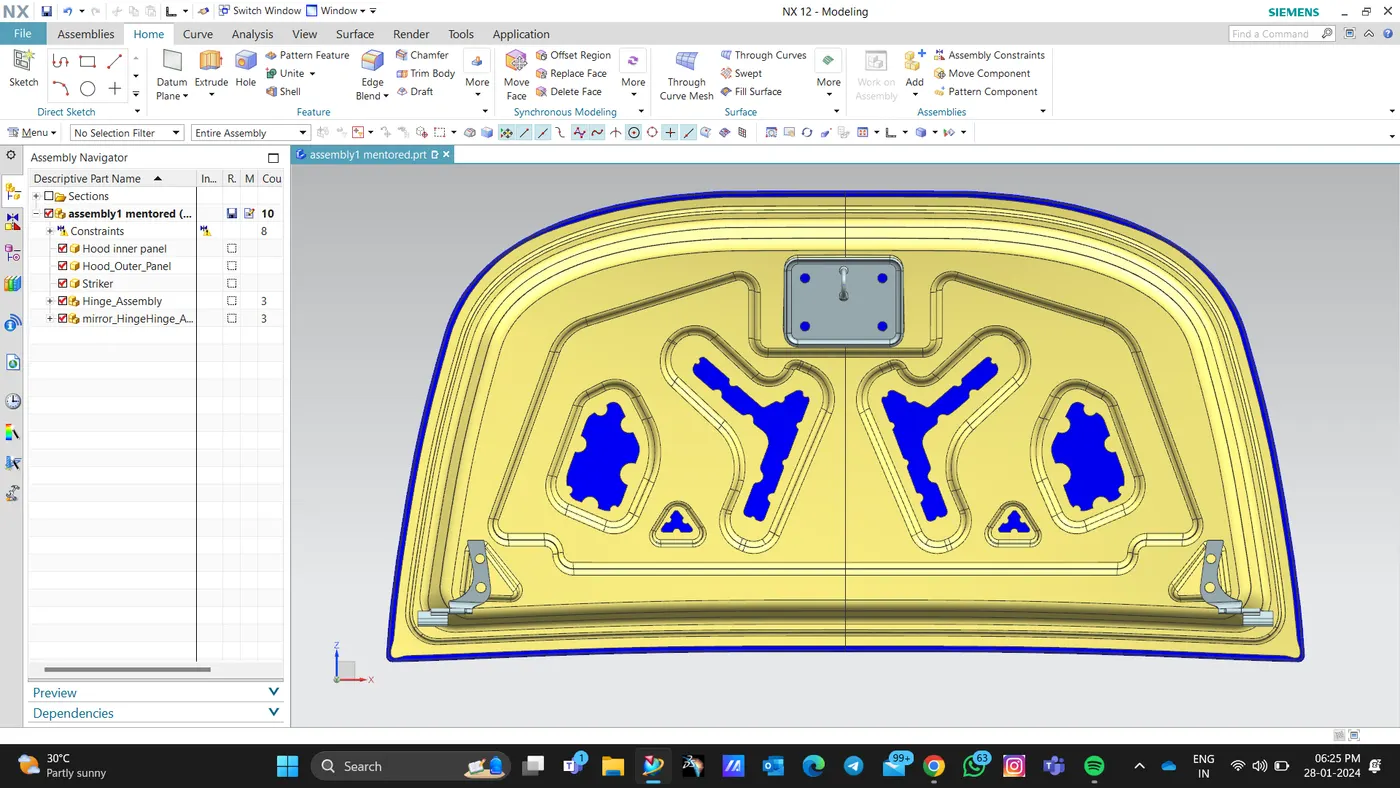
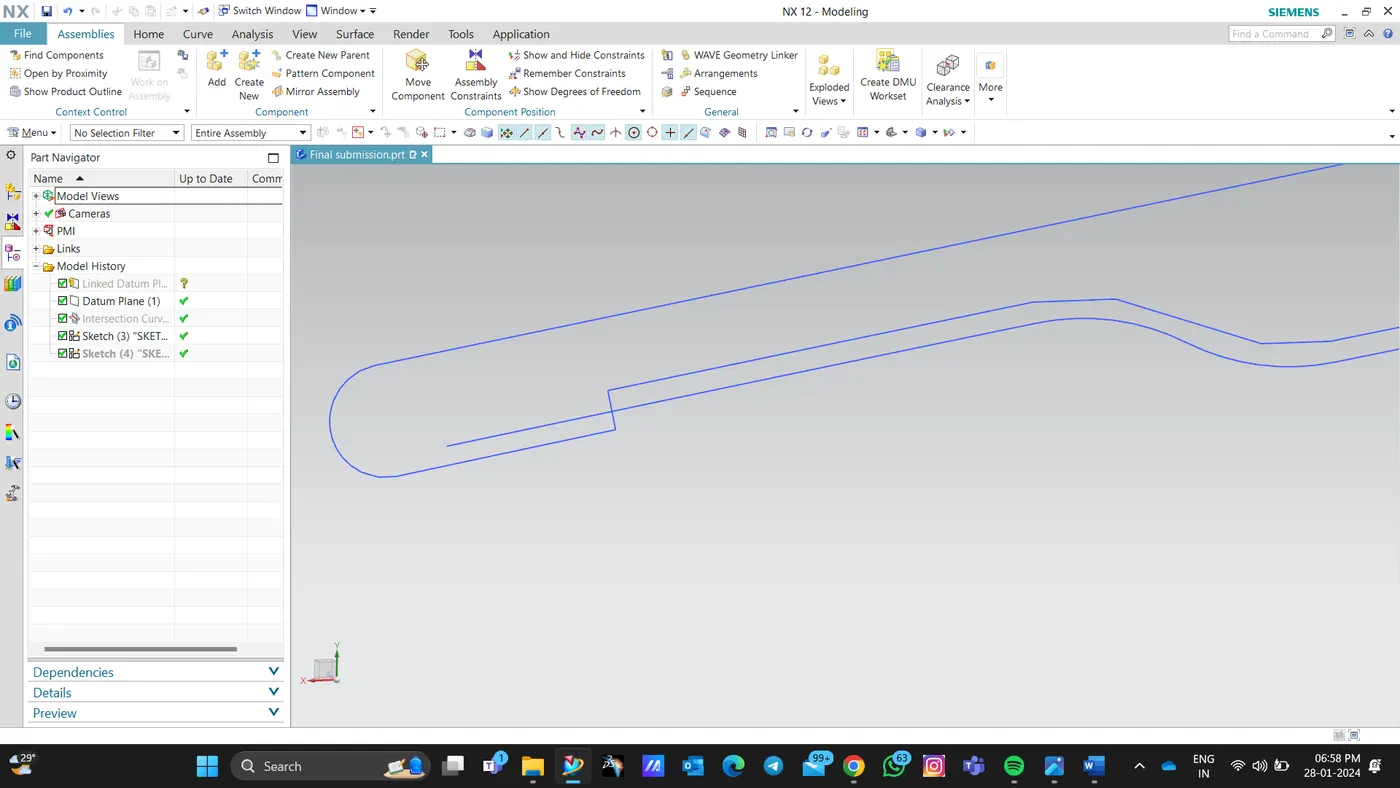
Section for this hood:
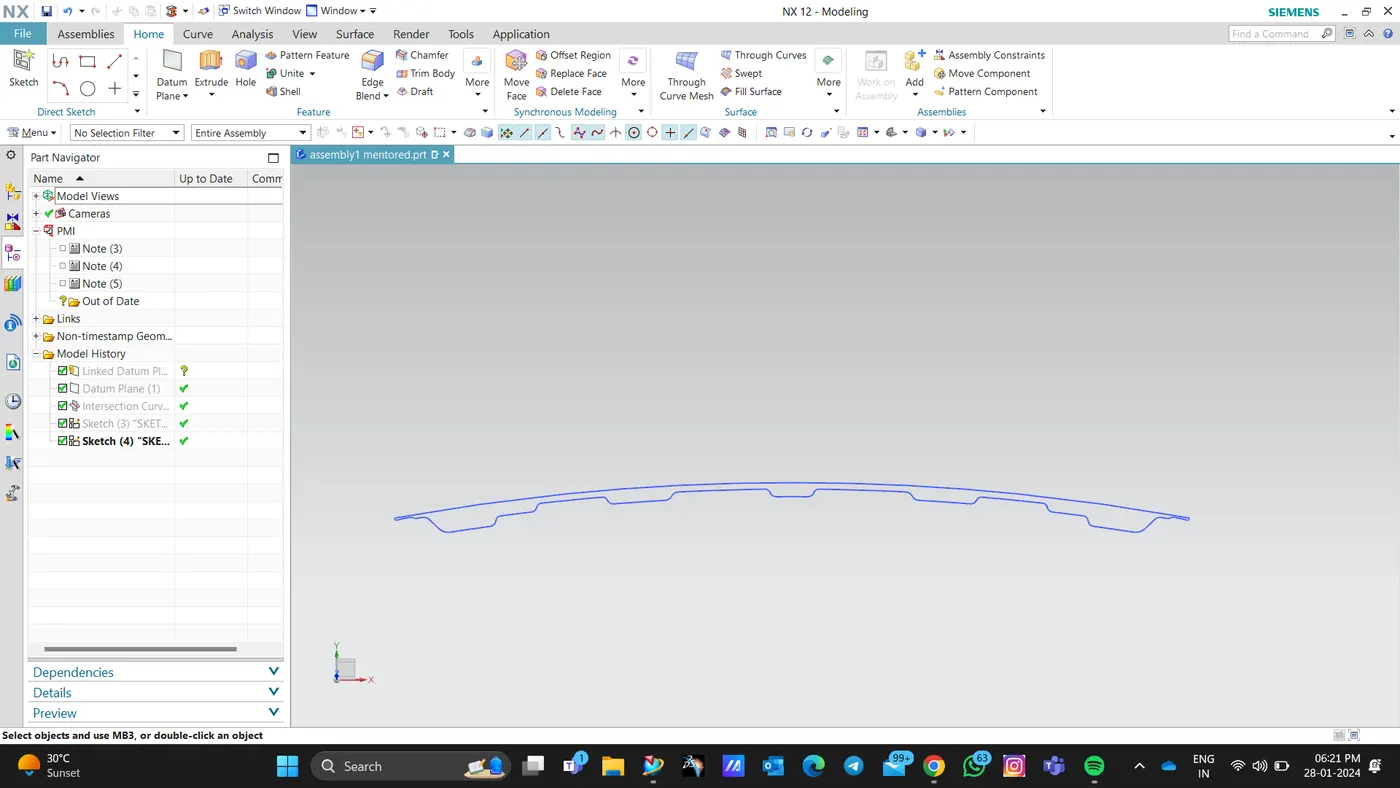
Section Analysis for the first case:
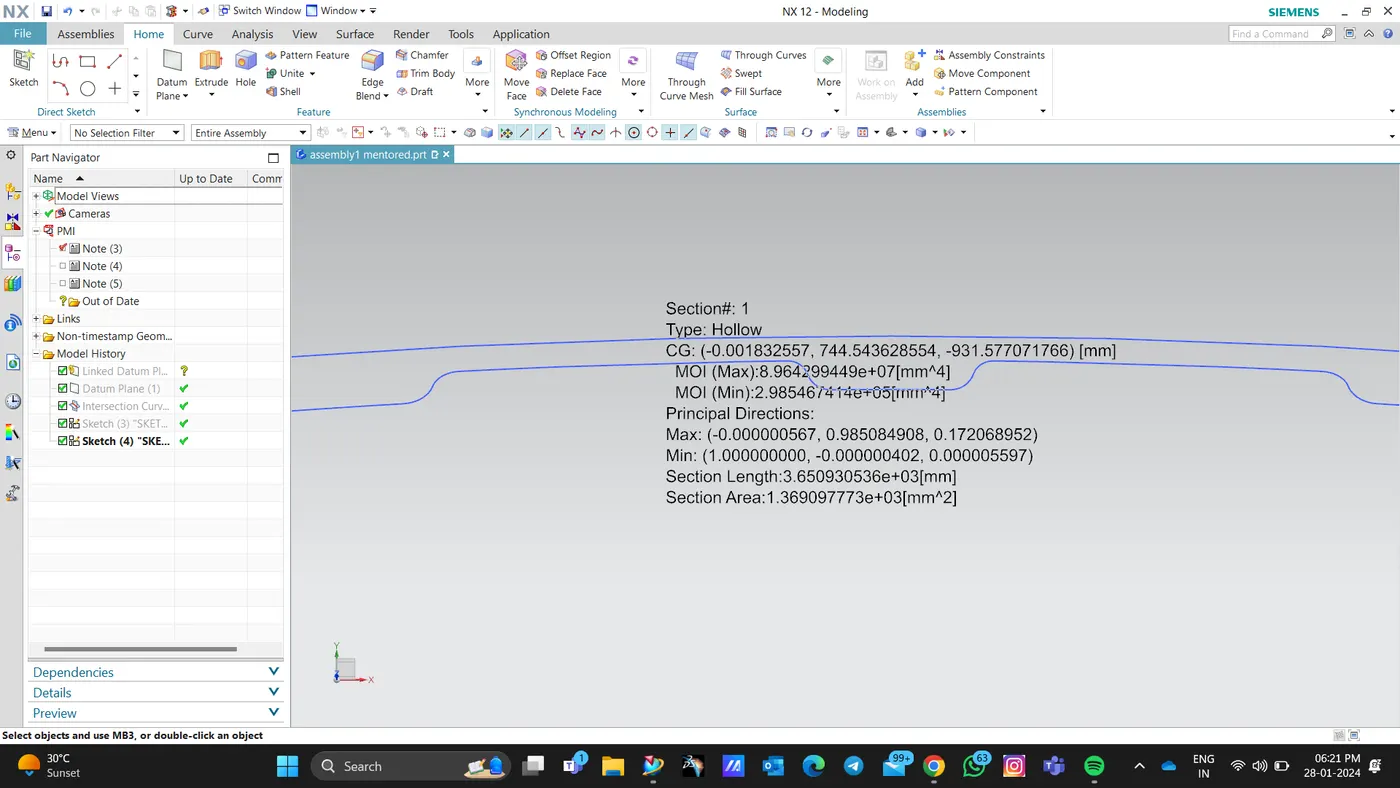
Here I'm getting is 2.9 * 10^10 mm^4 MOI (min)
Section Analysis for the second case:
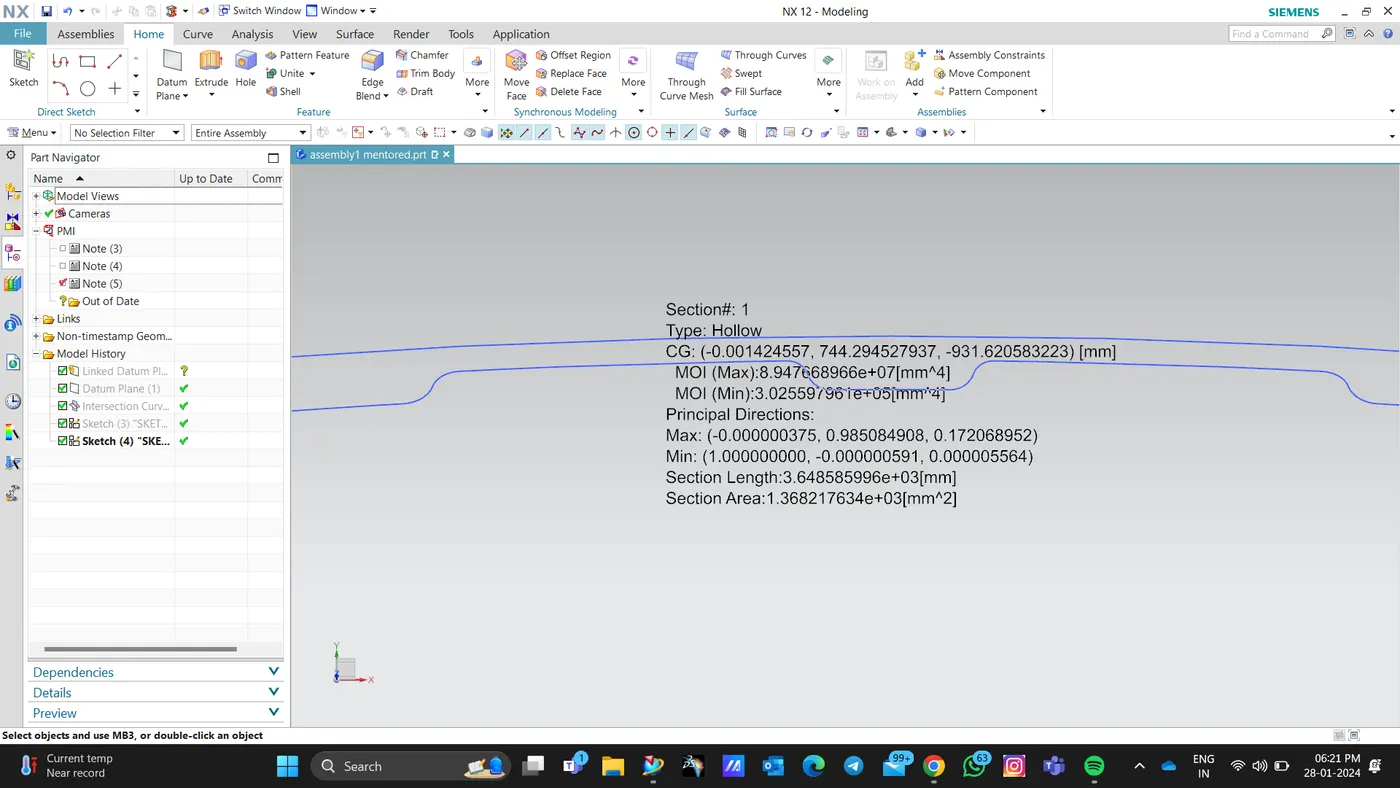
Here I'm getting is 3.0 * 10^10 mm^4 MOI (min)
Changes made in section:
0.5mm of offset of the bottom tangent has been done for this variance.
Conclusion:
3.448275862069% percentage has been increasedd compared to the case 1. Hence the strength has been improved slightly.
(Note: The previous hood which i had submitted in the previos project was a failure model. So I remodeled again with the guidance of the engineer as per the instruction given for me in the review and the respective section modulus calculus is calculated and studied and I'll also upload those files , Please correct me if i done anything wrong in that)