Section Modulus calculation and optimization
Use the Section from your Hood design and calculate the Section Modulus using the formula
S = I/y
Where,
S = Section Modulus
I = Moment of Inertia
y = distance between the neutral axis and the extreme end of the object
Come up with a new section that has an improved Section Modulus compared to the previous one and mention what changes you made which resulted in the increased strength.
Section Modulus:
Section modulus is a geometric property of a structural shape that relates to its ability to resist bending. It is an important parameter in structural engineering, particularly in the design of beams and other members subjected to bending moments. The section modulus is denoted by the symbol "S" and is typically expressed in cubic inches or cubic millimeters.
In simple terms, the section modulus quantifies how the cross-sectional shape of a member influences its resistance to bending stress. When a beam is subjected to a bending moment, different sections of the beam experience different levels of stress. The section modulus is a measure of the distribution of material around the axis of bending, indicating how effectively the shape can resist bending.
Mathematically, the section modulus (S) is related to the moment of inertia (I) and the distance from the neutral axis to the outermost fibers of the section (c) by the equation:
`S = I/Y`
Here,
- S is the section modulus.
- I is the moment of inertia of the section.
- Y is the distance from the neutral axis to the outermost fibers of the section.
A larger section modulus implies a better ability of the section to resist bending. Engineers use section modulus in the design process to ensure that structural members can withstand the expected loads without experiencing excessive deflection or failure.
Different cross-sectional shapes (e.g., I-beams, channels, rectangles) have different section moduli for the same amount of material. Engineers choose the appropriate shape and size of a structural member based on the specific requirements of a given application, considering factors such as loading conditions, span, and material properties.
Area moment of Inertia (I):
The area moment of inertia, often simply referred to as the moment of inertia or
I, is a property of a shape that describes its resistance to bending and is a crucial parameter in structural engineering. The moment of inertia is denoted by the symbol
I and is calculated based on the geometry of the cross-sectional shape.
For a given shape, the moment of inertia about a particular axis is calculated by summing the products of the squared distance from each infinitesimally small element of area (∫dA) to that axis. Mathematically, the formula for the moment of inertia (
I) about a particular axis is given by:
`I = int(y^2)dA`
Here:
- I is the moment of inertia,
- y is the perpendicular distance from each element of area dA to the axis of interest, and
- dA is an infinitesimally small element of area.
The integral represents the summation of all such products over the entire cross-sectional area. The moment of inertia is usually expressed in units of length to the fourth power (e.g., mm4 or in4).
Distance from the Neutral Axis (y):
The distance from the neutral axis to a point in the cross-sectional shape of a structural member is often denoted by the variable y. This distance, y, is measured perpendicular to the neutral axis. In the context of calculating the moment of intertia (I) and the elastic section modulus (S), the variabley represents the perpendicular distance from the neutral axis to an infinitesimally small element of area (dA) within the cross-sectional shape. The distance y varies across the cross-section, and the integral sums up the contributions from all these infinitesimally small areas to determine the overall moment of inertia.
In practical terms, understanding the distance y is essential for engineers when designing structures to ensure they can withstand bending loads. The distribution of material with respect to the neutral axis influences the structure's ability to resist bending stresses, and y is a key factor in these calculations.
Importance of Calculating Section Modulus:
- Strength Optimization: Determining and optimizing section modulus allows designers and engineers to enhance component strength by adjusting geometry parameters such as shape, thickness, or depth.
- Structural Integrity: Achieving an appropriate section modulus ensures that components like hoods can resist external forces without undergoing excessive deflection or failure.
- Weight Reduction: Optimizing section modulus enables lightweight designs while maintaining necessary levels of strength and rigidity.
- Cost Efficiency: Efficient use of materials based on accurate calculations helps reduce manufacturing costs by avoiding over-design or unnecessary material usage.
In the case of our project, by increasing the depth of the inner panel of the hood, we aim to increase the overall area moment of inertia (I). This increase in (I) will subsequently result in a higher section modulus (S), indicating improved resistance to bending and increased strength for the hood. It's important to strike a balance between optimizing section modulus and considering other design factors like weight, manufacturing constraints, and aesthetic considerations.
By using these calculations and principles during component design, engineers can ensure that automotive components like hoods provide optimal strength while meeting performance requirements within specified design parameters.
Example: Consider a bar as shown in figure below
CASE 1: Bar is subjected to the load at center by fixing at both ends with the help of support A and B. Cut section view is shown to the right side of the bar with dimensions of b and d.
Area moment of inertia of the above mentioned cross section is `= bd^3 /4`
CASE 2: The bar mentioned above is rotated to 90 degrees. Compared to CASE 1 , in CASE 2 the bar is difficult to bend.
Area moment of inertia of the above mentioned cross section is `= db^3 /4`
By visual inspection itself we can say bd. Area moment of inertia in CASE 2 is greater than CASE 1. Therefore resistance offered by a cross section towards bending is more in the case of case 2 so as the strength.
We can also prove it by bending equations.
`M/I = σ /Y = E /R`
We will consider the first two terms and we will rearrange them.
`M = I/Y * σ`
Where as,
M- bending moment ( resistance towards bending)
I - area moment of inertia
Y - distance from outer most fiber to neutral axis
σ - Bending stress.
Here I / Y is section modulus. So M is directly proportional to the section modulus and therefore to the area moment of inertia. By this we can say that if section modulus is more then the strength of cross section is more.
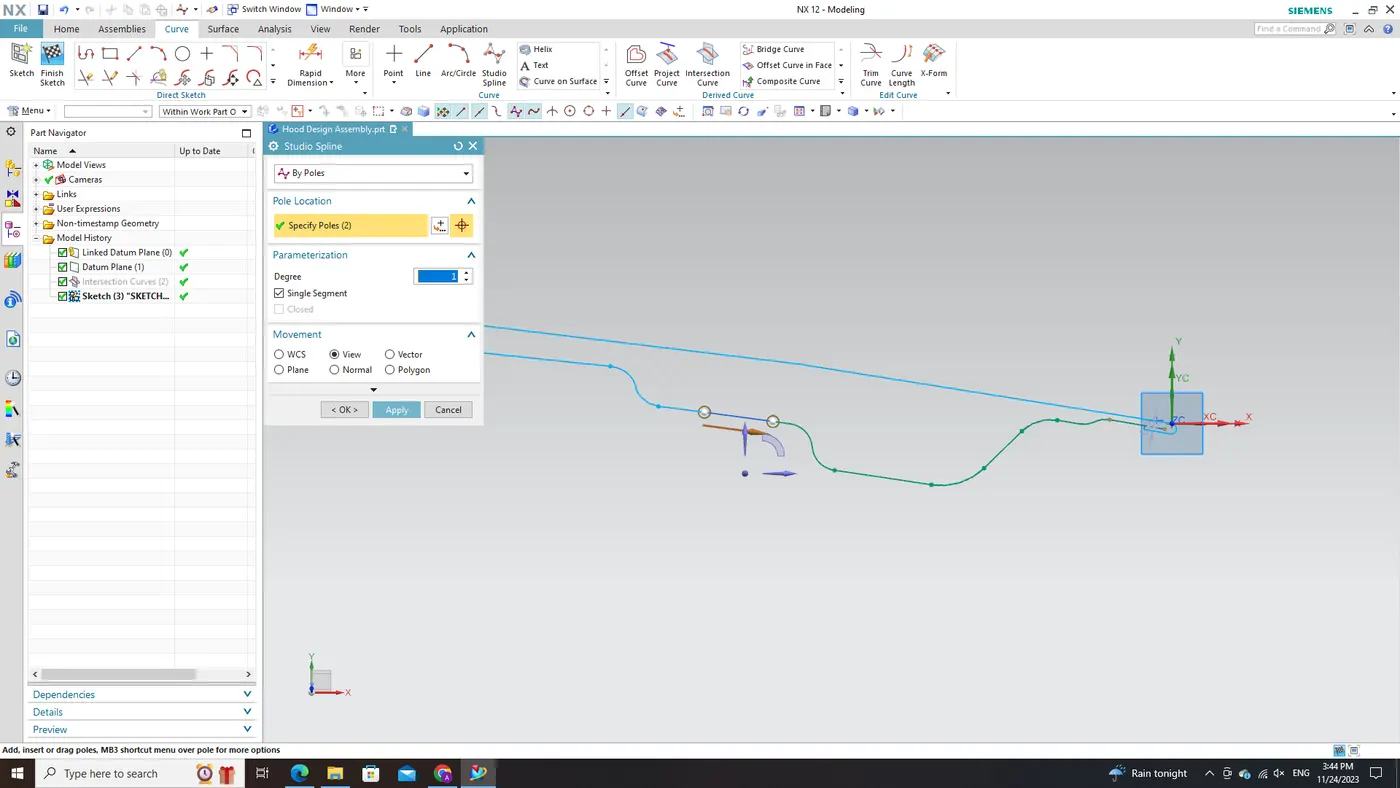
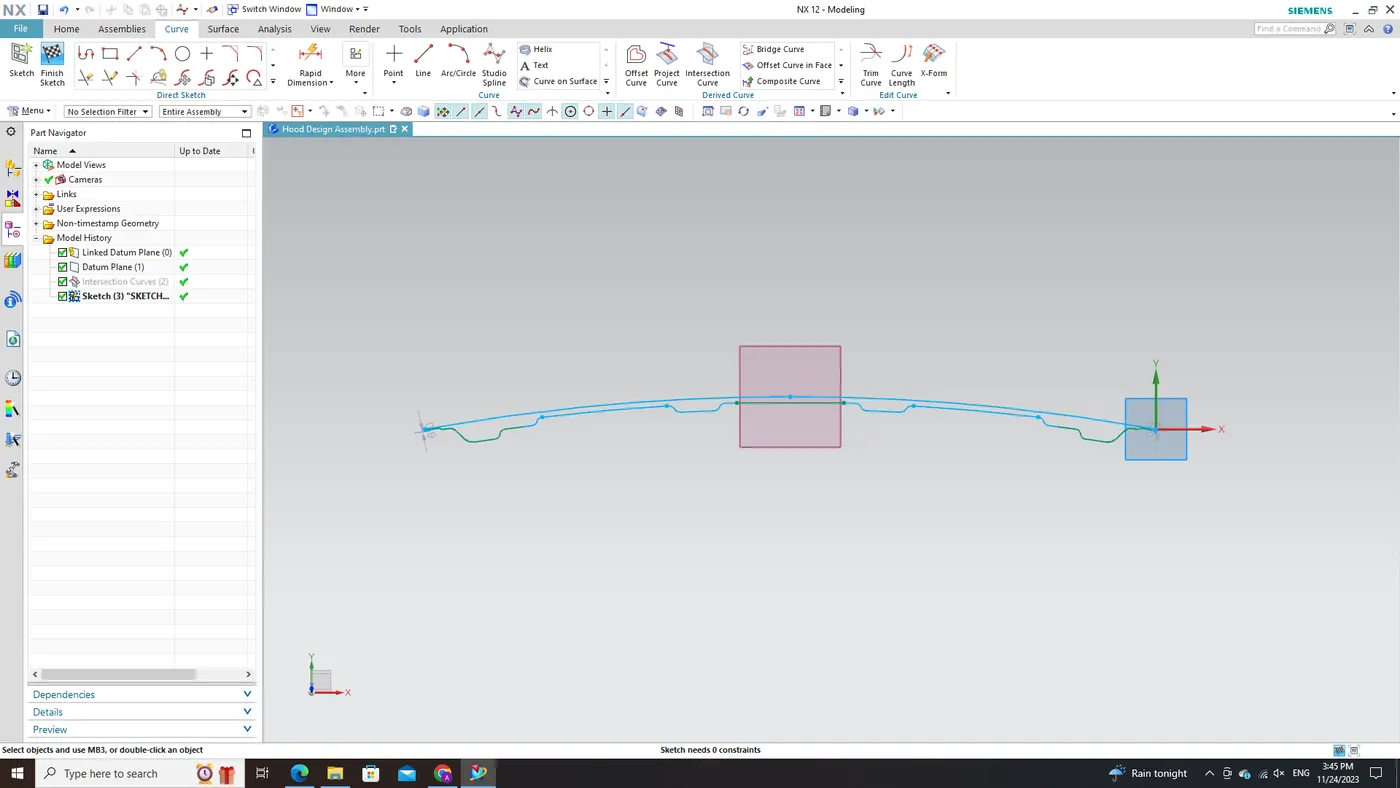
HOOD DESIGN from previous challenge:
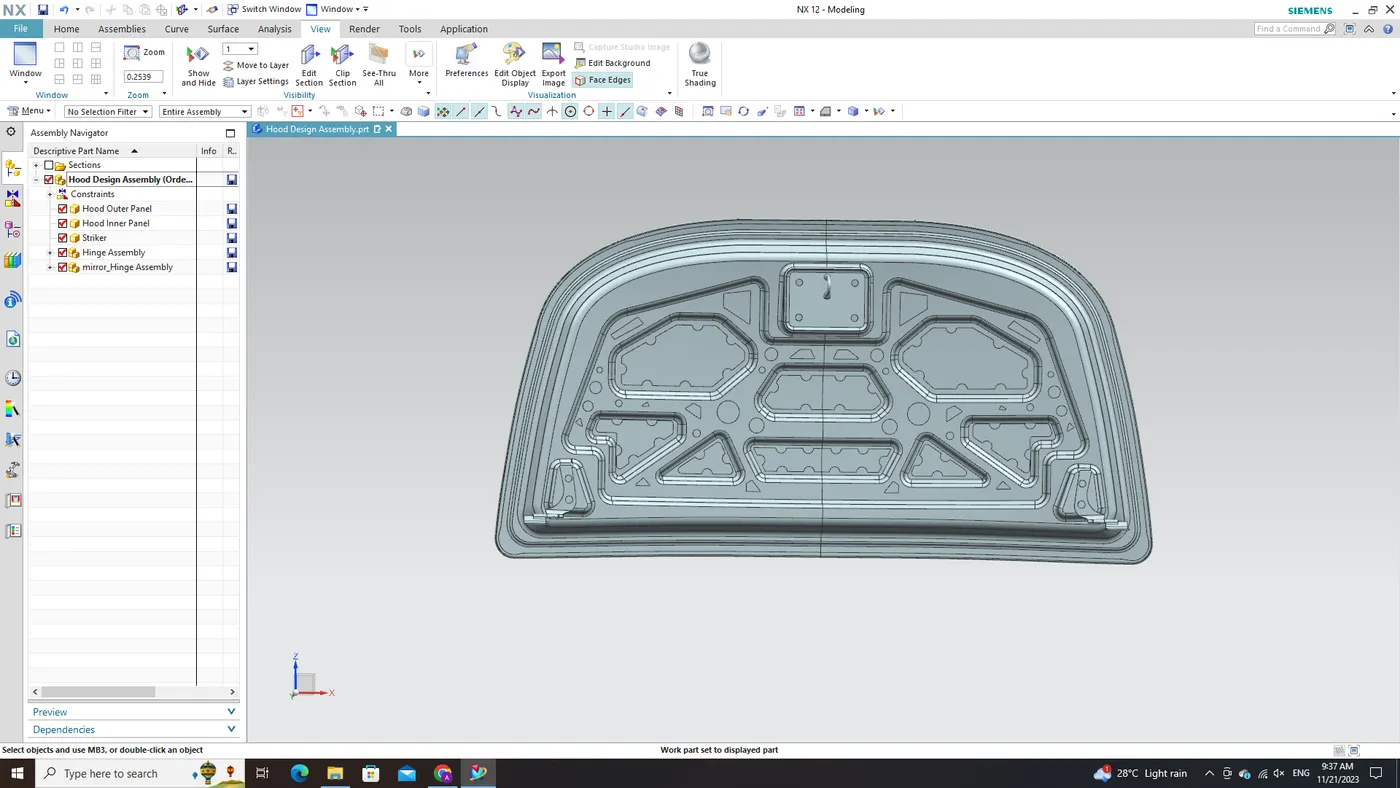
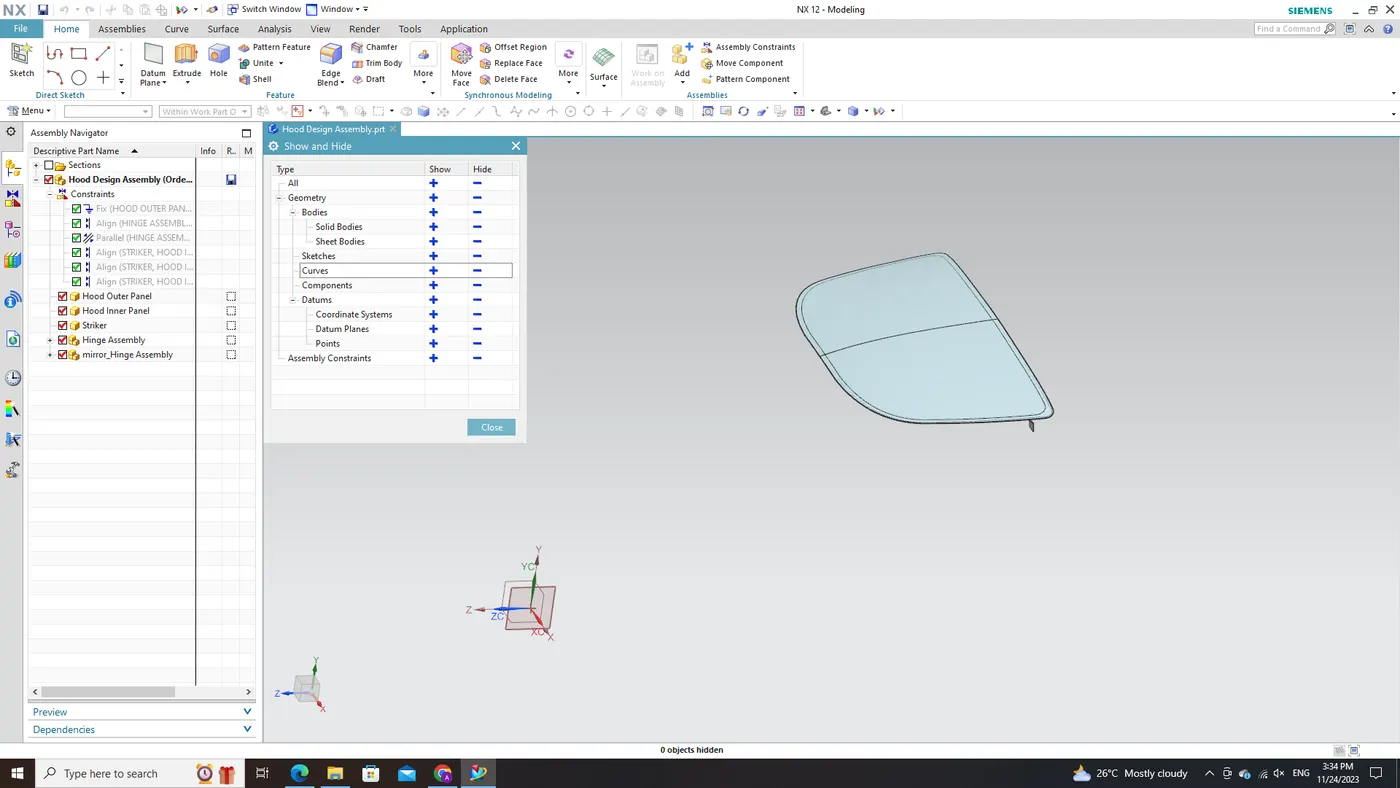
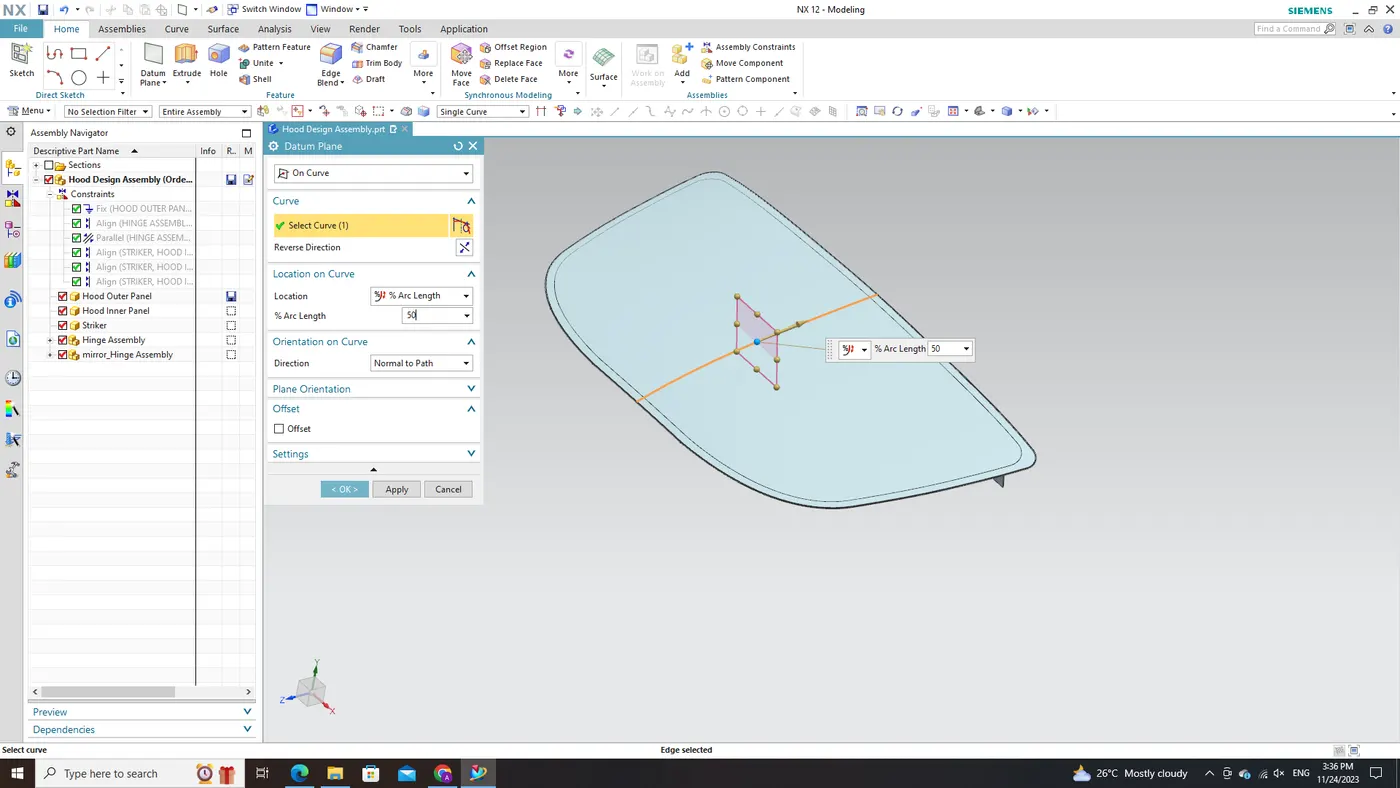
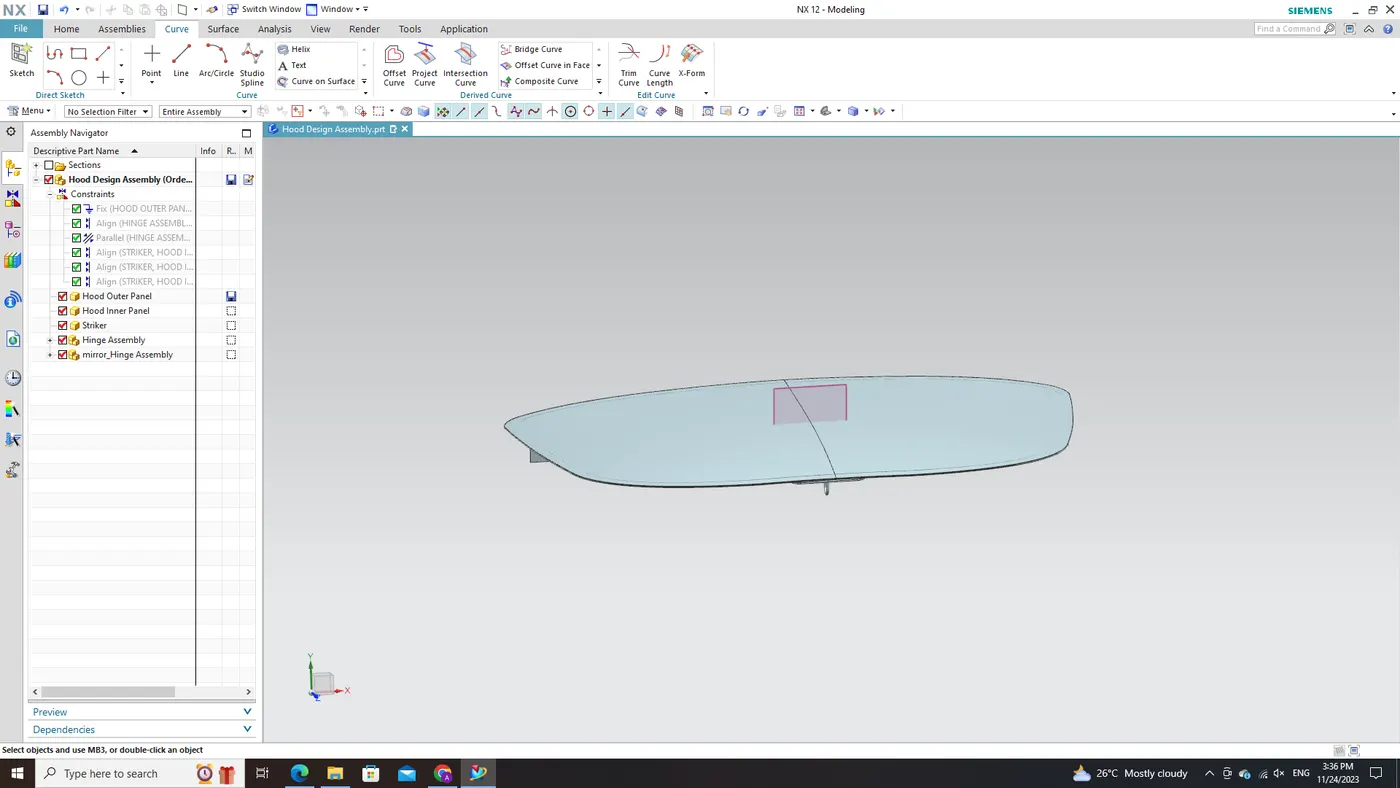
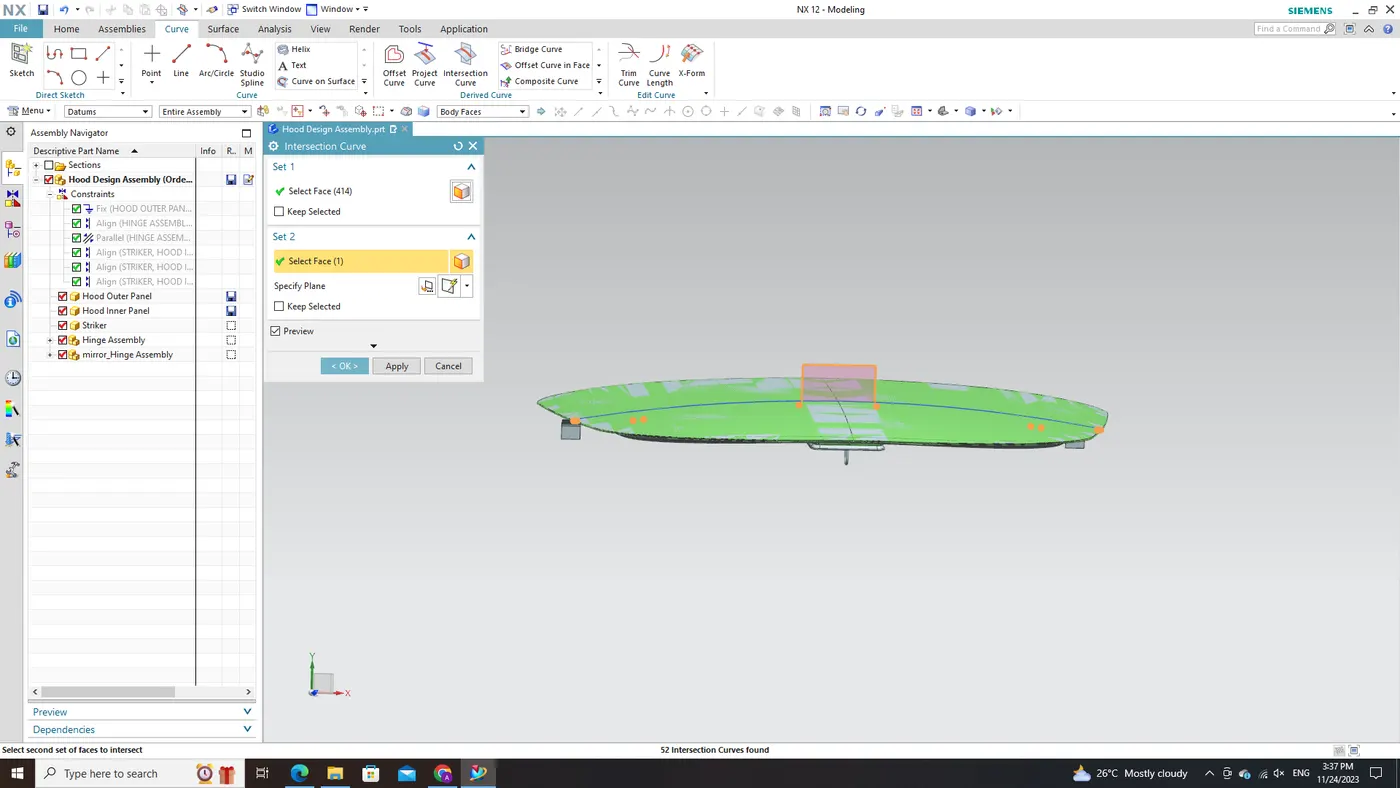
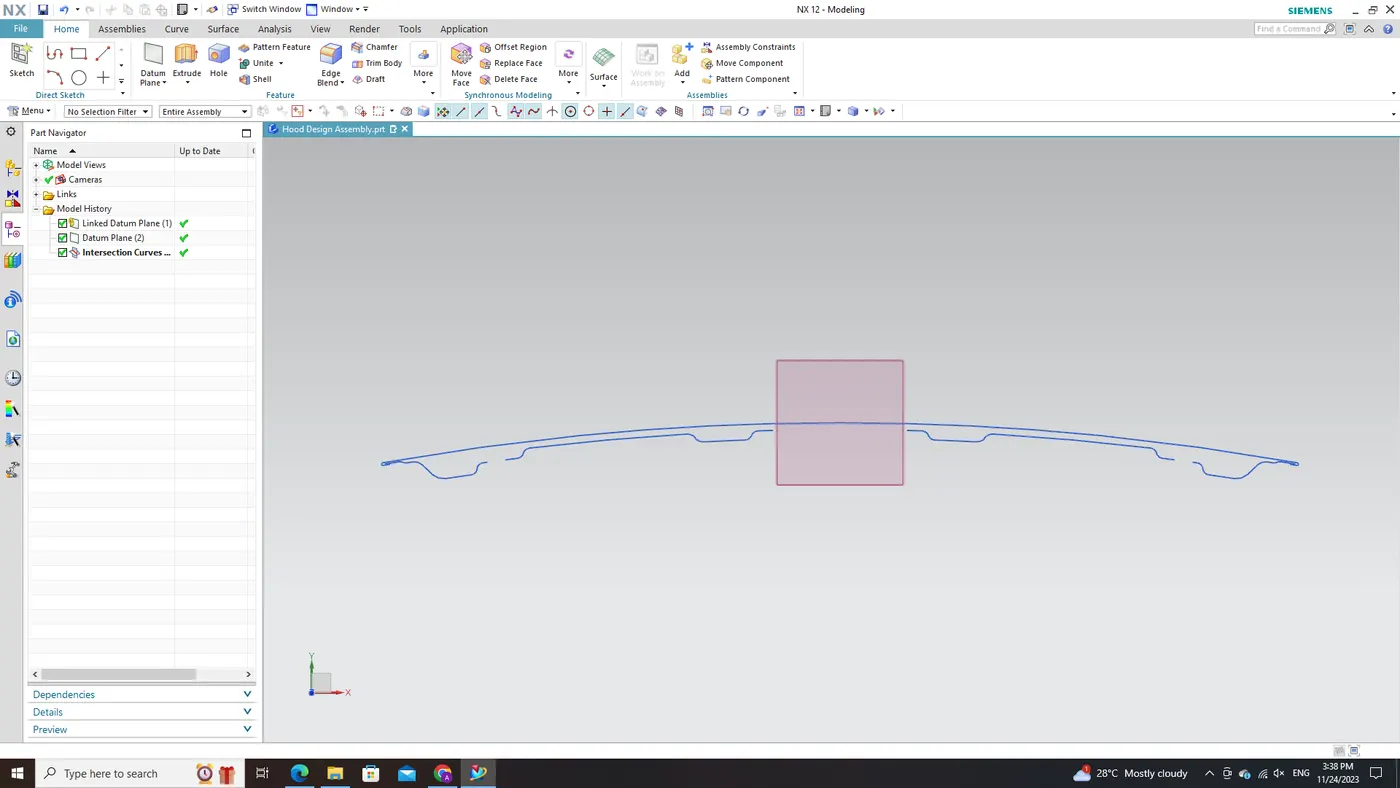
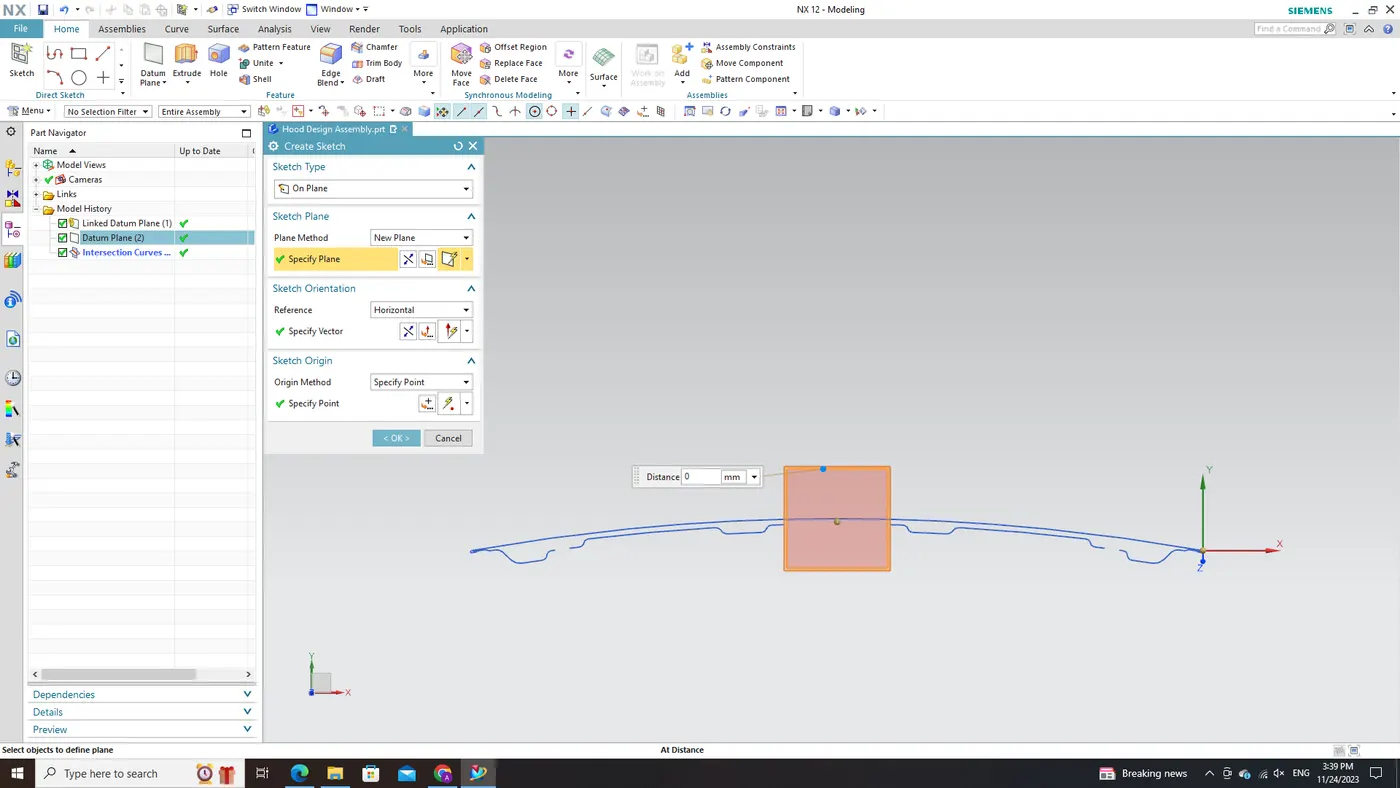
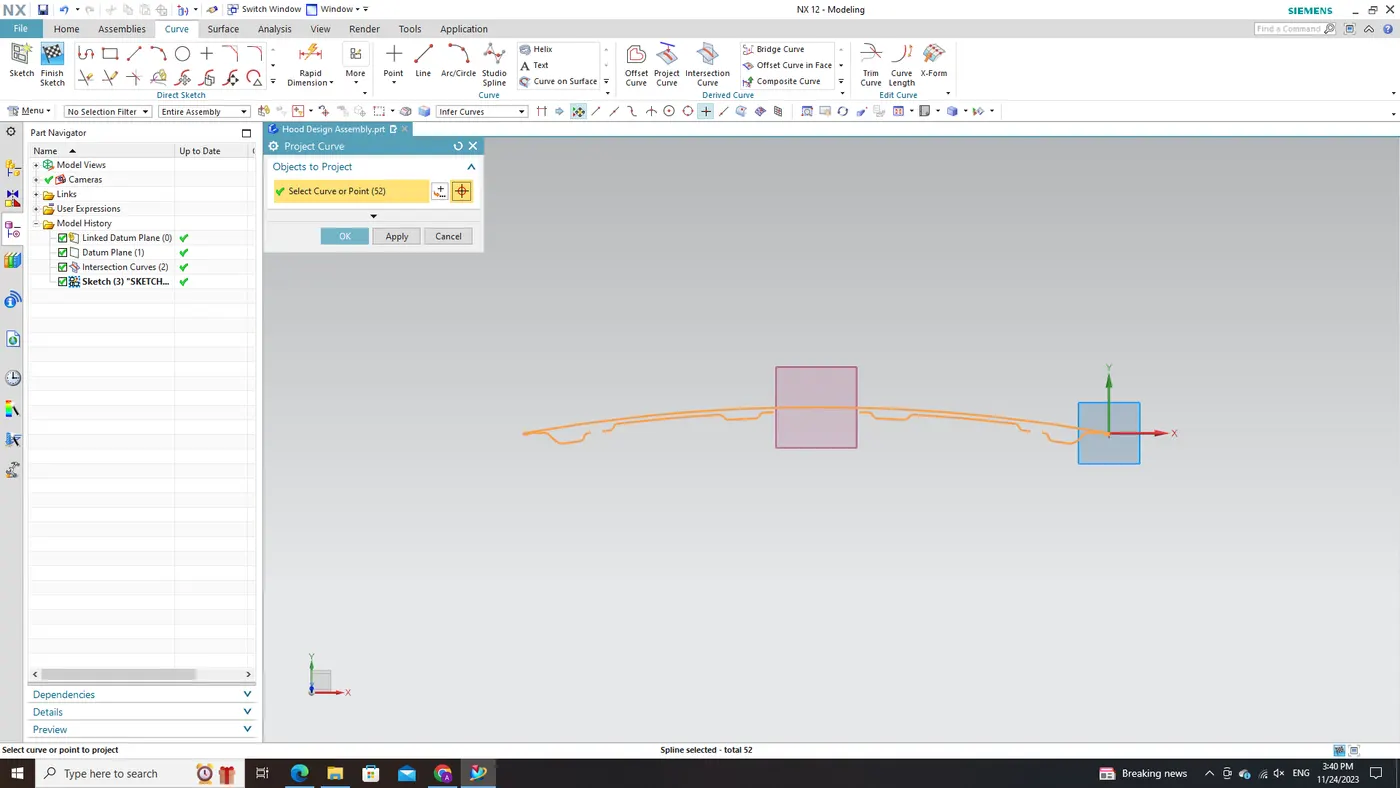
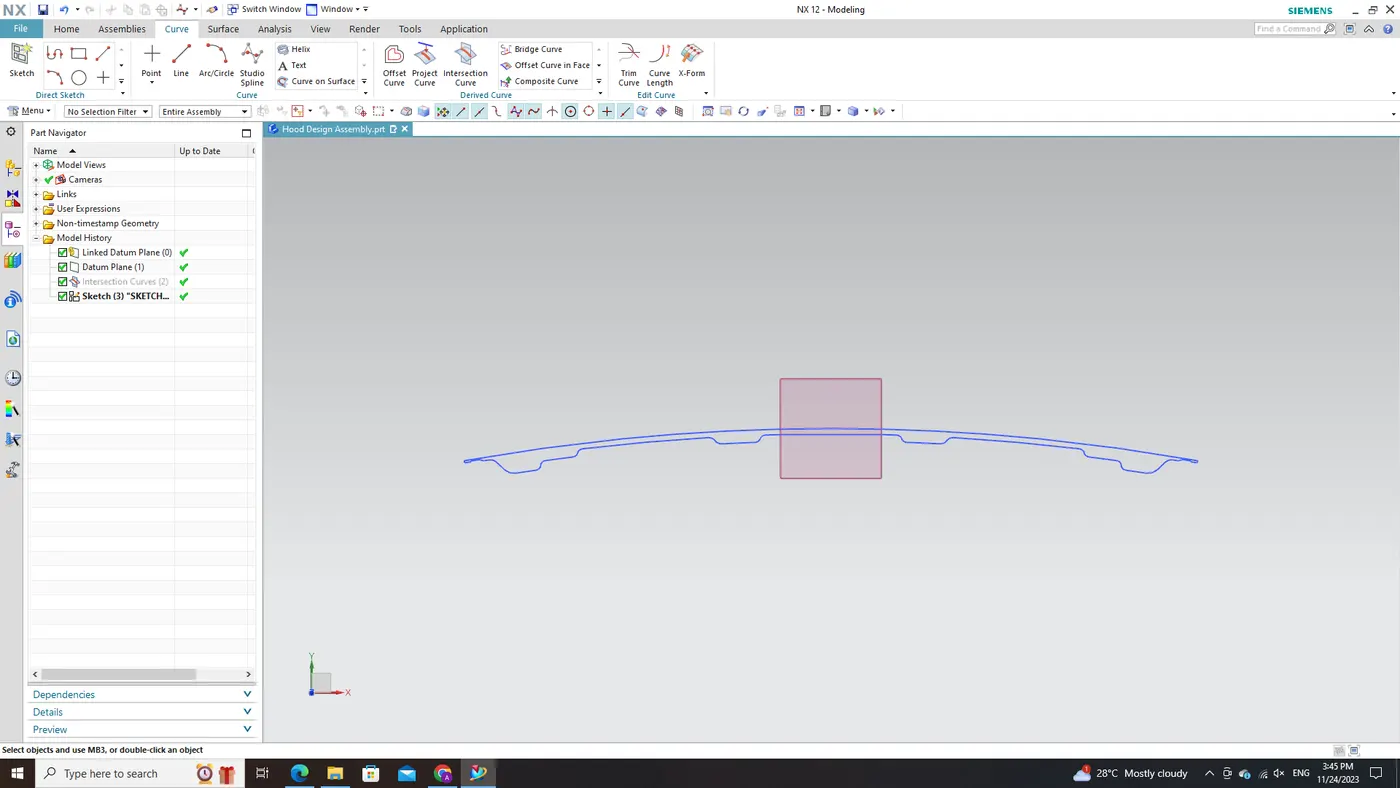
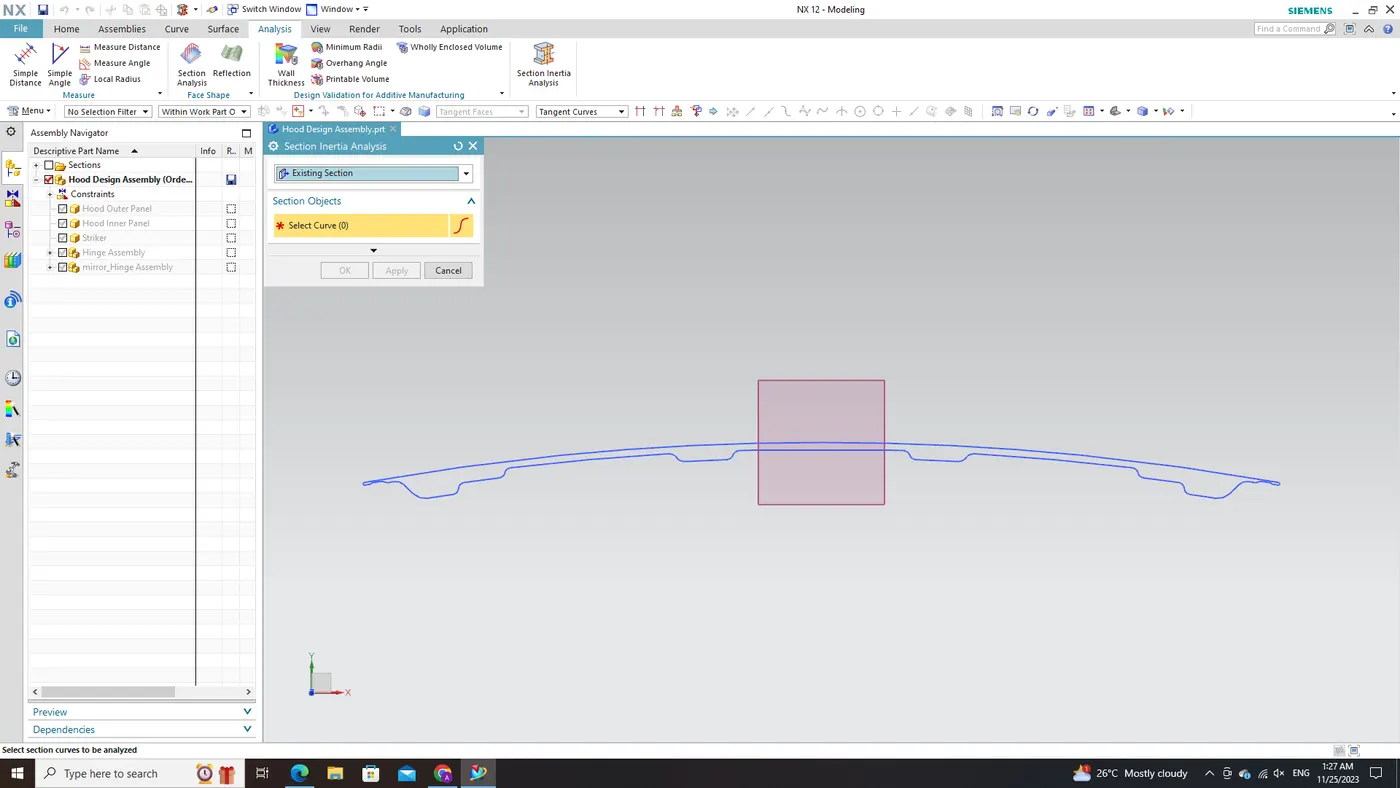
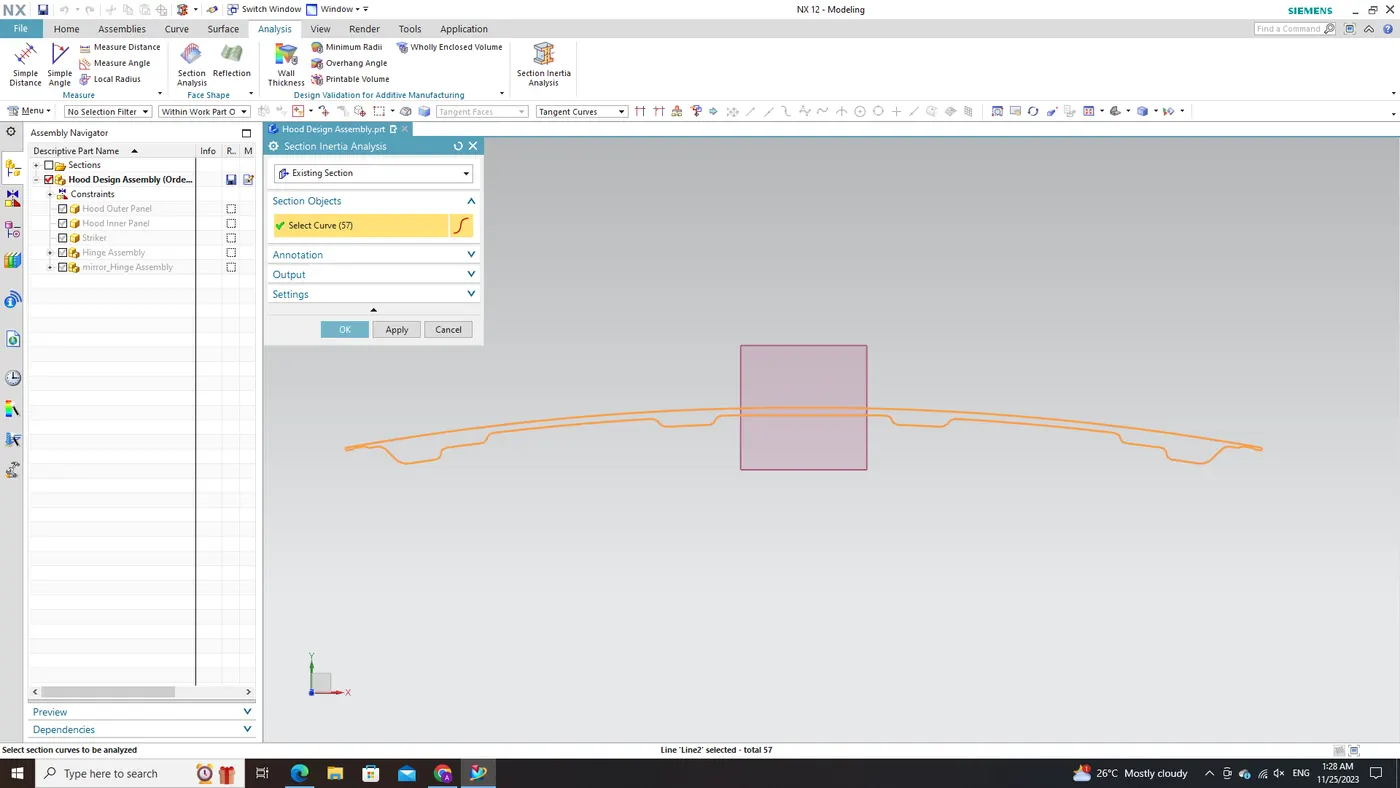
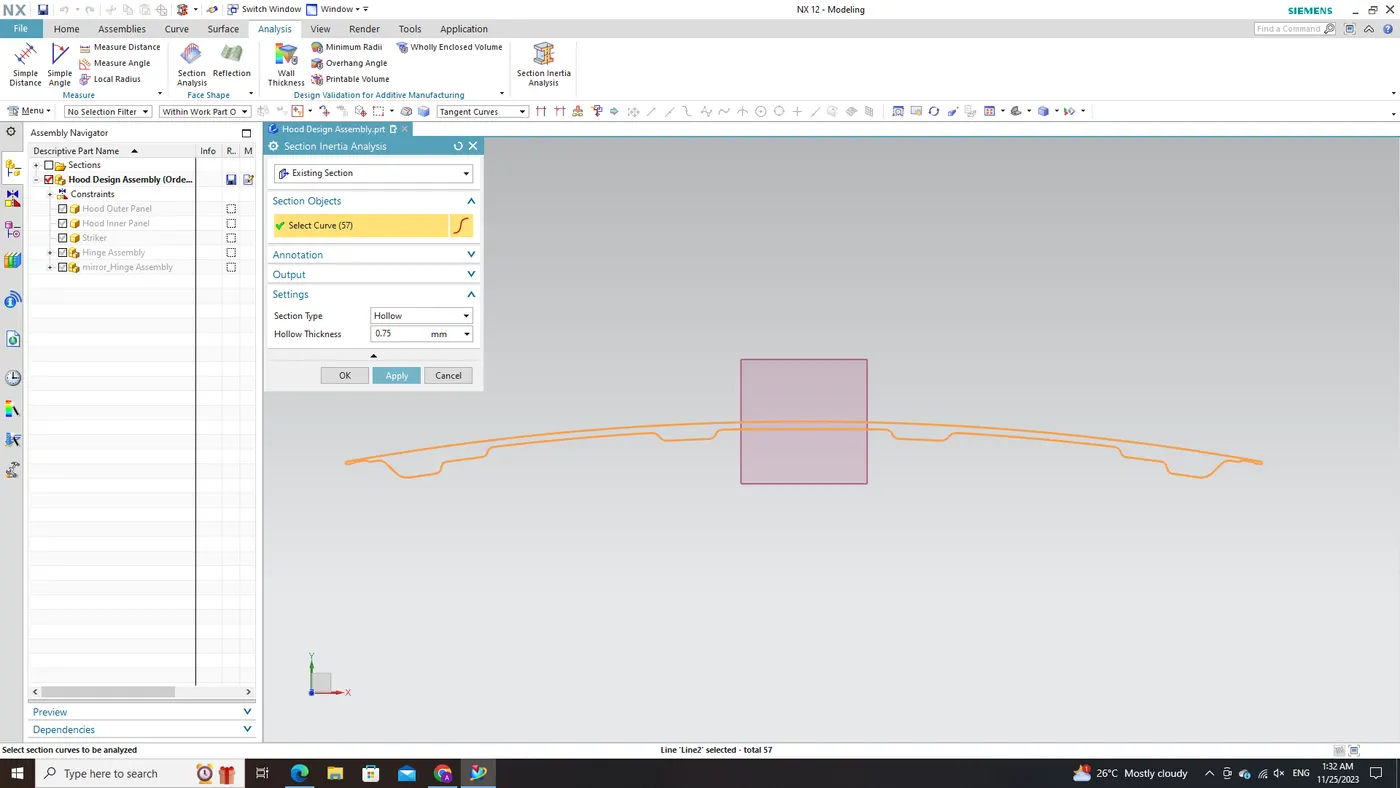
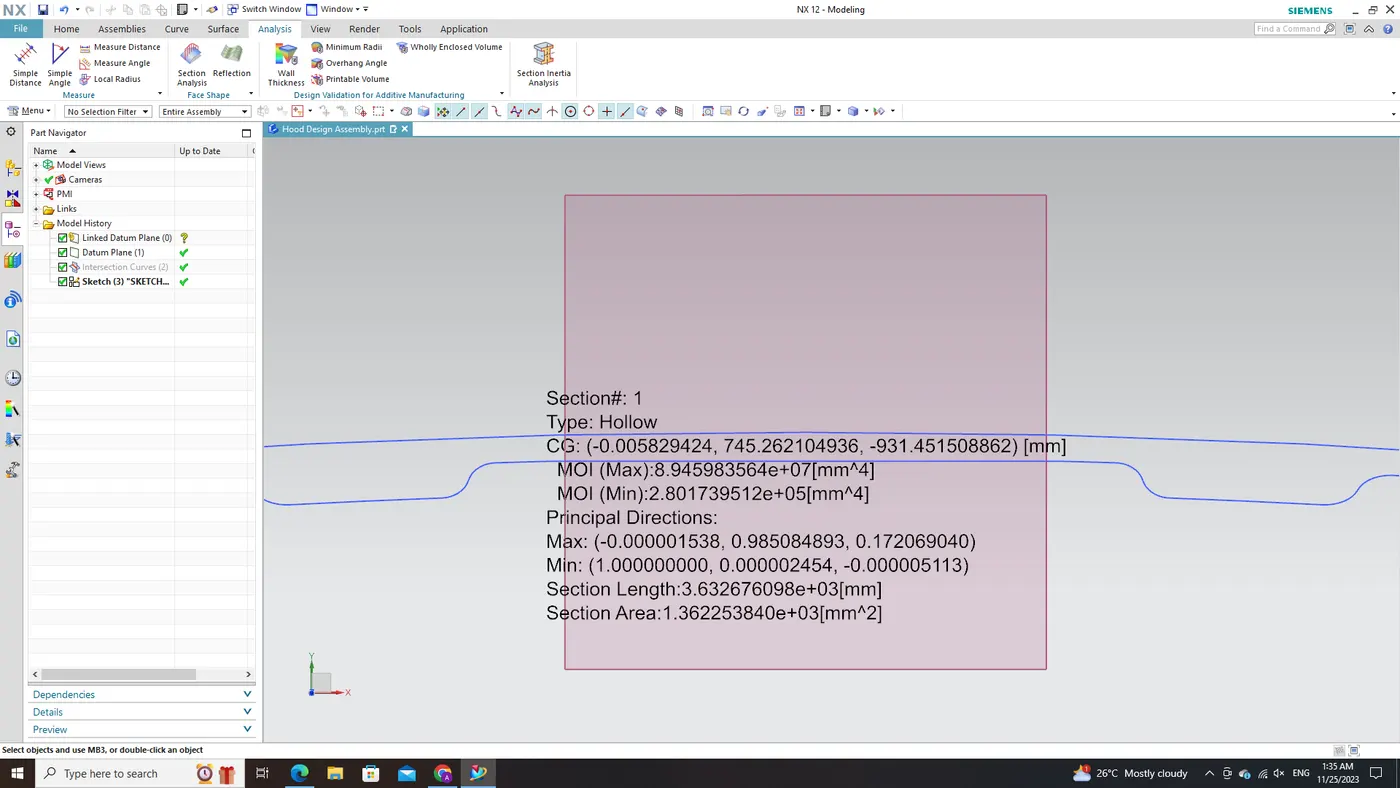
Maximum Moment of Inertia (Max) = `8.945983564 times 10^7 mm^4`
Maximum Moment of Inertia (Min) = `2.801739512 times 10^5 mm^4`
Total Distance of the Hood = 878.5845 mm
Y = `878.5845 / 2`
Y = 439.29225 mm
Section Modulus:
`S = I/Y`
Here,
- S is the section modulus.
- I is the moment of inertia of the section.
- Y is the distance from the neutral axis to the outermost fibers of the section.
S1 = `(2.801739512 times 10^5 mm^4)/(439.29225 mm)`
S1 = `637.78487146085550109295121869325 mm^3`
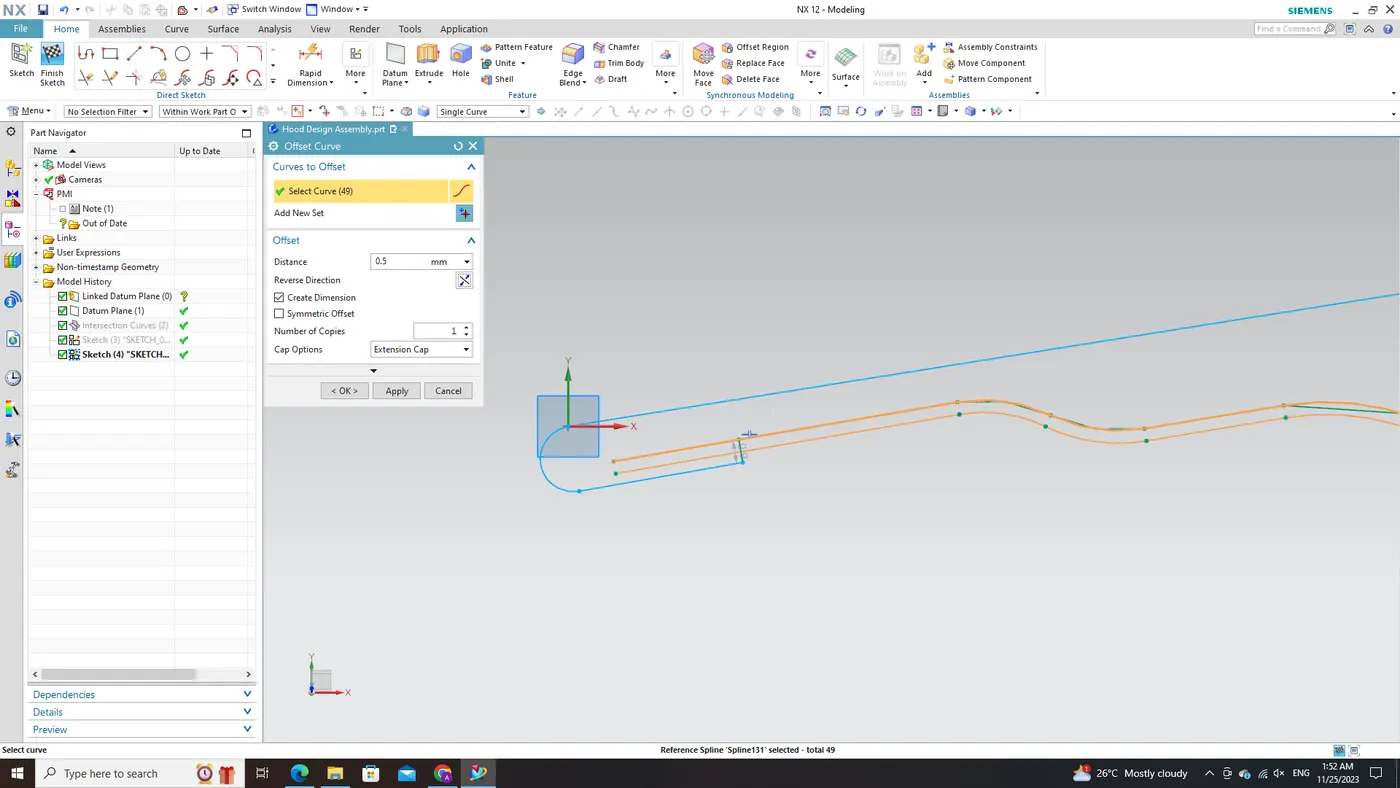
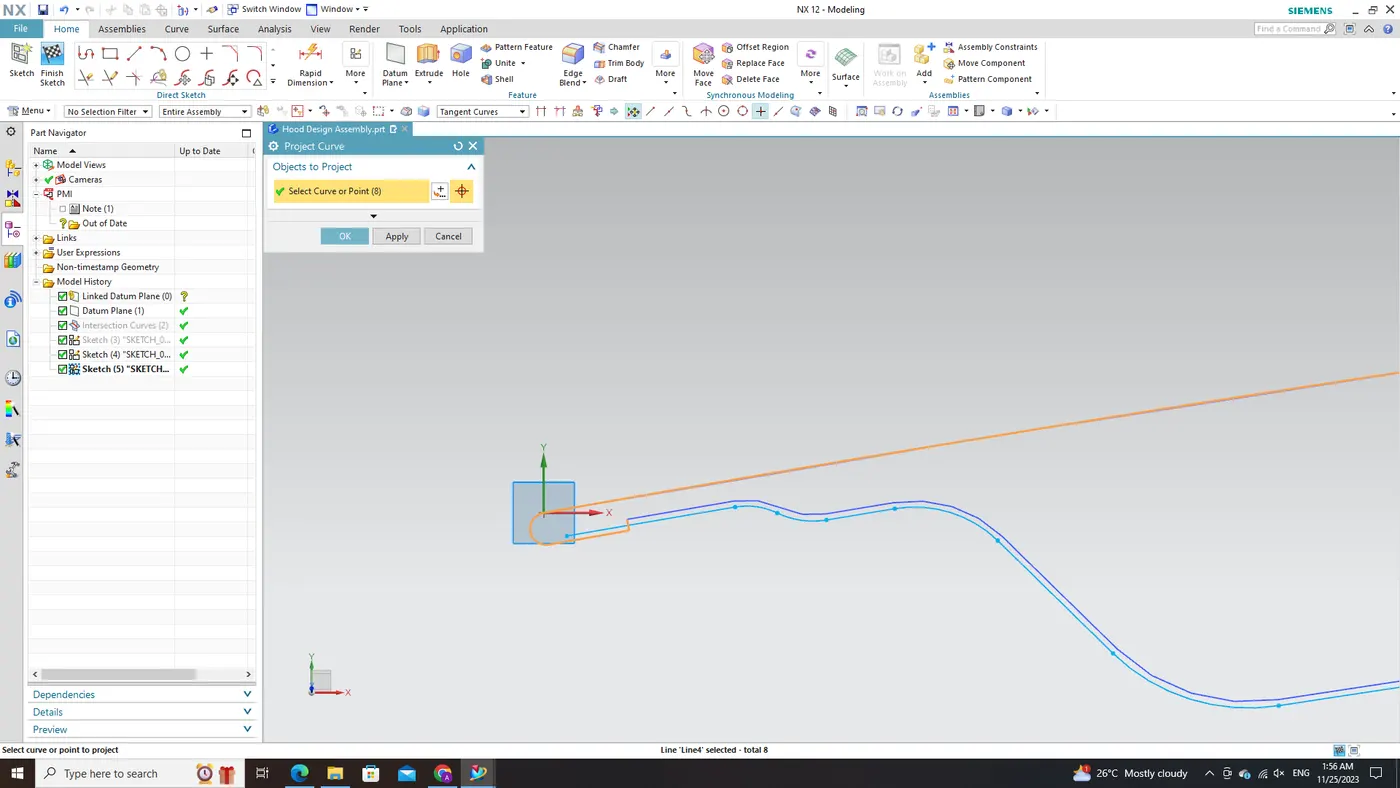
Now, we're going to optimize the design of our hood by increasing the depth of the inner panel by 0.5mm to increase the value of section modulus in order to improve the overall strength of our commodity.
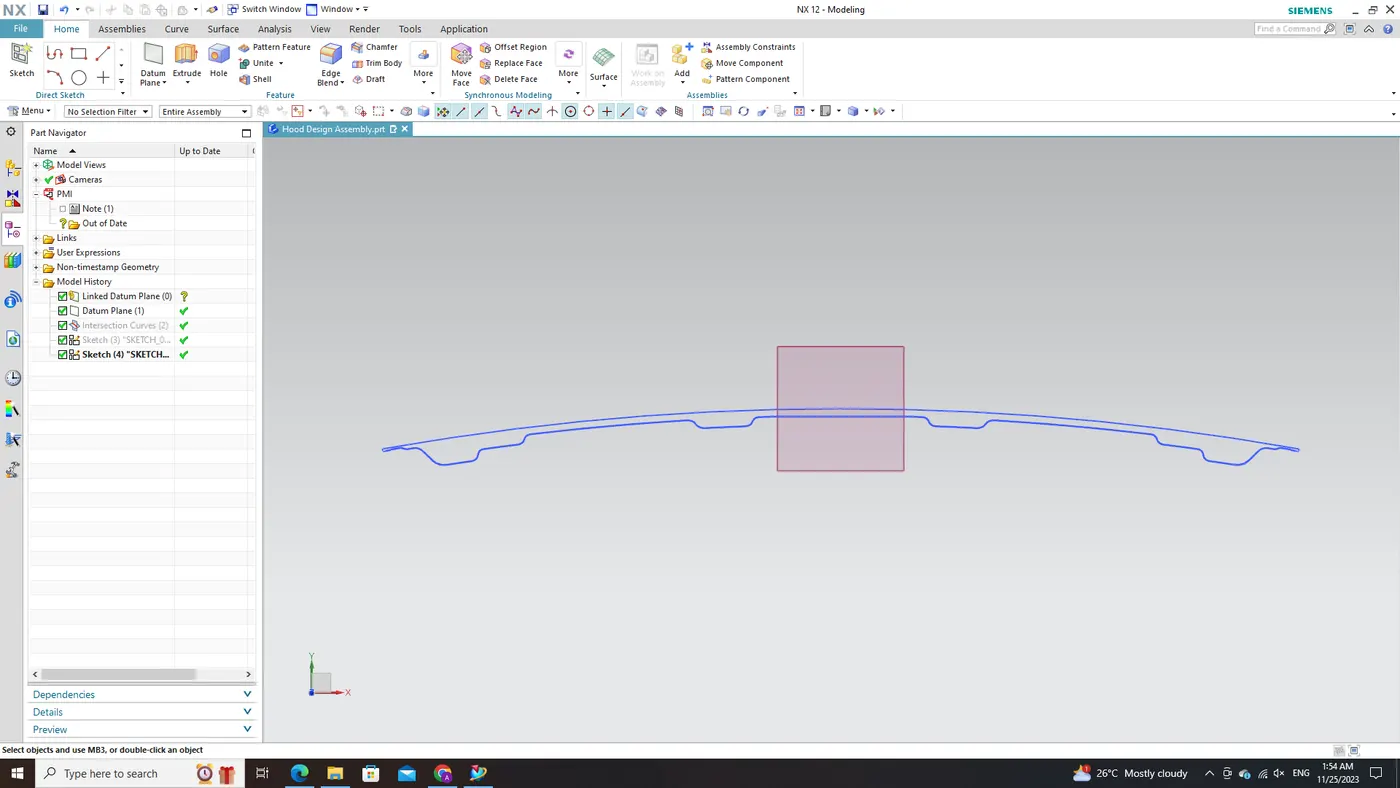
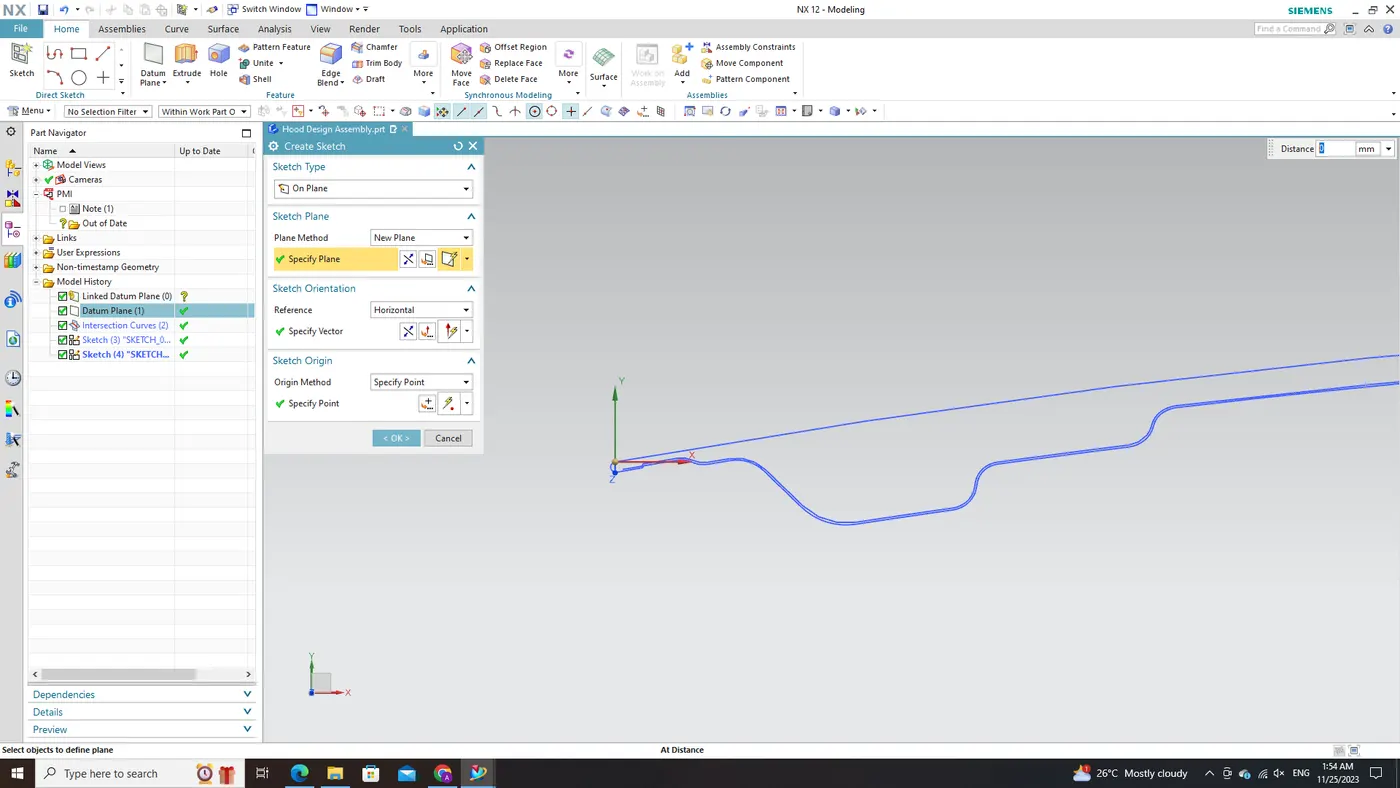
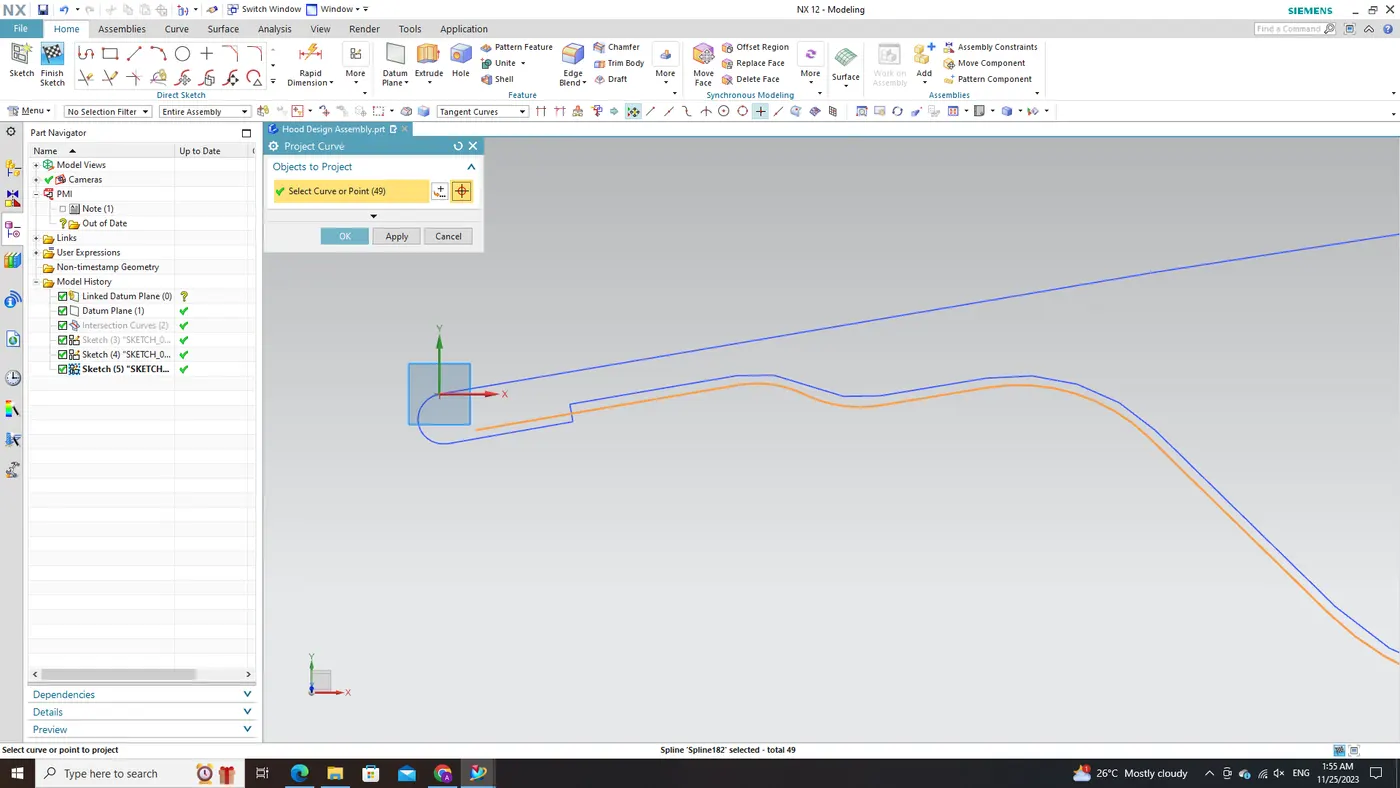
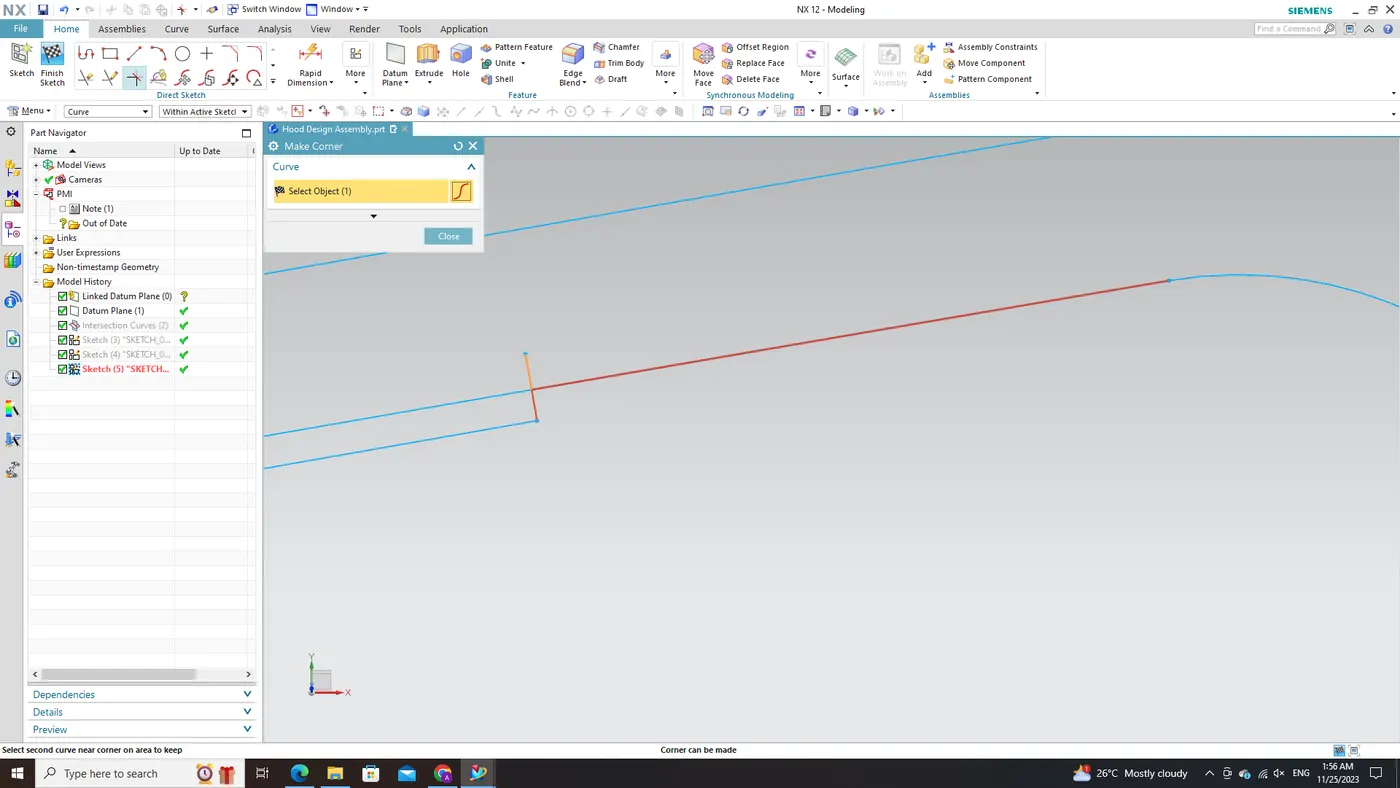
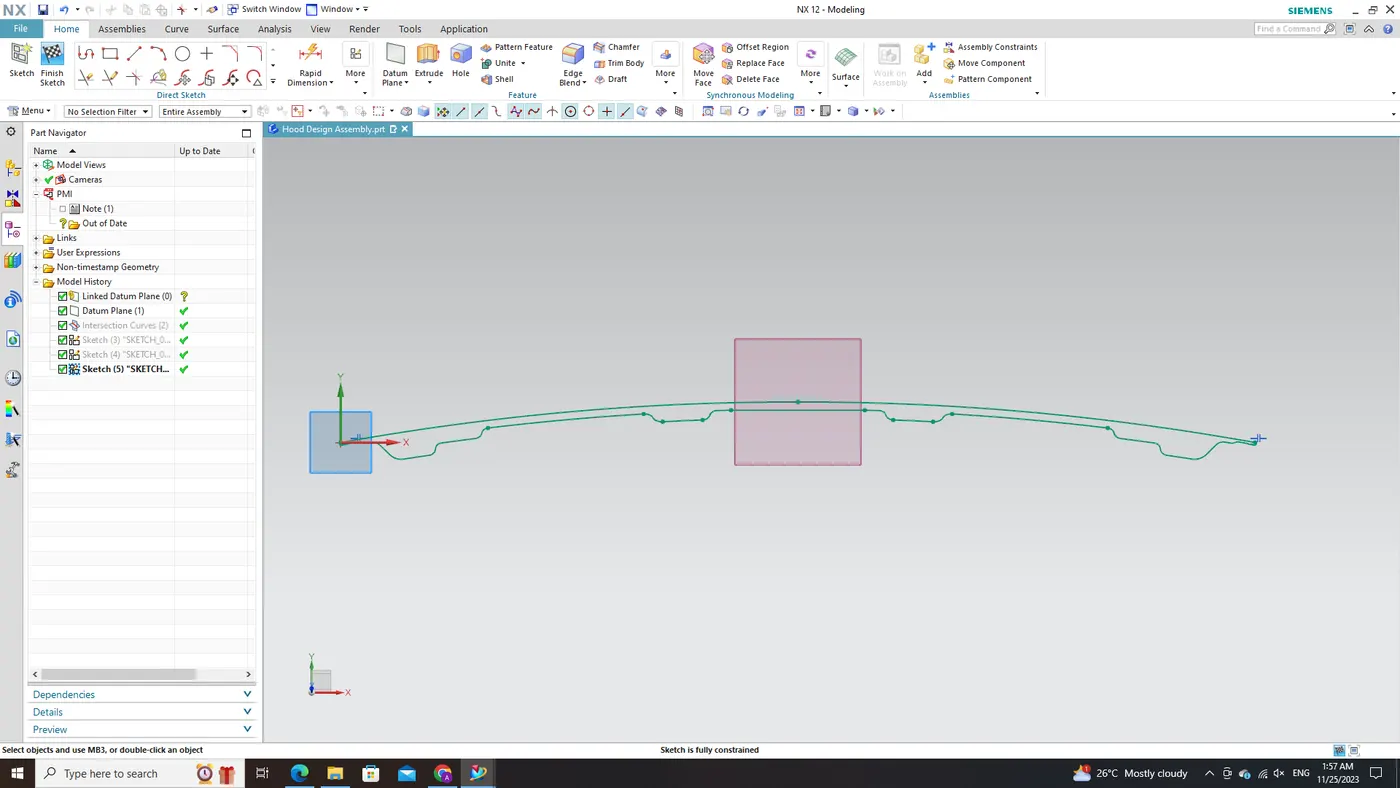
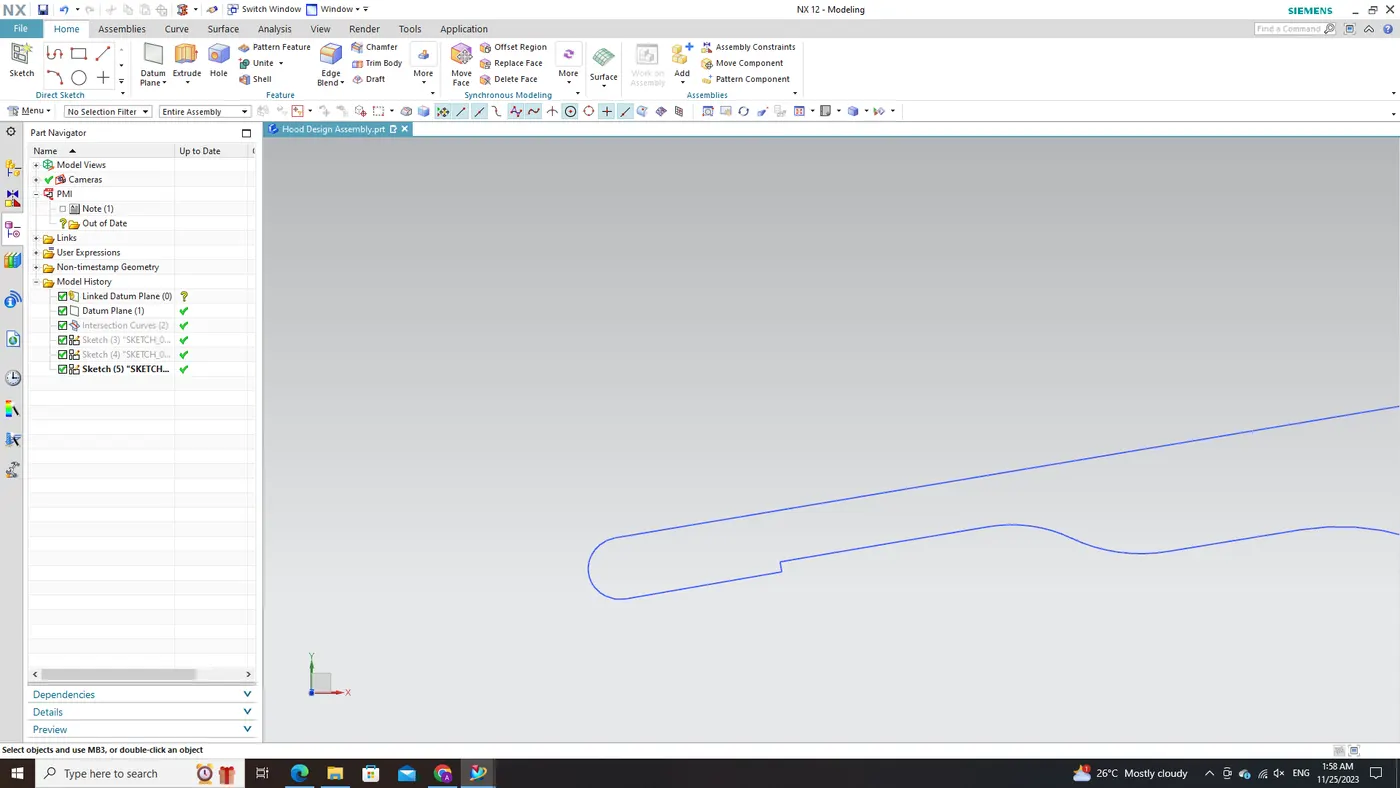
A new Sketch (4) to extract the main intersection curves to project the lower portion of the intersection curves, offset it to a distance and check the Section Inertia Analysis.
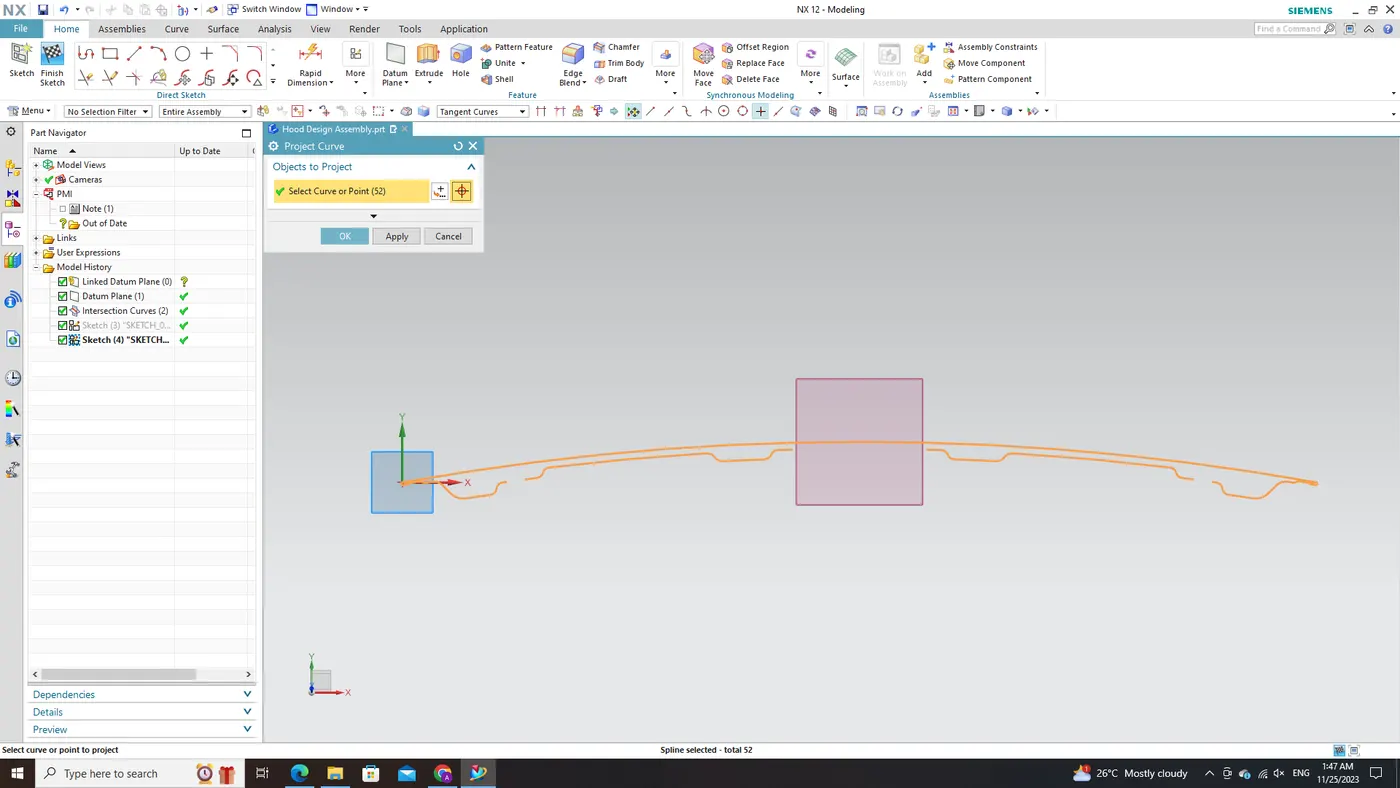
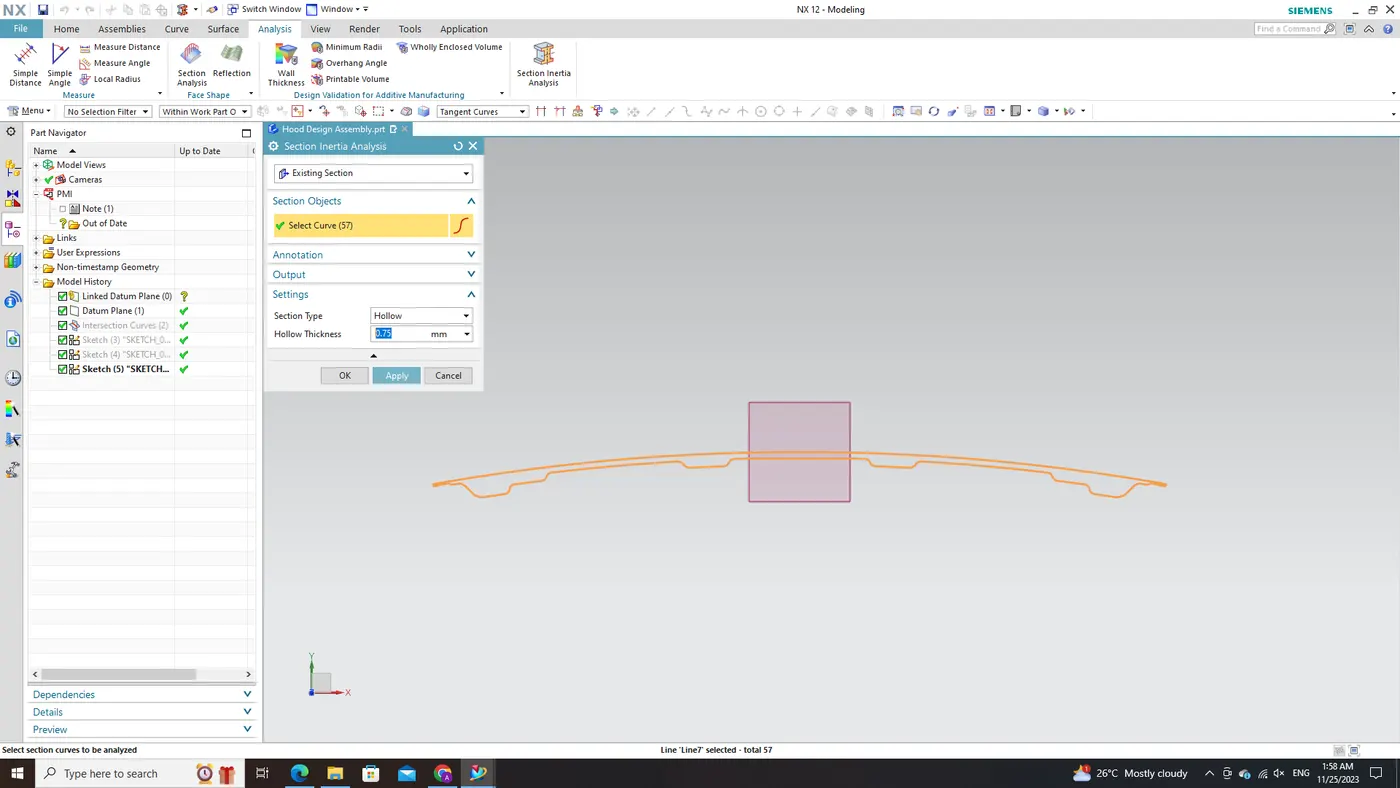
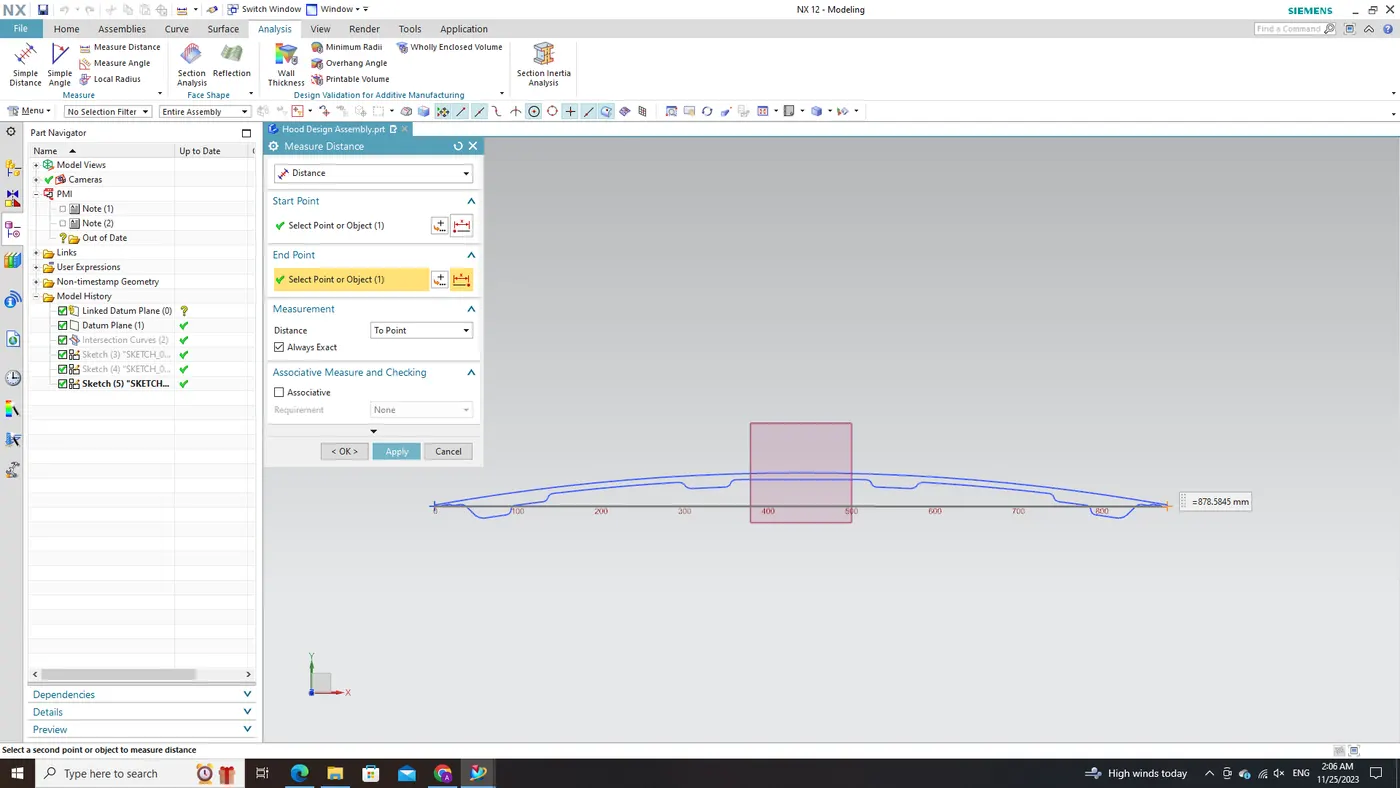
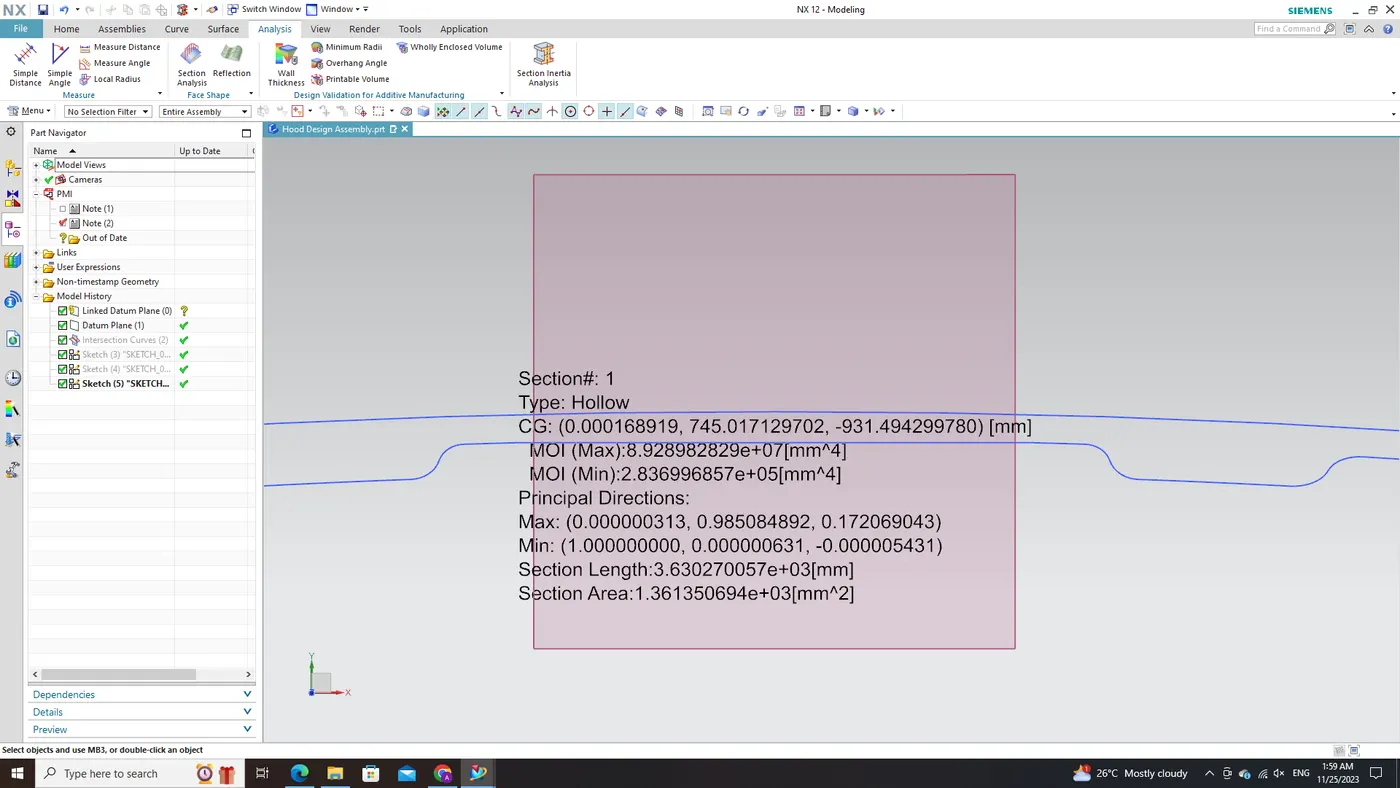
Maximum Moment of Inertia (Max) = `8.928982829 times 10^7 mm^4`
Maximum Moment of Inertia (Min) = `2.836996857 times 10^5 mm^4`
Total Distance of the Hood = 878.5845 mm
Y = `878.5845 / 2`
Y = 439.29225 mm
Section Modulus:
`S = I/Y`
Here,
- S is the section modulus.
- I is the moment of inertia of the section.
- Y is the distance from the neutral axis to the outermost fibers of the section.
S2 = `(2.836996857 times 10^5 mm^4)/(439.29225 mm)`
S2 = `645.81081432690879477158998366122 mm^3`
The observed increase in section modulus is evident from the difference of 8.0259428 mm^4 between the initial and modified values.
The objective of the project was to enhance the strength and structural integrity of a hood by increasing its section modulus. This involved analyzing the section inertia of the initial intersection curve and making modifications to optimize the design.
Analysis and Modification: The section inertia analysis of the first intersection curve resulted in a value of 637.7848714 mm^3. To achieve an increased section modulus, the curve was offset by 0.5mm, creating a new closed curve.
Follow-up analysis: Another section inertia analysis was performed on the modified curve, resulting in a calculated value of 645.8108143 mm^3 for the second scenario. This represents an increase in section modulus of approximately 8.0259428 mm^3 compared to the original design.
Significance of the increase: The observed increase in section modulus indicates that the geometric adjustments made have resulted in improved resistance against bending moments within the hood structure. A higher section modulus value signifies enhanced stiffness and rigidity, crucial factors for overall component strength.
Considerations: While increasing section modulus is beneficial for strength, other factors such as weight reduction, manufacturing constraints, and aesthetic considerations must also be considered during design optimization.
Conclusion: The project successfully demonstrates the impact of offsetting the curve by 0.5mm on the section modulus. This resulted in an improvement in the hood's strength and rigidity, enhancing its ability to withstand external forces and provide structural integrity under anticipated loading conditions.