Section Modulus calculation and optimization
AIM: - Calculate the section modulus of the previously designed hood to analyse its strength and optimise the design to see the difference in bending strength.
Section Modulus
Section modulus is a geometric characteristic for a cross-section utilised in constructing beams or flexural members; it is also known as Polar Modulus or Torsional Sectional Modulus. The area for tension and shear, the radius of gyration for compression, and the moment of inertia and polar moment of inertia for stiffness are some other geometric parameters employed in the design. Any link between these qualities is hugely form dependent. The section modulus of typical conditions is provided in the equations below.
S=I/Y
Here,
S = Section modulus
I= Moment of Inertia (Unit mm 4)
Y= Distance from the Neutral axis to the end (unit mm)
The Unit of a “Section Modulus” is (mm3)
The Moment of Inertia is defined as the amount indicated by the body resisting angular acceleration, which is the sum of the product of each particle's mass and its square of the distance from the axis of rotation. In simpler terms, it is a number that determines the amount of torque required for a certain angular acceleration in a rotating axis. The angular mass or rotational inertia are other names for the moment of inertia. kg m2 is the SI unit for a moment of inertia.
The moment of inertia is frequently expressed in relation to a certain axis of rotation. It is mostly determined by the distribution of mass around a rotating axis. MOI changes based on the axis used.
In broad strokes,
I = m*r2 denotes the moment of inertia.
where,
m = The sum of the mass products.
r = Distance from the rotation axis.
Area Moment of Inertia
The area moment of inertia of a beam cross-section area represents the capacity of the beam to resist bending. The greater the moment of inertia, the smaller the bend.
Where,
M = Bending Moment.
I = Area Moment of Inertia
E = Young modulus
R = Radius of Gyration
Neutral Axis
- When a beam is exposed to pure bending, the topmost fibres of the beam experience the most compression, while the bottommost fibres experience the highest tension.
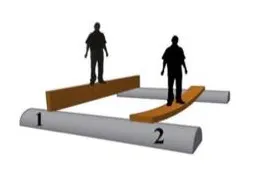
- This image includes the following scene: A beam with its narrow edge supported at both ends is depicted. A guy walks along a straight beam. A diagram of a beam supported at both ends and resting on its flat side. A guy walks on a straight beam that is bending in the centre.
Section modulus is calculated in the following steps:-
Step 1: Locate the centroid of the provided cross-section.
Step 2: Determine the moment of inertia around the neutral axis (I).
Step 3: Determine Ymax Ymin from the neutral axis.
Step 4: Using the method presented above, calculate the elastic section modulus.
The moment of inertia is nothing more than resistance to the moment, bending or twisting. The greater the moment of inertia, the greater the resistance to deformation.
The sectional modulus of the hood design before optimisation is shown below.
NX-CAD software calculates the moment of inertia.
Case 1: -
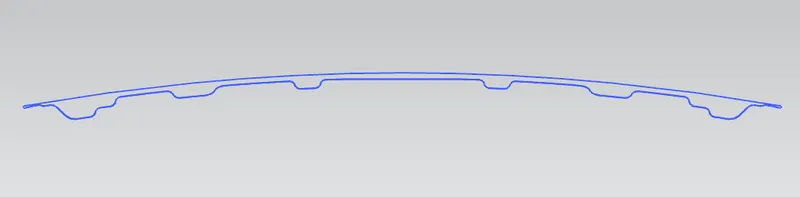
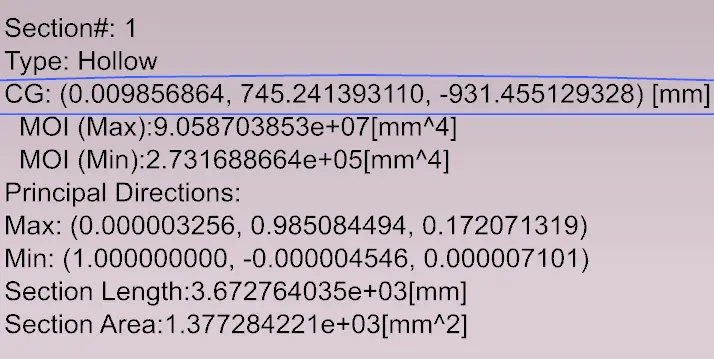
The Hood panel section is studied here to analyse the section inertia analysis. After doing so, we had the intended outcomes, as indicated in the figure above.
I (MAX) = 9.058703853e+07(mm^4)
I (MIN) = 2.731688664e+05 (mm^4)
As per the section modulus equation,
S = I/Y
I = MOI (min) Value is considered
Y = Total distance / 2
Y=876.468/2
Y=438.234mm
Therefore,
S = 2.731688664 x 10^5 mm^4 /438.234 mm
S1 = 0.00623340194 x 10^5 mm^3 = 623.340194 mm^3
Case 2: -
In this case, we have increased the distance between the hood's outer panel and inner panel by 0.5mm respective to the previous Case 1.
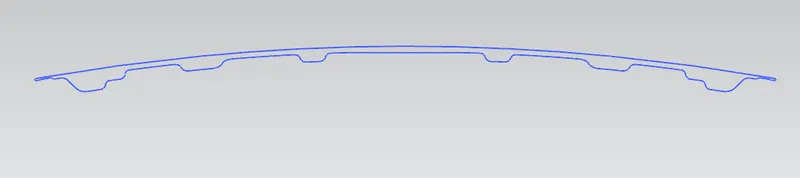
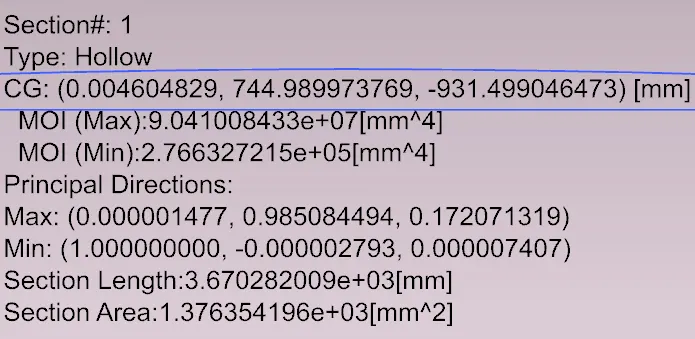
I (MAX) = 9.041008433e+07(mm^4)
I (MIN) = 2.766327215e+05 (mm^4)
As per the section modulus equation,
S = I/Y
I = MOI (min) Value is considered
Y = Total distance / 2
Y=876.468/2
Y=438.234mm
Therefore,
S = 2.766327215x 10^5 mm^4 /438.234 mm
S2 = 0.00631244316 x 10^5 mm^3 = 631.244316 mm^3
Result: - S2 > S1 = 631.244316 mm^3 > 623.340194 mm^3
Diffrence is 7.904122 mm^3
Conclusion: -
- We raised the area of the section by extending the space between the Hood's outer and inner panels by 0.5 mm, which enhanced the Section Modulus and hence increased the strength.
- As a result of comparing Case 1 with Case 2,
- Case 2 has a larger section modulus value than Case 1.
- The moment of inertia and section modulus rises as the section area grows, implying that the strength and load material also increases. The moment of inertia is exactly proportional to the material's strength.