Section Modulus calculation and optimization
SECTION MODULUS OF AN HOOD
The section modulus of a hood refers to the geometric property that indicates the resistance of the hood's cross-sectional shape to bending. It is a measure of the stiffness and strength of the hood section.
Section modulus is a direct measure of strength of any sectional area of an object about an reference axis(neutral axis).Strength is nothing but, capable of supporting greater loads, so higher the strength it has a high capable of supporting greater loads.This strength can measured directly from Section modulus formula, and defined by below formula.Section modulus represented by the symbol S.
S=I/Y
where,
I= Moment of inertia
Y= Distance from the refere line(neutral axis) to one of the extreme end of an object.
Moment of inertia is nothing but offering resistance against of moment, bending or twisting, i.e if we applied any external load on the body, how much resistance its offering to tend to deform.So, higher the value of moment of inertia , have higher resistance to deform under certain load, hence we can say that moment of inertia directly proportional to the strength of the material, and strength of the material can be calculated with the help of section modulus.
Area Moment of Inertia:
The area moment of inertia of a beam cross section area measures the beam ability to resist bending. The larger the moment of inertia less will be the bend.
(M/I) = (E/R)
where,
M = Bending Moment
I = Area moment of Inertia
E = Young modulus
R = Radius of gyration
Calculation:
Case 1: Before Optimization
The hood which was already created is imported and the section inertia analysis is done.
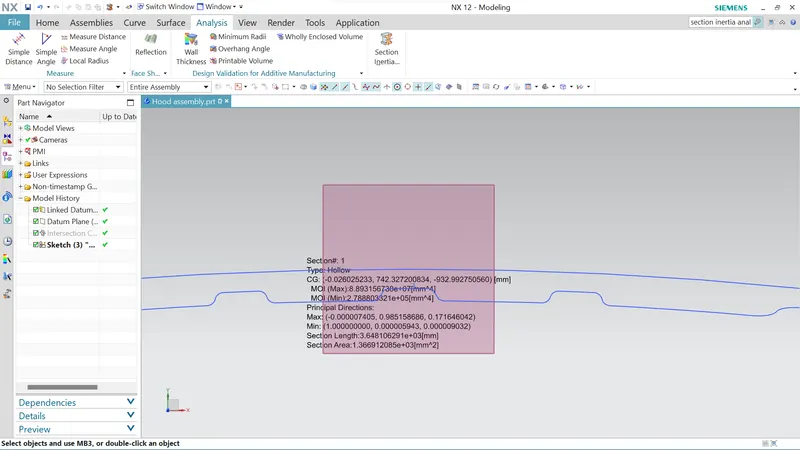
I (MAX) = 8.893156730e+07 (mm^4)
I (MIN) = 2.788803321e+05 (mm^4)
As per the section modulus equation,
S = I/Y
I = MOI (min) Value is considered
Y = Total distance / 2, Total distance = 480mm
Y = 480/ 2
= 240 mm
Therefore, S = 278880.3321mm^4 / 240mm
S = 0.116x10^3mm^3
Case 2: After Optimization
The hood inner panel’s curve is offset by 0.5mm outwards and section inertia analysis is done same as case 1 for a closed curve.
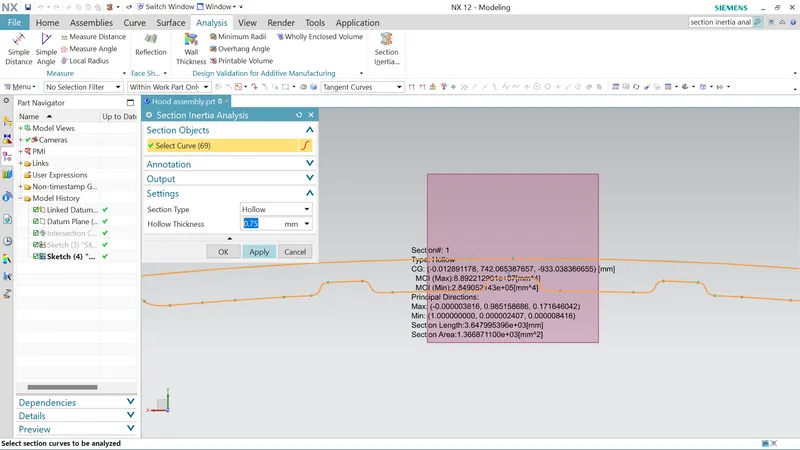
I (MAX) = 8.892212901e+07 (mm^4)
I (MIN) = 2.8490952143e+05 (mm^4)
As per the section modulus equation,
S = I/Y
I = MOI (min) Value is considered
Y = Total distance / 2, Total distance = 480 mm
Y = 480 / 2
= 240 mm
Therefore, S = 284909.52143 mm^4 /240 mm
S = 0.118x10^3 mm^3
Conclusion:
- The section modulus value of case 2 is higher than the case 1
- As we increase the section area, the moment of inertia & section modulus increase which means strength and load material also increase. Which the moment of inertia directly proportional to the strength of the material.