Section Modulus calculation and optimization
Aim: Doing an analysis of the hood to get the section module and modifying the cross-section area of the hood to increases the section modules of the hood.
Objectives:
- Study of the moment of inertia of the hollow parts.
- Study about section modulus and on which parameters it depends.
- Learn how to do get a moment of inertia in NX software.
Theory:
Section properties involve the mathematical properties of structural shapes. They are of great use in structural analysis and design. Note that these properties have nothing to do with the strength of the material, but are based solely on the shape of the section. It explains why some shapes are more efficient at supporting loads than others.
These properties are looked at in more detail following:
- center of the area (or centroid)
- the second moment of area or moment of inertia (I)
- section modulus (Z)
All of these values are generally calculated for both axes of symmetry (x-x and y-y on the standard coordinate plane). These axes are shown in the following diagram.
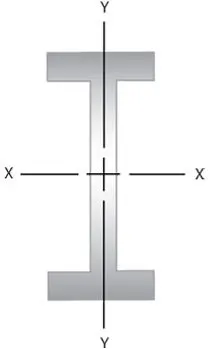
Centre of area (centroid):
The centroid of a section is important in structural design and is like the center of gravity of the shape. Most structural shapes have their centroid tabulated by the manufacturer. Many other simple shapes are symmetrical about the x-x and y-y axes and the centroid can easily be seen. Occasionally a structural shape is made up of more than one structural section. In these cases, a calculation is needed to work out the position of the centroid so that further structural design and analysis can be carried out.
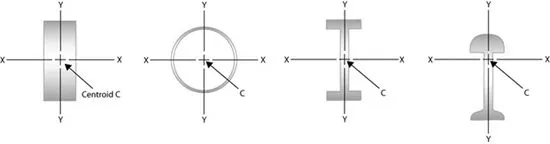
Second moment of area (I):
The second moment of area is also known as the moment of inertia of a shape. It is directly related to the area of material in the cross-section and the displacement of that area from the centroid. Once the centroid is located, the more important structural properties of the shape can be calculated. The axis that determines the centroid is also known as the neutral axis (N/A).
The second moment of area is a measure of the efficiency of a shape to resist bending caused by loading. A beam tends to change its shape when loaded. The second moment of area is a measure of a shape's resistance to change.
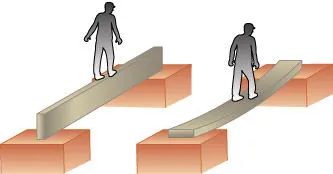
Section modulus (Z):
The section modulus of the cross-sectional shape is of significant importance in designing beams. It is a direct measure of the strength of the beam. A beam that has a larger section modulus than another will be stronger and capable of supporting greater loads.
It includes the idea that most of the work in bending is being done by the extreme fibers of the beam, i.e. the top and bottom fibers of the section. Therefore..., the distance of the fibers from top to bottom is built into the calculation.
The elastic modulus is denoted by Z. To calculate Z, the distance (y) to the extreme fibers from the centroid (or neutral axis) must be found as that is where the maximum stress could cause failure.
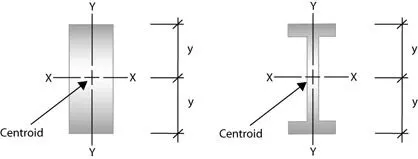
To calculate the section modulus, the following formula applies:
`Z = I/Y` where I = moment of inertia, Y = distance from the centroid to the outermost point
For symmetrical sections, the value of Z is the same above or below the centroid.
For asymmetrical sections, two values are found: Z max and Z min which can be calculated by calculating the Max MOI and Min MOI using the NX software as follows:
Steps to calculate the MOI in the NX software as follows:
1.First we have to get the intersection curve of the outer panel and inner panel to get the cross-section of the hood about the XY plane by using the intersection curve as follows:

As we can see in this cross-section we need to get to calculate the moment of inertia of the hood in NX software.
2. So after applying the intersection curve command to the surface of the outer panel and inner panel about its center plane we get the following curve as shown:

3.Now we have to trim the outer line of the outer panel and inner line of the inner panel and join the breaking lines through studio curve with tangent relation because the inner panel has curvature as shown below:

4.Now we have a cross-section hood now to get the moment of inertia we are using the section inertia analysis command with an option in that as the existing curve.
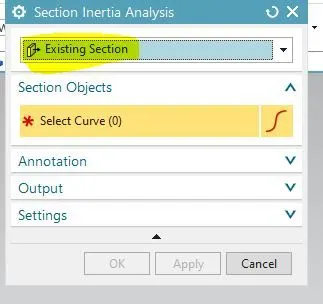
5.After this we get the Maximum and minimum MOI as shown :
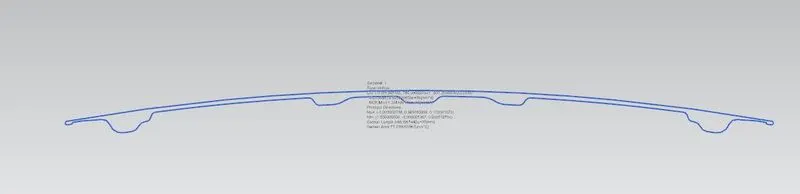
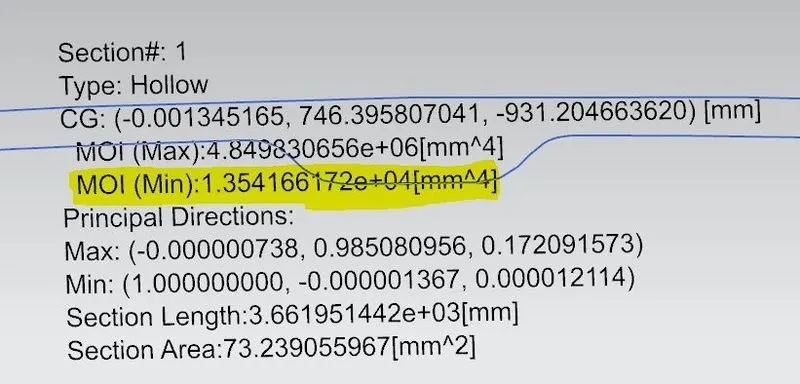
from this the minimum moment of inertia is I= 13541.66mm^4
6.Now we have to calculate the Y = distance from the centroid to the outermost point as follows;

Therfore the `Y = 879.9/2 = 439.95mm`
7. Next step is to calculate the Section Modulus(Z) as follows:
`Z = I/Y = 13541.66/439.95 = 30.78mm^3`
Steps to increase the section modulus:
8.Now increase the section modulus which depend on moment of inertia and distance from centroid as per our model we can't change the distance form centroid but we can change the moment of inertia which can increase the section modulus, so this can be done as follows:
a.we increase the mass of the part
b.we can increase the distance of the outer most curve of either inner panel or outer panel from center of rotation axis
So after adding some more areas and offsetting the inner panel curve to 0.5mm outer side, we get the modified new inner panel cross-section which is as follows:

The yellow color shows the modified areas.
So the Modified minimum MOI is as follows:
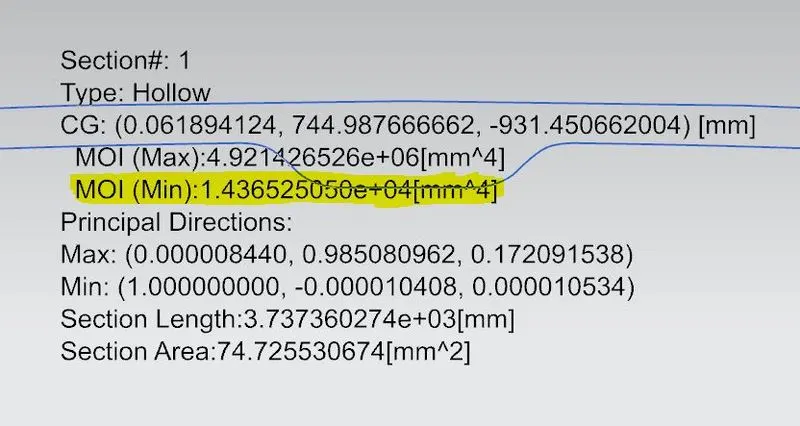
Let's calculate the new section modulus :
`Z_1 = I_1/Y = 14365.25/439.95 = 32.652mm^3`
Conclusion: From this project, we can say that the section modulus of the part depends on the moment of inertia and distance from the outer most point to centroid point, so to increase the section modulus we can either increase the cross-section or we can increase the distance of outer most curves from the center of the axis of rotation.