SECTION MODULUS
Section Modulus
Section Modulus is a geometric property used to calculate the bending stresses in a structural member.
Mathematically,
It is defined as the ratio of the moment of inertia of a section about its centroidal axis and to the distance of the extreme layer from the neutral axis.
It is denoted by Z.
Z = I/ymax
Mathematically By bending stress equation,
M/I = σmax/ymax
M = σmax × (I/ymax)
M = σmax × Z
Where,
I = Moment of Inertia(m⁴)
y = distance from NA to extreme layer(m)
The unit of section modulus is m³.
Types of Section Modulus
There are two types of section modulus:
- Elastic Section Modulus
- Plastic Section Modulus
Elastic Section Modulus
Elastic section modulus is calculated when we are to use the material behavior till the yield point.
For general design purposes, we use elastic section modulus.
Generally, elastic section modulus is denoted by Zₑ.
So,
Zₑ = I/ymax
Where,
I = Moment of inertia
ymax = Distance from NA to extreme layer
Elastic Section Modulus of Different Section
There are following different elastic section modulus:
Rectangular Section
As we know the moment of inertia of the rectangular section,
I = bd³/12
And the distance from the neutral axis,
ymax = d/2
So,
Zₑ = I/ymax
Zₑ = (bd³/12)/(d/2)
After calculating them,
Section modulus of rectangular section,
Zₑ = bd²/6
Hollow Rectangular Section
As we know the moment of inertia of the hollow rectangular section,
I = (BD³/12) - (bd³/12)
ymax = D/2
After putting these values,
Zₑ = I/ymax
(BD³/12) - (bd³/12)/(D/2)
Zₑ = (BD³ - bd³)/6D
Solid Circular
For solid Circular moment of inertia,
I = (π/64) × d⁴
ymax = d/2
Then,
Zₑ = {(π/64) × d⁴}/(d/2)
After calculating then find values of section modulus of solid circular
Zₑ = (π/32) × d³
Hollow Circular
The moment of inertia of hollow Circular,
I = (π/64) × (D⁴ - d⁴)
And,
ymax = D/2
After putting these values,
Zₑ = (π/64) × (D⁴ - d⁴)/(D/2)
Zₑ = π/32 × {(D⁴ - d⁴)/D}
Symmetric I & C Section
Moment of inertia for the I & C section,
I = (BD³/12) - {(B - b)d³}/12
ymax = D/2
So,
Zₑ = [(BD³/12) - {(B - b)d³}/12]/(D/2)
Zₑ = {BD³ - (B - b)d³}/6D
Diamond
Elastic section modulus for diamond is,
Zₑ = bd²/24
Plastic Section Modulus
The plastic section modulus is used for materials where the elastic yield is acceptable and the plastic behavior is considered to be an acceptable range.
It depends on the location of the plastic neutral axis. The PNA is the axis that bisects the cross-section such that the compressive force from the region in compression is equal to the tension force from the region under tension. So, for sections with a constant yield stress, the area above and below the PNA will be equal, but for mixed sections, this is not necessarily the case.
Mathematically,
The plastic section modulus is the sum of the areas of cross-sections on each side of the plastic neutral axis that may or may not be equal and multiplied by the distance from the local centroid of the two regions to the plastic neutral axis.
Zₚ = (Ac × yc) + (Aₜ + yₜ)
Where,
Ac = Area of cross-section under compression.
Aₜ = Area of cross-section under tension.
yc = Distance from the plastic neutral axis to the center of gravity of the areas under compression.
yₜ = Distance from the plastic neutral axis to the center of gravity of areas under tension.
Since on the neutral axis, the area under compression is equal to the area under tension.
So,
Ac = Aₜ
And,
yc = yₜ
Plastic Section Modulus of Different Section
There are following section modulus for different section:
Rectangular Section
As we know,
on the neutral axis, the area under compression is equal to the area under tension.
So,
Ac = Aₜ
And,
yc = yₜ
Ac = Aₜ = bd/2
yc = yₜ = d/4
So,
Zₚ = (Ac × yc) + (Aₜ + yₜ)
Zₚ = (bd/2 × d/4) + (bd/2 × d/4))
After calculating
Zₚ = bd²/4
Similarly, we can calculate the section modulus of the rectangular hollow section,
Zₚ = (bd²/4) - (b- 2t) × {(b/2) - t}²
Circular Section
As we know, on the neutral axis, the area under compression is equal to the area under tension.
So,
Ac = Aₜ = πd²/8
yc = yₜ = 2d/3π
Zₚ = (πd²/8 × 2d/3π) + (πd²/8 × 2d/3π)
After calculating,
Zₚ = d³/6
Similarly, we can calculate the section modulus of the circular hollow section,
Circular hollow section,
Zₚ = (D³ - d³)/6
IMPORTANCE OF THE SECTION MODULUS :
The section modulus of the cross-sectional shape is of significant importance in designing beams. It is a direct measure of the strength of the beam. A beam that has a larger section modulus than another will be stronger and capable of supporting greater loads.
The elastic modulus is denoted by Z. To calculate Z, the distance (y) to the extreme fibres from the centroid (or neutral axis) must be found as that is where the maximum stress could cause failure.
Generally the value of the section modulus directlyimplies on the strength of the member as the bending moment and the section modulus are defined in a relation by the bendingb moment equation
M/I = F/Y = E/R
M= Bending moment (N/m)
I = Mass moment of inertia (mm^4)
F= bending stress (N/mm^2)
y = Distance of the neutral axis from the outer most fibre .(mm)
e = youngs modulus (N/mm^2)
R = radius of curvature (mm)
from this we can able to attain a relation between the section modulus and the bending moment
As the section modulus is Z = I / Y
So , M/ I = F /y
So, M = (I *F )/ Y
here I/Y = z
So M = Z * F
So , the bending moment is directly propotional to the section modulus so, if the section modulus increases the bending moment increases which inturn leads to the increase in the strength of the member
So, maximum section ,odulus value is recommended for better strengh
Section modulus for the hood assembly :
Section 01:
For determing the section modulus of the hood we need to create the datum plane at the centre
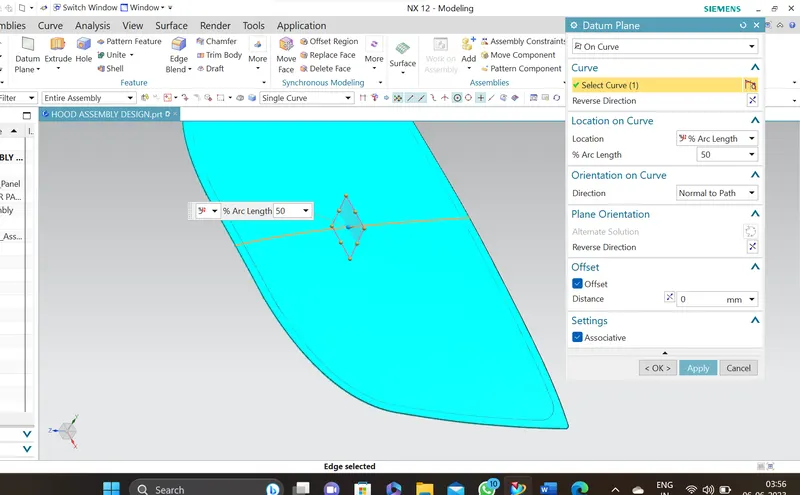
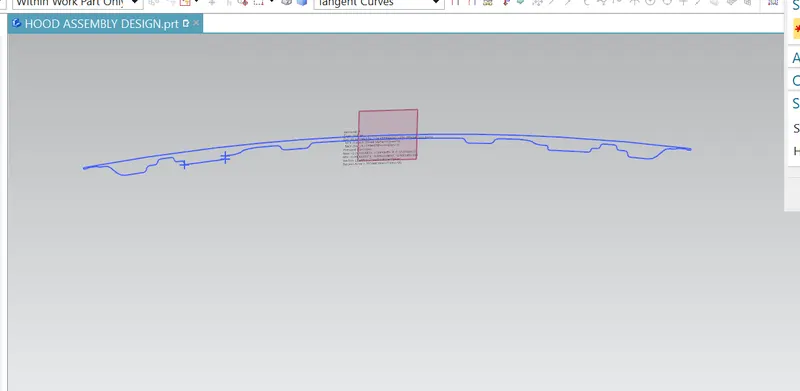
Now , create the intersction curve of the assembly with respect to the datum plane
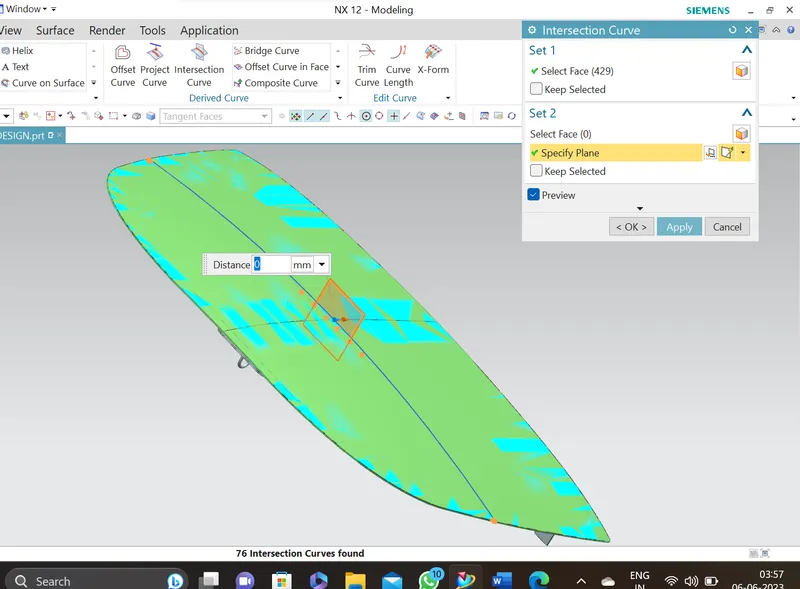
Noww the intersection curve obtained is
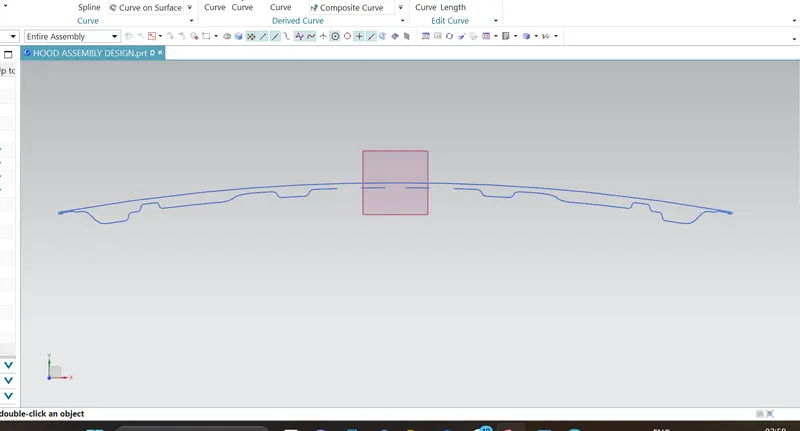
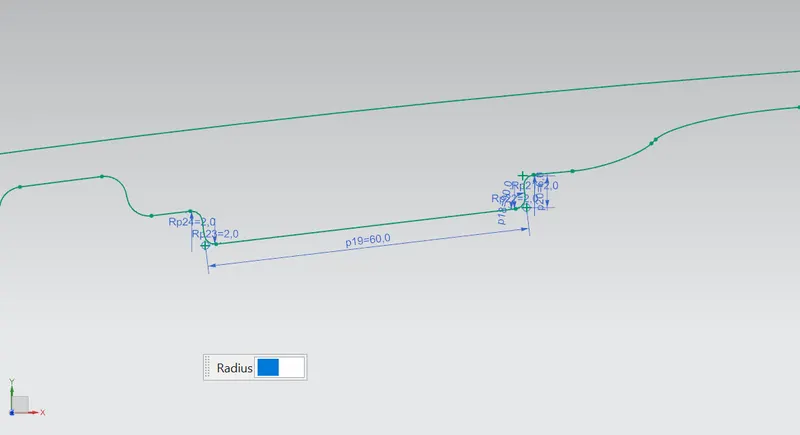
Now , use the studio spline to join the gaps in the intersection curve
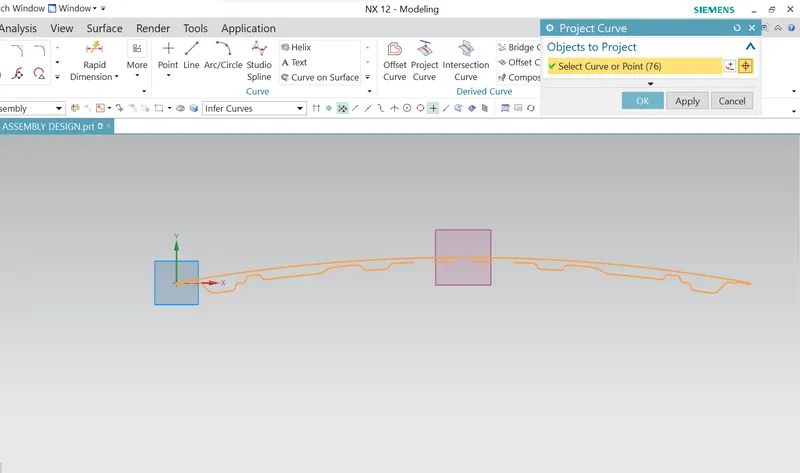
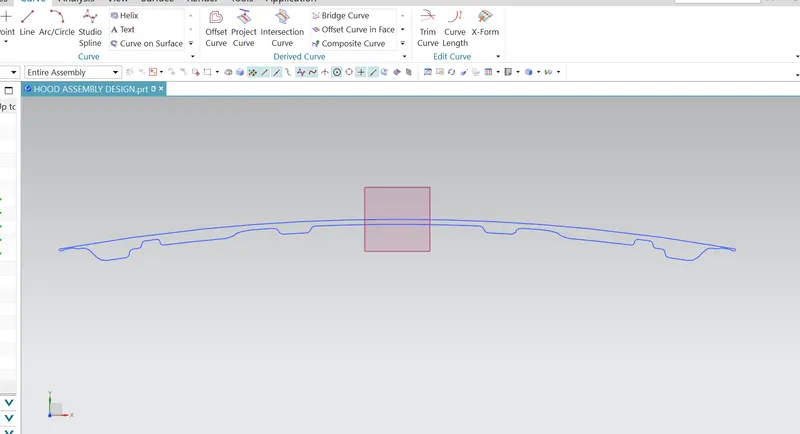
Once the sketch is fully constrained use the section inertia modulus feature to find the following
- Maximum moment of inertia
- Minimum moment of inertia
- Centre of gravity
- Coordinate loactions
- Section length
- Area of the section
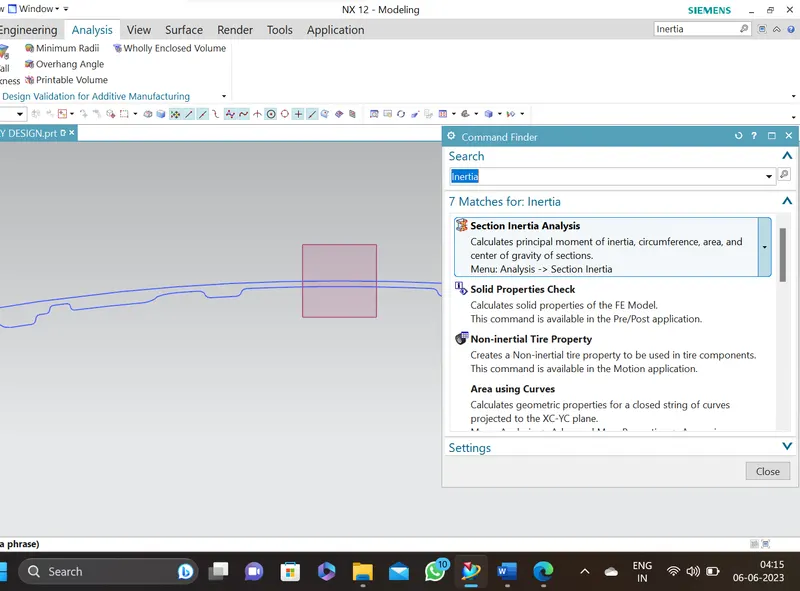
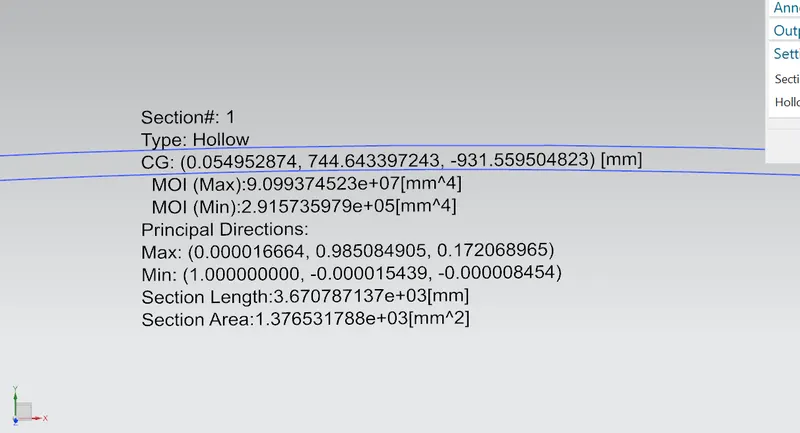
So we need to consider the minimum moment of inertia as if we increase the mimimum moment of inertia value the more safety and strengthen the member
so the I value is 2.951735979 * 10^4 mm^4
So the value of the Yis
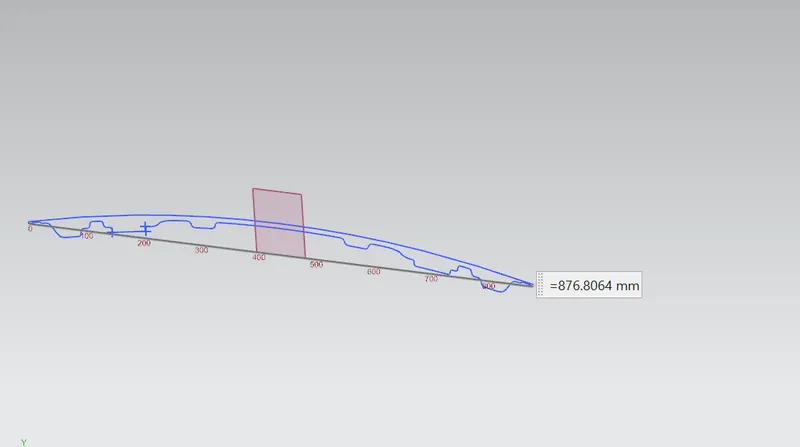
So the value of the Y is 876.8064 mm
So the section modulus Z is Z = I /Y
Z = (2.951735979 * 10^4) / 876.8064 mm^4 / mm
so, Z 1 = 332.54054mm^3
Section 02:
The obtained section modulus value of the hood assembly can be modifiedc and improved and lot of methods are deployed to attain good strength to the member
The method I enclose over here is creating an extra emboss aver the intersection curve to obtain greater moment of inertia value
Creating an emboss not to a greater depth on both sides along the midplane
Now , find out the inertia modulus
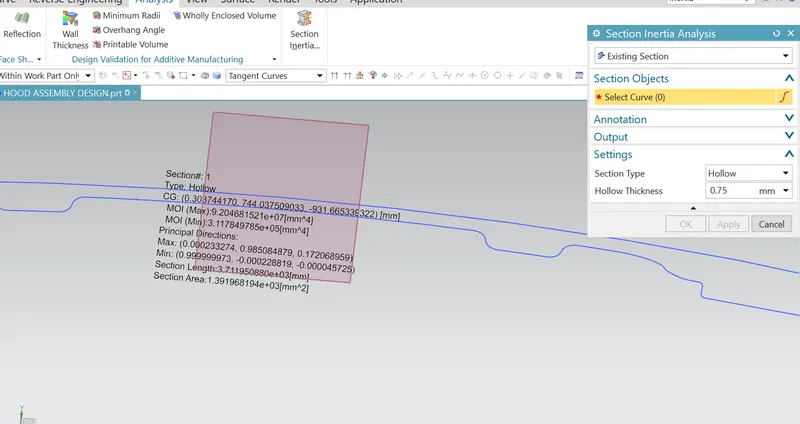
So the I value obtained is
I = 3.117849785 * 10^5 mm^4
and the Y value remains unaltered so , Y = 876.8.64 mm
So, the section modulus is Z = (3.117849785 * 10^5) / 876.8064 mm^4/ mm
so, Z 2 = 355.5916mm
So, finally with the help of the section 1 & the secytion 2 we need to compare how much amount of strength we can be able to increase wuth the section 2 rather than with the section 1
Sio % increase in the section modulus is [ ( Z2 - Z1 )/ Z1] * 100
SO % increase is [ ( 355.5916 - 332.54054) /332.54054 ] * 100
% increase =6.932 ( upto 3 decimals )
So with the help of the sction 2 we can able to attain an increase in the section modulus to a percentage of 6.932 more than the section 1 such that the section 2 is more preferable when compared to the section 01
Conclusion:
- By comparing the values we can clearly say that the section modulus of the optimized hood increases by 6.932%
Mass moment of inertia increases and which imturn reflects in the increase in the bending moment and leads to deply strength to the member at high impact loads so section 02 is highly recommended.


