Section Modulus calculation and optimization
Aim:
To find the section modulus of the hood and optimization to improve the overall section modulus. Objective: Use the section from your Hood design and calculate the section modulus using the formula S= I/y.
Objective:
Use the section from your Hood design and calculate the section modulus using the formula S= I/y.
Section Modulus:
The section modulus (S) is geometry property of the cross section used for designing beams and flexural members. It does not represent anything physically.
TWO TYPES OF SECTION MODULUS
1. ELASTIC SECTION MODULUS :
IT IS USED FOR THE MATERIALS WHICH BEHAVE ELASTICALLY UNDER THE LOADING
2.PLASTIC SECTION MODULUS:
IT IS USED FOR MATERIALS WHICH HAVE PLASTIC BEHAVIOUR .
IN ENGINEERING WE ALWAYS HAVE TO CALCULATE THE ELASTIC SECTION MODULUS. AS WE ASSUME ALL MATERIALS TO BE OF ELASTIC BEHAVIOUR
Formula of section Modulus:
It may be defined as the ratio of total moment resisted by the section to the stress in the extreme fibre which is equal to yield stress.
Which is equal to yield stress.
Therefore
S=I/y, Where
S= Section modulus (mm^3)
I = Moment of inertia of the section to the stress in the extreme end of the object (mm^4)
Y= Distance between the neutral axis and extreme end of the object (mm).
| Cross-sectional shape | Figure | Equation | Comment |
|---|---|---|---|
| Rectangle |  |
Solid arrow represents neutral axis | |
| doubly symmetric I-section (major axis) | 
|
NA indicates neutral axis | |
| doubly symmetric I-section (minor axis) |  [4] [4] |
NA indicates neutral axis | |
| Circle |  [3] [3] |
Solid arrow represents neutral axis | |
| Circular hollow section |  |
Solid arrow represents neutral axis | |
| Rectangular hollow section |  |
NA indicates neutral axis | |
| Diamond |  |
NA indicates neutral axis | |
| C-channel | |
NA indicates neutral axis |
 ,
,
Area Moment of Inertia:
The area moment of inertia of a beam cross section area measures the beam ability to resist bending. The larger the moment of inertia less will be the bend.
CASE 1
Hood design
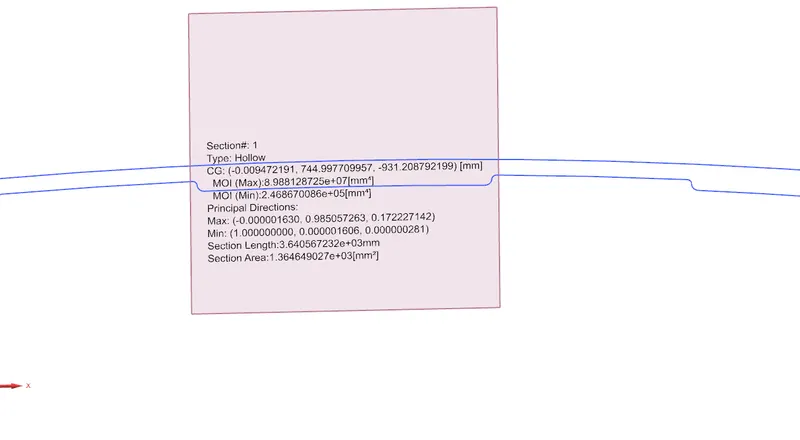
Here,
Moment of inertia(max) = 8.988128725×10^5×mm^4
Moment of inertia(min) =2.468670086×10^3×mm^4
VALUE OF Y IS 879.5538/2 =439.8
Zmin=2.468 10^4/439.8
= 0.0056*10^4 mm^4
=56.09mm^4
S = 20.436mm^4
CASE 2
Zmax=8.9881 10^6 /439.8
= 0.020436 *10^4 mm^4
=20.436mm^4
S = 56.09 mm ^4
comparing case 1 and 2
percentage increase in optimised one= (56.09 -20.436)\ 42.89
= 8.3%
CONCLUSION
- By comparing the values we can clearly say that the section modulus of the optimized hood 8.3%
- Moment of inertia increases by increasing depth of hood.
- It seems if we increase the gap between inner and outer panel moi also increases.