Section Modulus calculation and optimization
ABOUT SECTION MODULUS:
Section modulus In simple terms, the section modulus is the ratio of bending moment to bending stress for steel. If your steel has a high section modulus it will be harder to bend and can withstand a high moment without having high bending stress.
OR
It is the ratio of moment of inertia (I) of the beam cross-section about the neutral axis to the distance (y max) of extreme fiber from the neutral axis, The section modulus of the cross-sectional shape is significant in designing beams. It is a direct measure of the strength of the beam.
ABOUT MOMENT OF INERTIA:
Moment of inertia is defined as the quantity expressed by the body resisting angular acceleration which is the sum of the product of the mass of every particle with its square of a distance from the axis of rotation.
example: More the mass of a body more is the inertia. For instance, it is easier to throw a small stone farther than a heavier one. Because the heavier one has more mass, it resists change more, that is, it has more inertia.
so as per the question we have to claculate the moment of inertia of the hood which we created before.
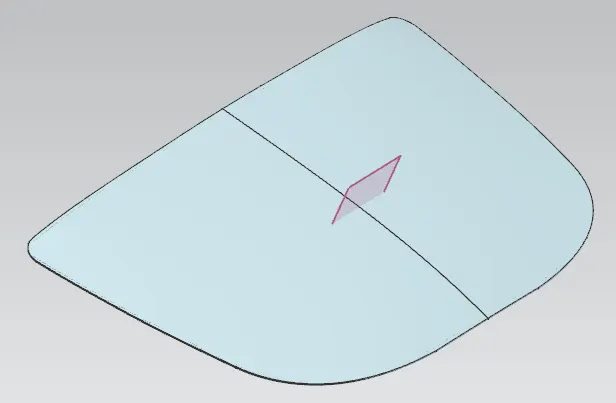
So for calculating the moment of inetia of our hood first we will go to hood design and then we will create a datum plane on the centre of the hood outer panel and we will recieve the output as follows:
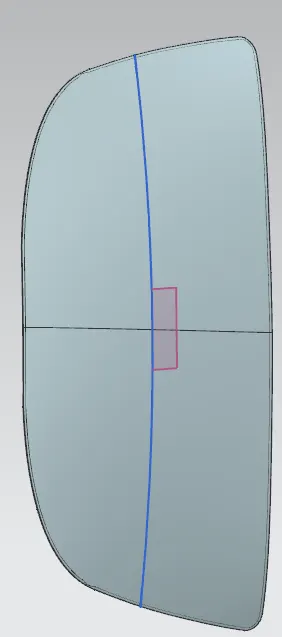
after recieving the output as above image we have to create the intersection on the outerpanel and the inner panel so for creating that we will go to curve>intersection curve and then we will select the faces as outer panel and inner panel both and then we will select the plane as the datum plane which we created and we will recieve the output as follows:
after getting the output as above image we have to hide the inner and outer panel both then we will recieve the output as follows:
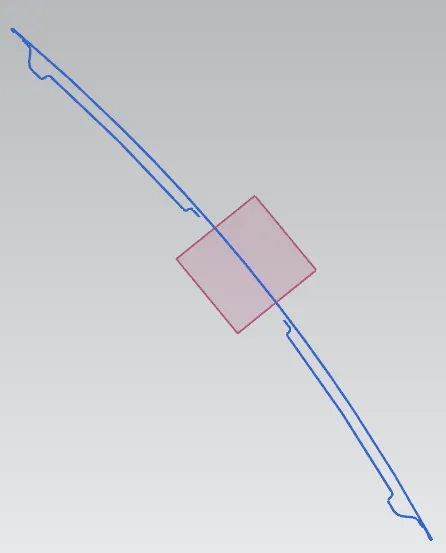
after getting the intersection curve we want only the outer boundary of inner and outer panel as well as the closed body so for that we will go to sketch and selecrt the datum plane which we created and then we will project the curve and then we will make it as a closed body and then we will trim the all unwanted lines and then we will recieve the output as follows:
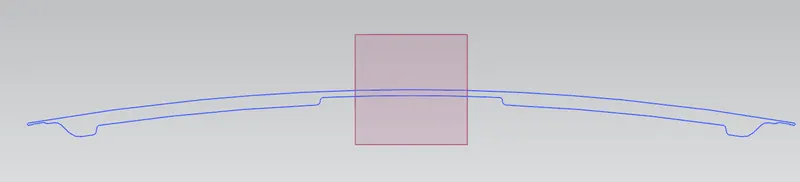
once if we get upto this much we have to check the moment of inertia value of our hood to check that we will go to menu>analysis>section inertia and then we will select the curve as our final output and then we will recieve the minimum and maximum values of moment of inertia the values are as follows:
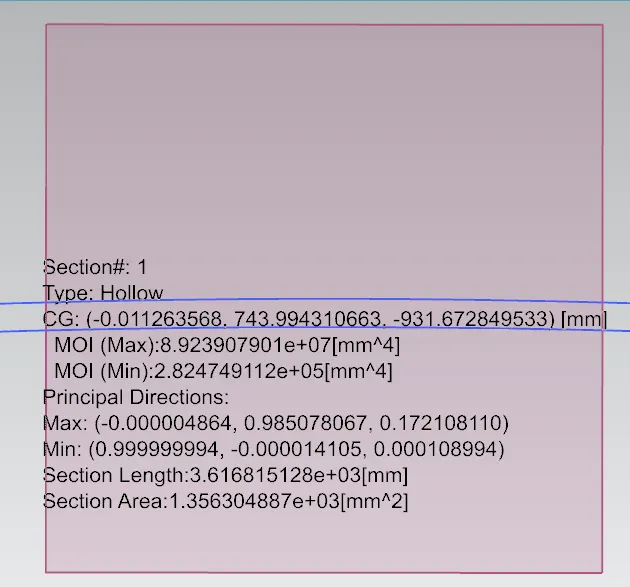
in which we will take MOI minimum as our I value and then we will check the y value.
to check the Y value we will measure the total width of out componet and then we will divide it by 2 and we will recieve some out put. from tyhat out put we have to find our section modulus value.
FINDING SECTION MODULUS:
WKT,
Z=I/Y
where Z= section modulus
I= moment of inertia
Y= distance between the neutral axis and the extreme end of the object
UNIT =mm^3
Z= I/Y =2.824749112e+05(mm^4)/439.5644 =642.6246329mm^4
here we have recieved the outptut in mm^4 unit but we want it as mm^3 to get that unit we will simply take one more power from the mm^4 unit and then we will recieve the out as follows:
Z=I/Y=2.824749112e+05(mm^4)/439.5644 =6426.246329mm^3
----------------------
hence the section modulus for our hood which we designed is 6426.246329mm^3.
but here the challenge is we have to achieve more section modulus value than our parent hood To achieve more vaule we will simply offset the inner panel 0.5 mm outside because we have to achieve more section modulus value so if we offset our inner panel 0.5 mm our hood get hallow space get more and our hood will be also strong than our parent hood.
after oofsetting the inner panel for 0.5mm outside we will do the same procedure which we did for the previous hood and then we will recieve I and Y value from that we have to calculate the section modulus.
FINDING SECTION MODULUSFOR IMPROVED HOOD:
WKT,
Z=I/Y
where Z= section modulus
I= moment of inertia
Y= distance between the neutral axis and the extreme end of the object
UNIT =mm^3
Z=I/Y=2.873383223e+05mm^4/439.5644=653.6887935mm^4
here we have recieved the outptut in mm^4 unit but we want it as mm^3 to get that unit we will simply take one more power from the mm^4 unit and then we will recieve the out as follows:
Z=I/Y=2.873383223e+05mm^4/439.5644 = 6536.887935mm^3
----------------------
hence the section modulus for our improved hood is 6536.887935mm^3.
CONCLUSION
COMPARISON OF BOTH VALUES AND FINDING OUT HOW MUCH PERCENTAGE OF SECTION MODULUS VALUE IS INCREASED.
so here we have our first section modulus as 6426.246329mm^3 and our second section modulus value as 6536.887935mm^3 and here we are going to calculate that how much of percentage is increased in the second section modulus value compared to first section modulus value.
here we have answers in 4 digits so we take 10000 as the 100%.
so,
6426.246329/10000*100=64.26246329
so here in first section modulus value our moment of inertia is 64.26%
and in the second,
6536.887935/10000*100=65.36887935
we have got the 65.36% of moment of inertia
so comparing this both value
65.36887935-64.26246329=1.10641606
we have got the value as 1.1%
so comparing to our parent hood our child hood is 1.1%increased its moment of inertia by offsetting the inner panel 0.5 mm outside.