Section Modulus calculation and optimization
CHALLENGE 4
SECTION MODULUS
AIM:
To calculate and explain the section modulus using the section from the created hood design
SECTION MODULUS:
Section modulus is a geometric property for a given cross-section used in the design of beams or flexural members.
- Other geometric properties used in design include areafor tension and shear, radius of gyration for compression, and second moment of area and polar second moment of area for stiffness.
- Any relationship between these properties is highly dependent on the shape in question. Equations for the section moduli of common shapes are given below.
- There are two types of section modulus
- Elastic section modulus.
- Plastic section modulus.
ELASTIC SECTION MODULUS:
It is defined as the ratio of moment of inertia about neutral axis to the distance of outermost layer from the neutral axis. It is expressed as
S = I/Y
PLASTIC SECTION MODULUS:
The plastic section modulus is used for materials where elastic yielding is acceptable and plastic behaviour is assumed to be an acceptable limit. It is expressed as
The plastic section modulus is the sum of the areas of the cross section on each side of the PNA (which may or may not be equal) multiplied by the distance from the local centroids of the two areas to the PNA
Zp = Acyc + Atyt
CALCULATION OF HOOD SECTION MODULUS:
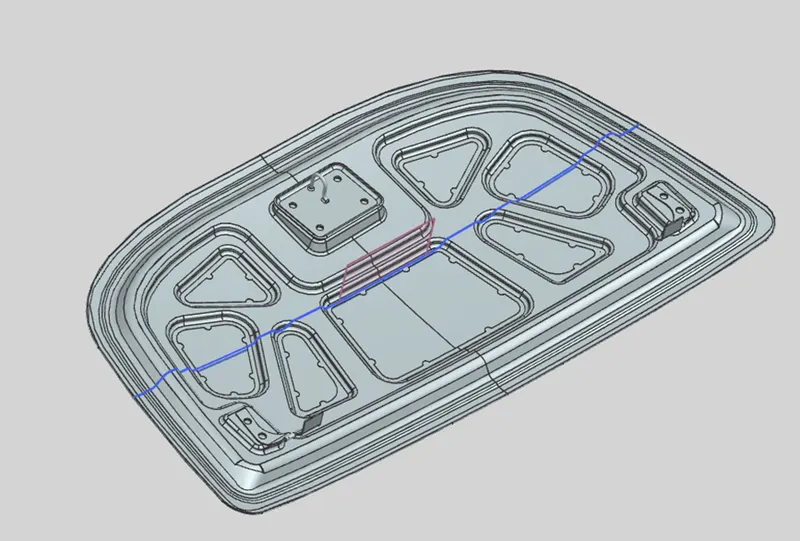
- Create a XY datum plane at the centre of the hood using the on curve option and create a intersection between the component and the plane/
- Using the sketch create a closed curve from the outer panel and inner panel by trimming the inner lines.
- Moment of inertia is find using the section inertia analysis command.
- Next is to find the section modulus.
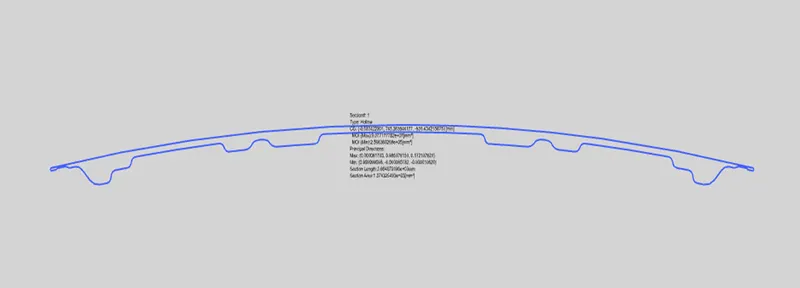
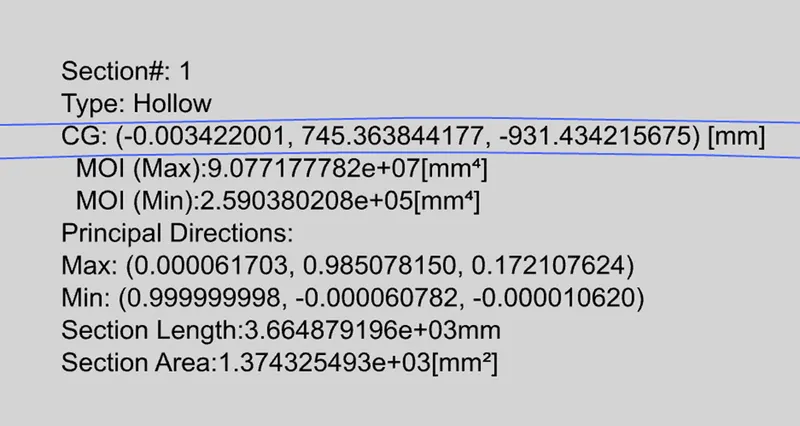
Using the formula we can find the section modulus.
S = I/Y
S= Section modulus
I = Moment of inertia
Y = Distance between the neutral axis and the extreme end of the object
Imax = 9.077*10^7 mm^4
Imin = 2.590*10^5 mm^4
Y = Total length/2
= 438.50 mm
Smax = 9.077*10^7/ 438.50
= 2.07*10^5 mm^3
Smin = 2.590*10^5/ 438.50
= 5.90*10^2 mm^2
OPTIMISING DESIGN:
- Optimising in increasing the area
- It means the inner panel curve should offset at 0.5 mm, the direction is should be proper.
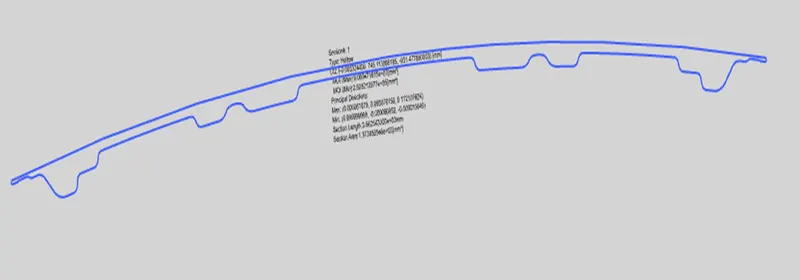
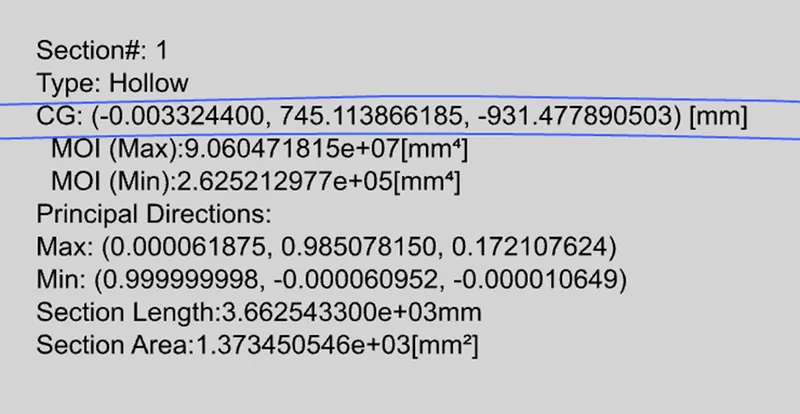
Imax = 9.06*10^7 mm^4
Imin = 2.625*10^5 mm^4
Y = Total length/ 2
= 438.50 mm
Smax = 9.06*10^7/438.50
= 2.06*10^5 mm^3
Smin = 2.625*10^5/438.50
= 5.986*10^2 mm^3
We consider the minimum value of section modulus, because the portion having minimum inertia will face deformation in the first place and the failure will start from that portion itself
Smin = 5.90*10^2 mm^3
When increase in area the value is
Smin = 5.986*10^2 mm^3
CONCLUSION:
The section modulus is calculated for the hood component and optimized design is also done to increase the strength of section modulus of the hood.