Section Modulus calculation and optimization
SECTION MODULUS CALCULATION AND OPTIMIZATION
AIM: To calculate the section modulus of the designed hood and compare it with optimized design.
Section modulus:
The section modulus is a geometric property of a cross-sectional shape that measures its ability to resist bending stress. It is defined as the moment of inertia of the cross-sectional area divided by the distance from the centroid of the cross-section to its farthest edge, as shown in the following equation:
S = I / Y
Where:
S = Section modulus
I = Moment of inertia
Y = Distance between the neutral axis and the extreme end of the object
The moment of inertia is a measure of a cross-sectional shape's resistance to bending and is defined as the summation of the areas of the cross-sectional elements multiplied by the square of their distance from the neutral axis. The neutral axis is the line through the cross-section where there is no bending stress.
The section modulus is an important parameter in the design of beams, as it determines the maximum bending stress that a beam can withstand without failing. The larger the section modulus, the greater the beam's ability to resist bending stress. Therefore, it is desirable to use cross-sectional shapes with a larger section modulus for structural members subjected to bending loads.
Case 1: Section modulus of the hood before optimization
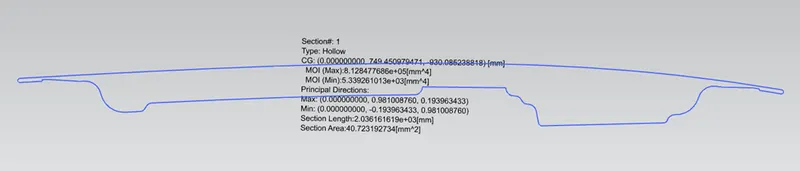
I(max)= 8.12e+05(mm^4)
I(min)= 5.33e+03(mm^4)
To find section modulus we need length ‘L’
Distance between the neutral axis and the extreme end of the object, Y= L/2
From the below figure we get L= 485.9mm

Then Y = 485.9 / 2 = 242.95mm
To check the stiffness, we have to consider minimum moment of inertia I(min) = 5.33e+03mm^4
Section modulus (S) = I(min) / Y = 5.33e+03 / 242.95
= 21.94mm^3
Case 2: Section modulus of the hood after optimization
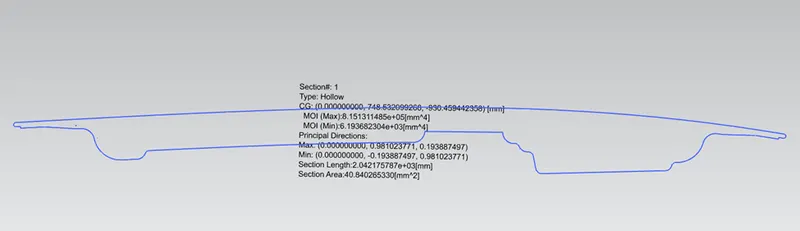
I(max)= 8.15e+05(mm^4)
I(min)= 6.19e+03(mm^4)
To check the stiffness, we have to consider minimum moment of inertia I(min) = 6.19e+03mm^4
Section modulus (S) = I(min) / Y = 6.19e+03 / 242.95
= 25.48mm^3
The case 2 has increased section modulus than the case 2. Hence the strength of the hood also increased.
Changes made:
Increased the cross-sectional area of the hood, which result in the increase in the moment of inertia. We know that section modulus directly proportional to moment of inertia.
As we increase the cross-sectional area the section modulus increases. Therefore, strength of the hood increases.
Conclusion:
Section modulus of the hood before and after optimization calculated. It increased from 21.94mm^3 to 25.48mm^3. Therefore, strength of the hood also increased.