Section Modulus calculation and optimization
AIM:
To calculate section modulus of hood and optimize the design to have improved section modulus.
SECTION MODULUS:
Section modulus is a direct measure of a strength of any cross-sectional area of an object about a reference axis.
The formula of section modulus is given by,
S = I / Ymax
Where,
I = Moment of inertia (mm^4)
Y = Distance between neutral axes and outermost fibre (mm)
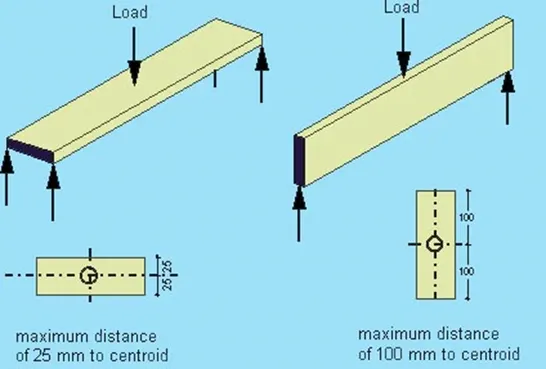
Steps to calculate section modulus:
Step 1: Find location of centroid of given cross section.
Step 2: Find moment of inertia about neutral axis (INAINA)
Step 3: Find Ymax from neutral axis.
Step 4: Find elastic section modulus using the formula provided above.
Moment of inertia is nothing more than bending or twisting in opposition to the moment. As a result, the resistance to deformation will be larger the higher the moment of inertia.
Elastic section modulus
For general design, the elastic section modulus is used, applying up to the yield point for most metals and other common materials.
The elastic section modulus is defined as S = I / y, where I is the second moment of area (or area moment of inertia, not to be confused with moment of inertia) and y is the distance from the neutral axis to any given fibre. It is often reported using y = c, where c is the distance from the neutral axis to the most extreme fibre, as seen in the table below. It is also often used to determine the yield moment (My) such that My = S × σy, where σy is the yield strength of the material.
Importance:
- It is important for the design of flexural members and beams.
- The member is more resistant to the bending of the beam when the section modulus is higher.
- It is simpler to determine the exact strength of steel and the stresses in the beam.
- When comparing the "section modulus" of two beams constructed of the same material, the beam with a higher section modulus will be stronger and better equipped to handle heavier loads.
Section Modulus calculation of the Hood Design:
CASE 1: Initial Hood Design.
- Area Moment of Inertia: I(min)
- MOI (min): 5.059056900e+03 mm^4
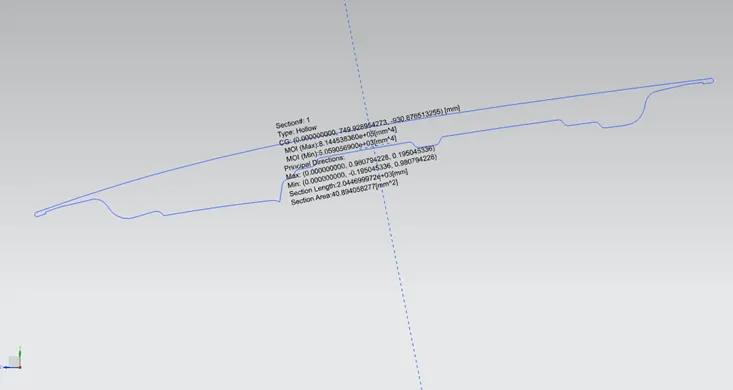
Y distance: 476.5mm
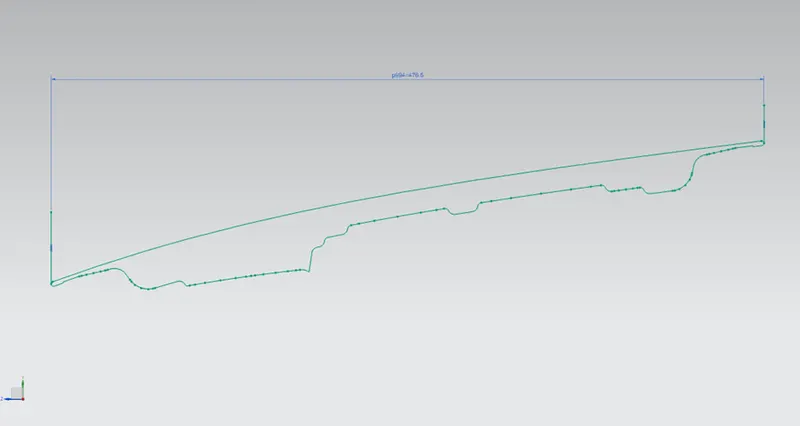
S=I/Y
S = 5.059056900e+03 mm^4/476.5mm
S = 10.617 mm^3
CASE 2: Optimized Hood Design
Aim: Our Aim here is to increase the I(min)
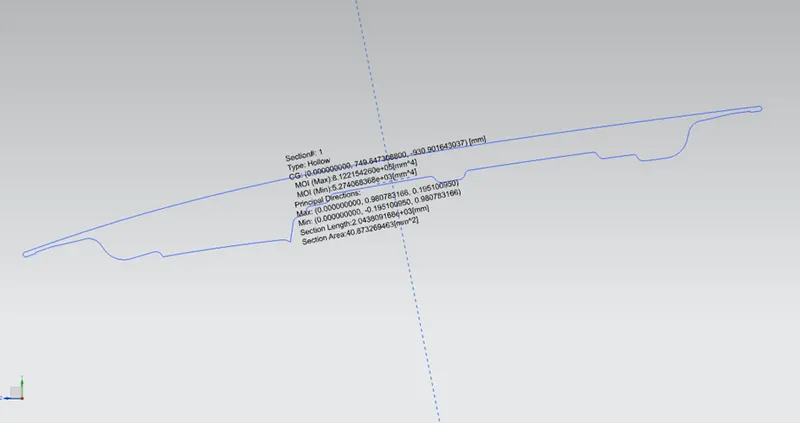
MOI (min): 5.274068369e+03 mm^4 (increased)
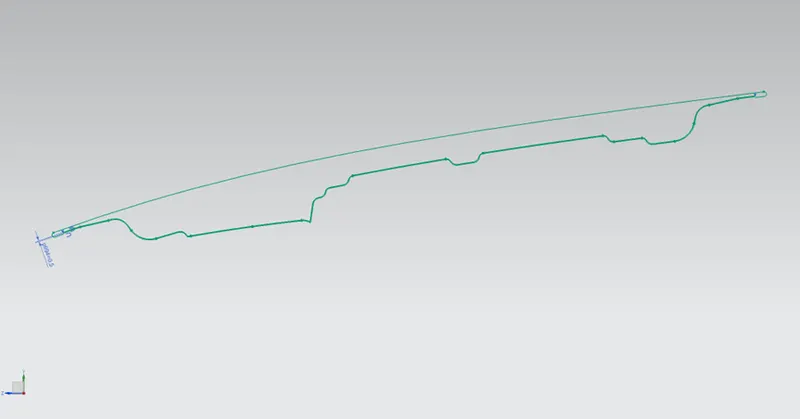
INCREASED MOI
Y distance
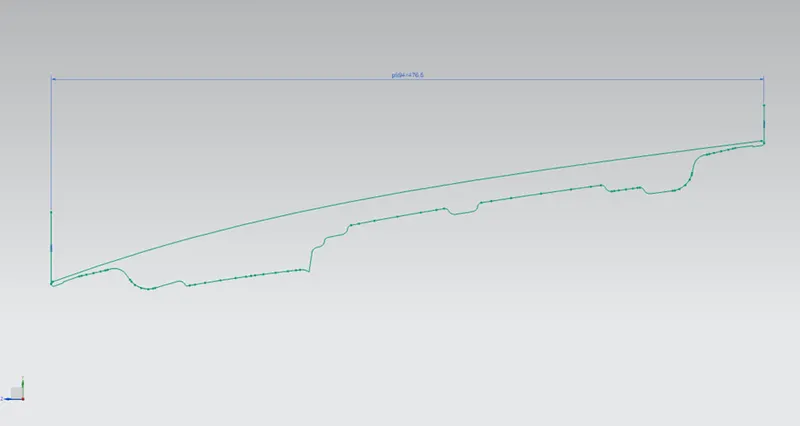
S=I/Y
S = 5.274068369e+03 mm^4/476.5mm
S = 11.068349148 mm^3
Thus, the area moment of inertia of the car hood has been raised, enhancing its rigidity.
CONCLUSION:
The distance from the neutral axis and area moment of inertia are both directly correlated with section modulus. Hence, by increasing the area MOI of a given section, it is possible to increase the section modulus and so enhance the geometry to handle greater bending force. The spacing between the outer and inner panels can be increased to enhance the section modulus.